Severance Agreement Template 2026: Small Business Guide
Protect your small business with a fair severance agreement template. Learn what to include in releases, payment terms, and benefits in 2026.
 James · Content Manager August 8, 2026 10 min read
Severance Agreement Template 2026: Small Business Guide
Facing your first termination or layoff is rarely easy for small business owners. Beyond the emotional weight, there is a significant legal and operational risk: a poorly handled exit can lead to costly wrongful termination lawsuits or reputational damage. In 2026, the landscape of employment law continues to tighten, particularly around non-compete bans, data privacy, and the clarity of separation agreements.
A professional severance agreement is not just a formality; it is a risk management tool. It buys you peace of mind by securing a release of claims in exchange for fair compensation. This guide breaks down exactly what a small business should offer, how to structure the agreement, and how to execute the exit with dignity and legal precision.
Why Small Businesses Need a Formal Severance Agreement
Many small business owners operate under the assumption that "at-will" employment means they can let an employee go without any formal documentation. While at-will employment is the default in most U.S. states, relying on silence is dangerous. Without a written agreement, a terminated employee retains the right to sue for discrimination, breach of contract, or wrongful termination.
A severance agreement serves three critical purposes:
- Risk Mitigation: It secures a "release of claims," meaning the employee agrees not to sue the company for past actions in exchange for severance pay. This is the primary legal shield for small businesses.
- Clarity and Finality: It clearly outlines what the employee receives (pay, benefits, equipment return) and what they must do (return property, keep secrets). This prevents "he said, she said" disputes after the employee leaves the building.
- Professionalism: A structured exit process preserves your company’s reputation. Even if the separation is involuntary, treating the employee with respect and providing a clear path forward reduces the likelihood of negative online reviews or bad references.
In 2026, with increased scrutiny on workplace fairness and transparency, having a documented, fair agreement is more important than ever. It demonstrates that your business operates with integrity and follows due process, even in difficult moments.
Key Components of a Severance Package
When drafting a severance agreement, you must balance fairness with financial sustainability. There is no one-size-fits-all formula, but there are standard components that every robust agreement should include. Here is what a fair package looks like for small businesses in 2026.
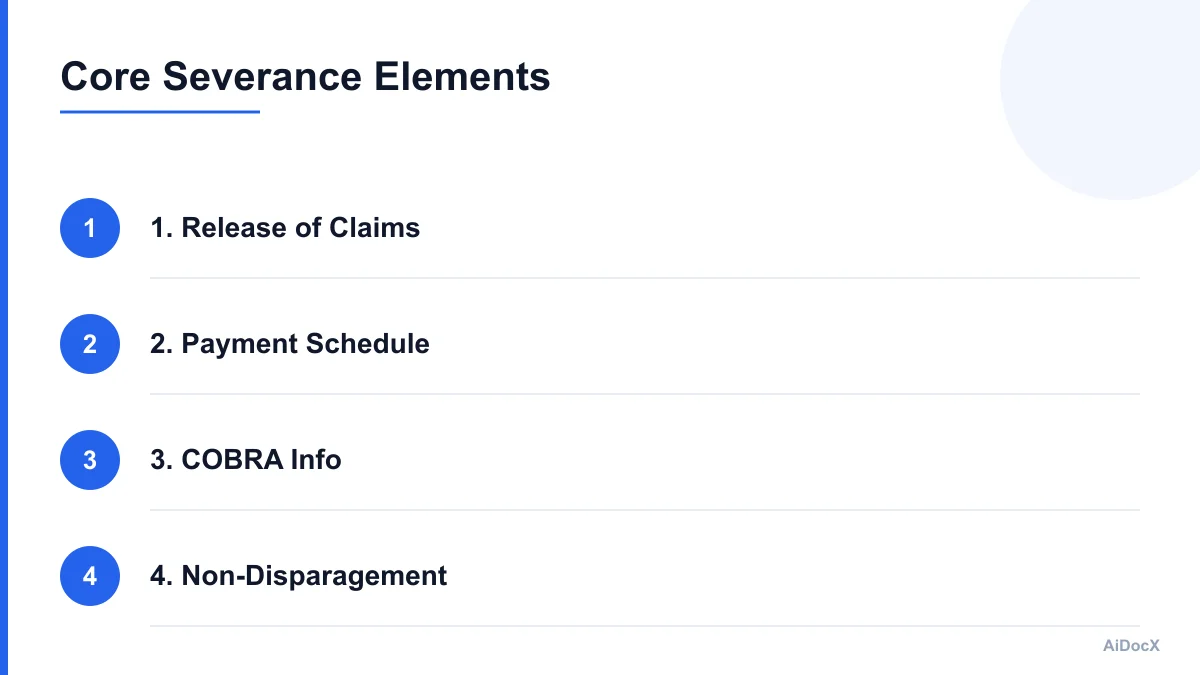
1. The Release of Claims
This is the most critical section. The release must be clear, unambiguous, and compliant with federal and state laws. Typically, it requires the employee to waive their right to sue the company for any claims arising during their employment.
- Age Discrimination in Employment Act (ADEA): If the employee is 40 or older, federal law requires specific language in the release. You must give them at least 21 days to consider the agreement and 7 days to revoke it after signing.
- State-Specific Requirements: Some states have additional requirements for releases. For example, California requires specific language regarding unpaid wages and other rights.
- Scope: Ensure the release covers the company, its owners, officers, and employees. This prevents the terminated worker from suing your CFO or HR manager individually.
2. Severance Pay Structure
How much should you pay? There is no legal requirement for severance pay in most cases, unless you have an existing employment contract or company policy stating otherwise. However, offering severance is often worth the cost to secure the release.
- Standard Benchmarks: A common starting point is one to two weeks of pay for every year of service. For example, an employee with five years of tenure might receive 5-10 weeks of pay.
- Layoffs vs. Terminations: If you are laying off employees due to economic reasons, offering more generous severance (e.g., 4-6 weeks per year of service) can reduce the likelihood of litigation and help maintain morale among remaining staff.
- Lump Sum vs. Installments: Paying in a lump sum is simpler but requires cash flow management. Installments can be structured as "salary continuation," but be aware that this may extend the employee’s eligibility for certain benefits and could have tax implications.
3. Benefits Continuation
Severance isn’t just about cash; it’s about bridging the gap until the employee finds new work.
- Health Insurance: You may offer to continue health coverage for a period, often at the employee’s expense (via COBRA) or subsidized by the company. A common offer is 3-6 months of premium coverage.
- COBRA Notices: You are legally required to provide COBRA election notices. The severance agreement should reference these notices and confirm that the employee has received them.
- Accrued Payout: Clearly state whether the employee will be paid for accrued but unused vacation or PTO. This is required by law in many states, so check your local regulations.
4. Confidentiality and Non-Disparagement
Protect your business interests post-exit.
- Confidentiality: Reinforce the employee’s obligation to keep trade secrets, client lists, and proprietary information confidential. This should mirror any existing NDA or confidentiality clause in their employment contract.
- Non-Disparagement: Include a clause preventing the employee from making negative public statements about the company, its owners, or its clients. In 2026, social media amplifies these risks, making this clause more valuable than ever.
- Return of Property: Explicitly require the return of all company assets, including laptops, phones, access cards, and digital credentials.
5. Outplacement Services (Optional but Recommended)
For small businesses, offering outplacement services can be a low-cost way to show goodwill. This might include access to career coaching platforms or resume review services. It signals that you want the employee to succeed elsewhere, which can soften the blow and reduce animosity.
Common Mistakes to Avoid in Severance Deals
Even well-intentioned small business owners can make costly errors when handling terminations. Avoid these common pitfalls to ensure your severance agreement holds up legally and maintains professional standards.
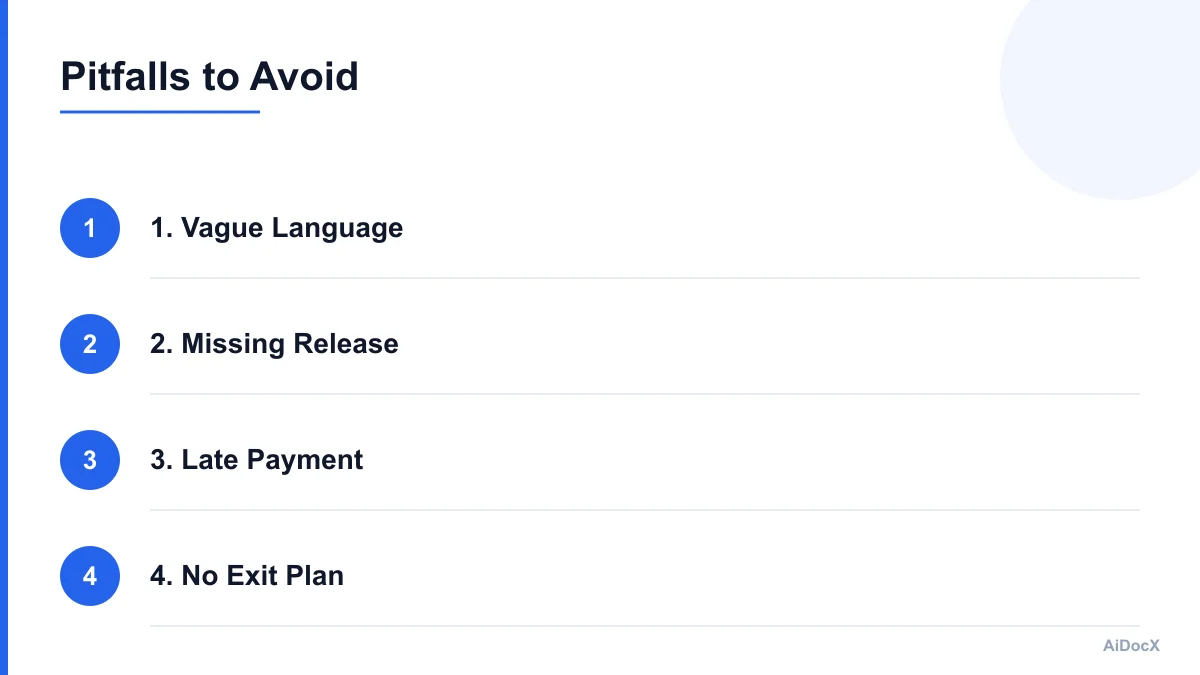
Mistake 1: Using an Outdated or Generic Template
Every employment situation is unique. A template downloaded from the internet may not comply with your state’s specific laws or your company’s existing policies. For example, using a template from a different industry or state can result in unenforceable clauses. Always customize the agreement to reflect your specific business structure, the employee’s role, and local laws.
Mistake 2: Failing to Provide Adequate Review Time
As mentioned, if the employee is over 40, you must give them at least 21 days to review the agreement (or 45 days for a group layoff). Rushing the process or pressuring the employee to sign immediately can invalidate the release. Respect the timeline; it protects you.
Mistake 3: Vague Payment Terms
Never leave the amount or timing of severance payments ambiguous. The agreement must specify:
- The exact dollar amount or calculation method.
- The date of the first payment.
- The frequency of subsequent payments (if any).
- What happens if the employee breaches the agreement (e.g., clawback provisions).
Ambiguity leads to disputes. Clear terms prevent them.
Mistake 4: Ignoring State-Specific Wage Laws
Some states require immediate payment of all accrued wages upon termination. If your severance agreement delays these payments, you could face severe penalties. Ensure that final paycheck requirements are met independently of the severance agreement.
Mistake 5: Poor Communication During the Exit
The severance agreement is only one part of the process. How you deliver it matters. Meet in person (or via video call), be direct but compassionate, and have the agreement ready for review. Avoid surprise terminations without explanation. A professional exit conversation sets the tone for the entire separation process.
Step-by-Step: How to Structure Your Severance Agreement
Drafting the agreement doesn’t have to be a legal nightmare. Follow this step-by-step process to create a clean, professional document.
Step 1: Determine Eligibility and Amount
Before drafting, decide who qualifies for severance. Is it offered to all employees, or only those with more than one year of service? Calculate the exact amount based on your chosen formula (e.g., weeks per year of service). Consider the employee’s salary, tenure, and reason for separation.
Step 2: Draft the Release Language
Work with an employment attorney to draft the release of claims. This is the most legally sensitive part. Ensure it includes:
- A clear waiver of known and unknown claims.
- Compliance with the Older Workers Benefit Protection Act (OWBPA) if applicable.
- A statement that the employee is waiving their right to sue for discrimination, harassment, and other employment-related claims.
Step 3: Define Payment and Benefits
Outline the severance pay structure. Specify:
- Total amount.
- Payment schedule (lump sum or installments).
- Health insurance continuation options.
- Payout of accrued PTO.
Step 4: Include Protective Clauses
Add clauses for:
- Confidentiality.
- Non-disparagement.
- Return of company property.
- Cooperation clause (if the company needs the employee’s help in future litigation).
Step 5: Review and Customize
Review the draft against your company’s existing policies and state laws. Ensure all placeholders (names, dates, amounts) are filled in correctly. If possible, have an employment lawyer review the final draft.
Step 6: Prepare for the Exit Meeting
Plan the logistics. Choose a private location, decide who will be present (typically the manager and an HR representative or lawyer), and have the agreement ready for the employee to take home or review on the spot.
Step 7: Execute and File
During the exit meeting, explain the agreement clearly. Allow the employee to ask questions. Once they sign, ensure you have a copy for your records and that the employee receives a copy. Process the severance payments according to the agreed schedule.
Leveraging Technology for Clean Exits
Managing terminations manually is prone to error. In 2026, small businesses are increasingly turning to digital tools to streamline the process. AiDocX drafts a severance agreement with a release of claims and clear payment terms, then routes it for signature so an exit stays professional and legally clean.
Using a platform like AiDocX offers several advantages:
- Compliance: Templates are updated to reflect current laws, reducing the risk of using outdated clauses.
- Efficiency: Digital routing allows for quick signatures, eliminating the need for physical mail or in-person meetings for the signing process.
- Audit Trail: All documents and signatures are stored securely, providing a clear record if disputes arise later.
- Customization: You can easily customize templates to fit your specific business needs without starting from scratch.
By leveraging technology, you can ensure that every severance agreement is consistent, professional, and legally robust, regardless of how many terminations you handle.
Checklist: Preparing for a Smooth Termination
Use this checklist to ensure you haven’t missed any critical steps before executing a termination.
- Determine eligibility and calculate severance amount.
- Draft severance agreement with legal counsel.
- Ensure compliance with OWBPA (if employee is 40+).
- Prepare final paycheck according to state laws.
- Schedule exit meeting in a private location.
- Prepare employee’s access revocation plan (IT).
- Have severance agreement ready for review.
- Plan for COBRA notices and benefits continuation.
- Conduct exit meeting with professionalism and clarity.
- Process severance payments as agreed.
- Secure signed agreement and file it properly.
- Notify relevant teams (IT, HR, Finance) of the exit.
Conclusion
Handling a termination is one of the most challenging aspects of running a small business. However, with a well-drafted severance agreement, you can protect your company from legal risks and maintain a professional reputation. In 2026, fairness, clarity, and compliance are more important than ever.
Take the time to get it right. Use a reliable template, consult with legal counsel, and treat the employee with respect. A clean exit benefits everyone involved and allows your business to move forward with confidence.
Start by reviewing your current practices. If you’re unsure about your severance agreement, consider using a tool like AiDocX to draft a professional, compliant document in minutes. Your business deserves a secure future, and a solid severance agreement is a key step toward that goal.
Ready to automate your documents with AI?
Start free with AiDocX — AI contract drafting, meeting minutes, consultation notes, e-signatures, and more in one platform.
Get Started FreeMore from AiDocX Blog
Affiliate Agreement Template (2026): Protect Your Business When Paying Commissions
Free affiliate agreement template for 2026: key clauses, FTC disclosure requirements, affiliate vs referral agreement compared, a worked example, and a copy-paste version.
James September 22, 2026 11 min
AI Receipt Generator (2026): Create Professional Payment Receipts in Seconds
Generate professional payment receipts with AI in seconds. Receipt vs invoice vs credit note explained, the fields to include, a worked example, and a copy-paste template.
James September 22, 2026 9 min
Bill of Sale Template (2026): Free Generator for Cars, Trailers & Personal Property
Free bill of sale template for 2026: the fields to include, state notarization rules, federal odometer disclosure, a worked example, and a copy-paste version.
James September 22, 2026 10 min