SaaS Terms of Service 2026: Must-Have Clauses for Launch
Don’t launch without these critical SaaS ToS clauses. Learn what to include, avoid, and how to protect your new software company from day one.
 James · Content Manager August 9, 2026 11 min read
SaaS Terms of Service 2026: Must-Have Clauses for Launch
You have built the product. The beta testers are happy. You are ready to open the gates and accept your first paying customer. But before you flip the switch, you need a Terms of Service (ToS) agreement that actually protects you.
Too many founders make the fatal mistake of copy-pasting a competitor’s ToS or downloading a generic template from the internet. They assume legal language is interchangeable. It is not. A generic template might leave you exposed to liability, fail to comply with 2026 data privacy standards, or create a confusing cancellation policy that frustrates users and invites chargebacks.
Your ToS is not just a legal formality; it is the operational rulebook for your business. It defines the relationship between you and your user, limits your risk, and sets expectations for service delivery. In this guide, we break down exactly what clauses you cannot skip, why they matter, and how to structure them for clarity and enforceability.
The Non-Negotiable Clauses
When drafting your SaaS Terms of Service, certain clauses are not optional. They form the backbone of your legal protection and operational framework. If these are missing or poorly defined, you are flying blind.
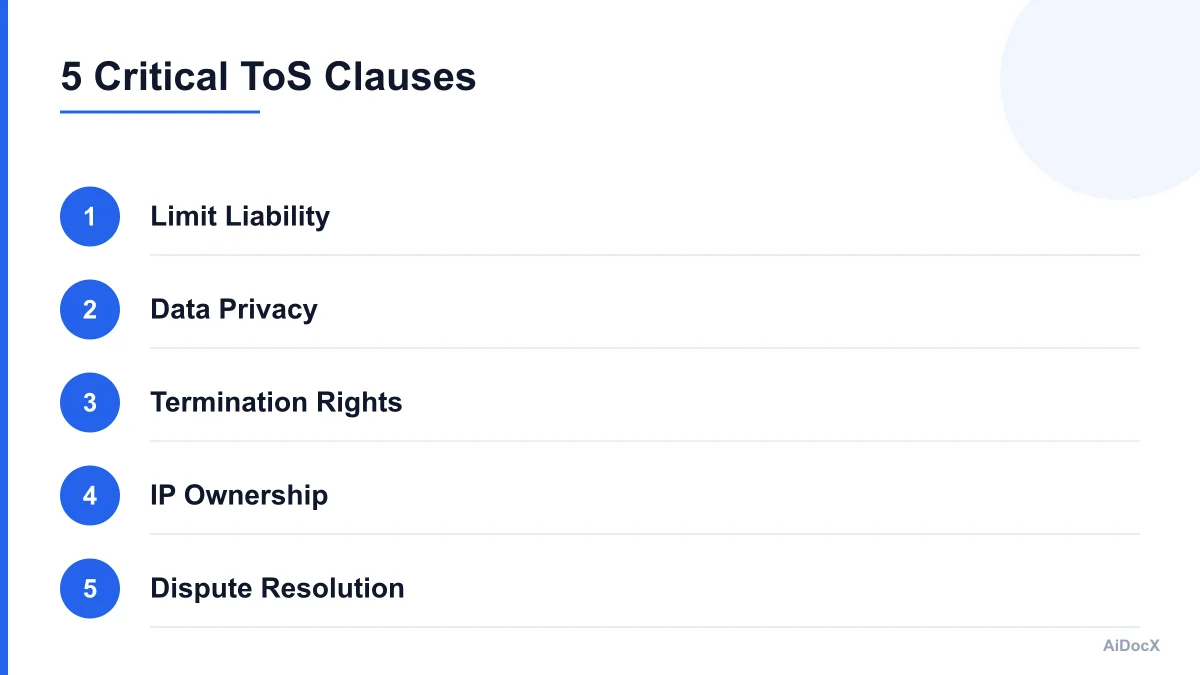
1. Limitation of Liability
This is arguably the most critical clause in any software contract. It caps the amount of money you can be sued for. Without it, a single bug that causes data loss or business downtime for a client could lead to a lawsuit for millions of dollars, potentially bankrupting your startup.
A strong limitation of liability clause typically states that your total liability is limited to the amount the customer paid you in the last 12 months. It also explicitly excludes indirect, incidental, or consequential damages. This means if your software goes down and the customer loses profit, you generally aren’t liable for that lost profit, only for the refund of their subscription fee.
2. Service Level Agreement (SLA) and Uptime
While your main ToS might reference an SLA document, you must define the scope of your service obligations. In 2026, customers expect transparency. Clearly state your uptime guarantee (e.g., 99.9%) and what happens if you miss it.
Do not promise 100% uptime. It is technically impossible. Instead, define "downtime" carefully. Exclude scheduled maintenance, force majeure events, and issues caused by the user’s internet connection or hardware. Be specific about remedies, such as service credits, rather than open-ended refunds.
3. Intellectual Property (IP) Rights
You need to protect your code, brand, and content, but you also need to respect your user’s data. The IP section should clearly state that you own the software, the platform, and the underlying technology.
Crucially, you must define what happens to the user’s data. Do you claim ownership of the content they upload? Usually, you should not. Instead, grant yourself a limited license to host, process, and display their data solely to provide the service. This distinction is vital for trust and compliance with data protection laws.
4. Acceptable Use Policy (AUP)
You need the right to ban users who misuse your platform. The AUP defines prohibited activities. This includes using your SaaS for illegal activities, spamming, hacking, or scraping your platform.
In 2026, with the rise of AI, you must also address AI misuse. Explicitly prohibit users from using your platform to generate harmful content, deepfakes, or to train other AI models without permission. This protects your brand reputation and keeps you compliant with emerging AI regulations.
5. Termination and Suspension
How do you handle bad actors or non-paying customers? You need a clear termination clause. Outline the conditions under which you can terminate the agreement, such as breach of contract, non-payment, or illegal activity.
Specify the notice period. Can you terminate immediately for severe breaches? Yes. For minor issues? You might require a 30-day notice. Also, detail what happens after termination. Do users get their data back? For how long? Is there a final grace period? Clarity here prevents post-termination disputes.
Understanding Data Privacy and Compliance
In 2026, data privacy is not just a GDPR issue. It is a global expectation. Your ToS must align with your Privacy Policy, but it sets the contractual stage for how data is handled.
Data Ownership and Processing
Be explicit about who owns the data. The general rule is: the customer owns their data. You are the processor. You must state that you process data only on documented instructions from the customer.
If you use third-party vendors (like AWS, Stripe, or SendGrid), you must disclose this. You are responsible for ensuring these vendors are also compliant. Mentioning that you use "industry-standard security measures" is not enough. You should reference specific certifications or standards if applicable, such as SOC 2 Type II or ISO 27001.
International Data Transfers
If your SaaS serves customers globally, data may cross borders. The EU-US Data Privacy Framework and similar mechanisms have evolved. Ensure your ToS includes standard contractual clauses (SCCs) if you transfer data from the EU to non-adequate jurisdictions. This is a complex area, so consult legal counsel, but your ToS should at least acknowledge cross-border transfers and the user’s rights.
User Rights
Modern privacy laws grant users rights to access, correct, and delete their data. Your ToS should outline the process for users to exercise these rights. How do they request deletion? How long do you have to comply? Typically, it’s 30 days. Make this process clear to build trust.
Payment, Billing, and Cancellation Policies
Money matters are the most common source of customer disputes. A clear billing policy protects your cash flow and reduces chargebacks.
Subscription Model
Define the subscription type. Is it monthly, annual, or per-user? Specify the billing cycle and the payment methods accepted. Do you use auto-renewal? If so, disclose this clearly. Many jurisdictions require explicit consent for auto-renewal.
Late Payments and Collections
What happens if a credit card fails? Outline your dunning process. Do you send reminders? Do you suspend access after 7 days? Do you terminate after 30 days? Be consistent. Also, specify if you charge late fees. While common in enterprise contracts, it’s less common in B2C SaaS, but still enforceable if stated.
Cancellation and Refunds
This is where most founders get stuck. Can users cancel anytime? Yes, usually. But do they get a refund for the current period?
- Monthly Plans: Typically, no refund for the current month. Access continues until the end of the billing cycle.
- Annual Plans: Often non-refundable, or prorated refunds.
Be explicit. "All sales are final" is too blunt. Instead, say: "Subscriptions are non-refundable. If you cancel, you will retain access until the end of your current billing period."
For enterprise contracts, you might offer a refund window (e.g., 30 days). For most startups, stick to a no-refund policy for digital services unless you have a specific reason not to.
Intellectual Property and User Content
Beyond the basic IP clause, you need to address user-generated content (UGC) and feedback.
User Content License
If your SaaS allows users to upload files, create posts, or generate content, you need a license to that content. This license should be non-exclusive, worldwide, and royalty-free, allowing you to host, display, and distribute the content as part of the service.
Feedback
If users suggest features or improvements, you want the right to use those ideas. Include a clause stating that any feedback, suggestions, or ideas provided by the user become your property. You are not obligated to compensate them or implement their suggestions. This prevents users from claiming ownership of your product roadmap later.
Infringement Claims
Include a DMCA-compliant process for reporting copyright infringement. If a user uploads copyrighted material, you need a way to take it down and protect yourself under the "safe harbor" provisions of copyright law.
Dispute Resolution and Governing Law
Where do you fight if things go wrong? This clause determines the venue and rules for legal disputes.
Governing Law
Choose a jurisdiction that is convenient for you and predictable. Delaware is common for US startups due to its well-developed corporate case law. If you are in the EU, choose a member state with strong consumer protection laws.
Arbitration vs. Court
Consider including a mandatory arbitration clause. This can be cheaper and faster than court. However, be aware that some jurisdictions (like California) have restrictions on arbitration clauses for consumer contracts. For B2B SaaS, arbitration is often more acceptable.
Class Action Waiver
If you use arbitration, include a waiver of the right to participate in a class action lawsuit. This prevents a group of users from suing you collectively, which can be financially devastating.
Attorney’s Fees
State that the prevailing party in any dispute is entitled to recover legal fees. This discourages frivolous lawsuits and makes it easier for you to enforce your rights.
Common Mistakes to Avoid
Even with the right clauses, founders make errors that weaken their legal position. Avoid these pitfalls.
1. Copy-Pasting Without Customization
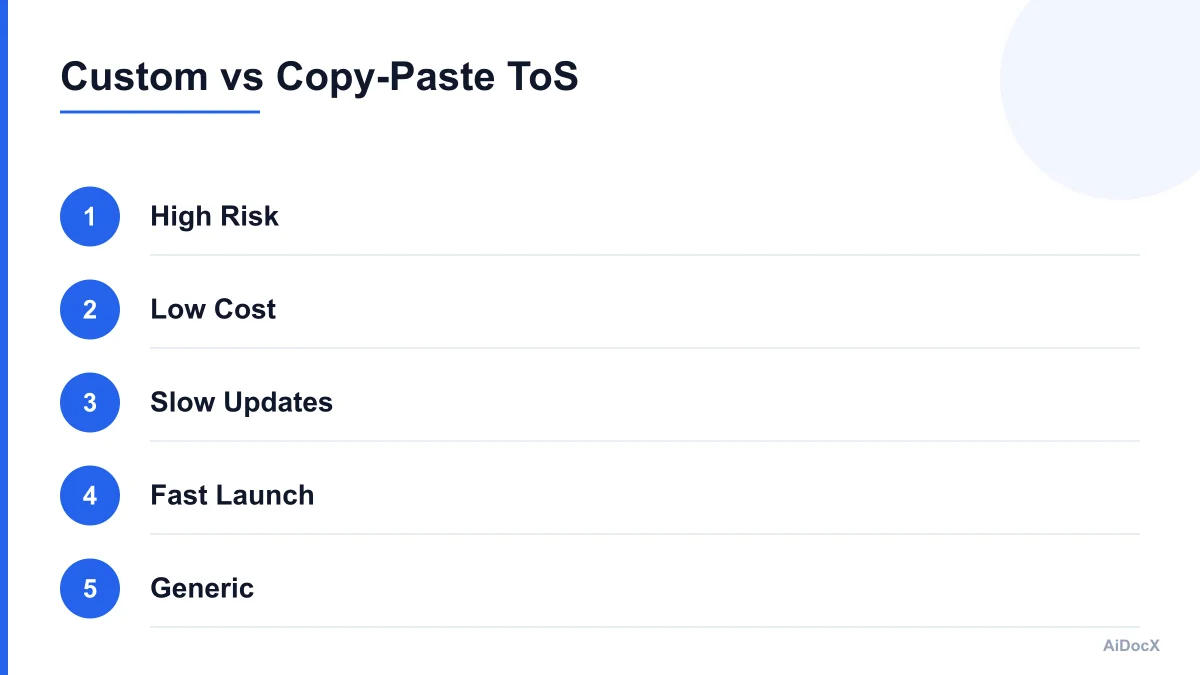
A competitor’s ToS is tailored to their product, not yours. If they sell enterprise software with long sales cycles, their indemnification clause will be different from yours. If they sell to consumers, their privacy policy will be stricter. Always customize.
2. Overpromising on Uptime
Never promise 100% uptime. It sets an impossible standard. Use realistic numbers like 99.9% or 99.95%, and define exclusions clearly.
3. Vague Termination Rights
Avoid terms like "at our sole discretion." This can be deemed unconscionable by courts. Instead, list specific grounds for termination, such as "material breach," "non-payment," or "illegal activity."
4. Ignoring Accessibility
Ensure your ToS is accessible. Use clear headings, plain language where possible, and readable fonts. This is not just good UX; it’s becoming a legal requirement in some jurisdictions.
5. Failing to Update
Your ToS is a living document. As you add features, enter new markets, or change vendors, update your ToS. Notify users of changes and require acceptance of new terms for continued use.
Drafting Your Unique ToS
Creating a robust ToS from scratch can be daunting. The key is to balance legal protection with readability. Your users should understand the terms, not just sign them blindly.
Step 1: Audit Your Product
List all the ways users interact with your platform. Data upload? Payments? Third-party integrations? Each interaction may require a specific clause.
Step 2: Identify Your Risks
What are your biggest fears? Data breach? IP theft? Non-payment? Prioritize clauses that mitigate these risks.
Step 3: Use Plain Language
Avoid legalese where possible. Instead of "Hereinafter referred to as," use "We" and "You." Clear communication builds trust and reduces support tickets.
Step 4: Consult Legal Counsel
While this guide provides a framework, it is not legal advice. Have a lawyer review your ToS, especially for complex issues like cross-border data transfers and arbitration.
Step 5: Use AiDocX for Efficiency
Drafting a SaaS terms of service with the liability, data, and cancellation clauses a real product needs can be time-consuming. AiDocX drafts a SaaS terms of service tailored to your specific business model, ensuring all critical clauses are included. It then keeps a signed or accepted copy on file for every customer, creating an immutable record of consent. This saves you hours of manual drafting and ensures you have a defensible contract for every user.
Pre-Launch Checklist
Before you launch, run through this checklist to ensure your ToS is ready.
- Liability Cap: Is liability limited to fees paid in the last 12 months?
- IP Ownership: Is your software IP clearly defined as yours?
- User Data: Is user data ownership and processing clearly stated?
- Cancellation: Is the cancellation and refund policy unambiguous?
- Termination: Are grounds for termination specific and fair?
- Dispute Resolution: Is the governing law and arbitration clause clear?
- Accessibility: Is the document readable and well-formatted?
- Version Control: Is the effective date and version number visible?
Conclusion
Your Terms of Service is more than a legal hurdle; it is a foundational element of your SaaS business. It protects your assets, defines your customer relationships, and sets the tone for your brand. In 2026, with increasing regulatory scrutiny and sophisticated users, a generic template is no longer sufficient.
Take the time to draft a ToS that reflects your unique product and risk profile. Use clear language, be transparent about data and billing, and ensure you have a system for recording user acceptance. By doing so, you lay the groundwork for a sustainable, defensible, and trustworthy SaaS business.
Don’t wait until a dispute arises to fix your terms. Start strong, start compliant, and start protected.
Ready to automate your documents with AI?
Start free with AiDocX — AI contract drafting, meeting minutes, consultation notes, e-signatures, and more in one platform.
Get Started FreeMore from AiDocX Blog
Buy Sell Agreement Template (2026): Triggers, Valuation and Funding for Co-Owners
A free buy sell agreement template for co-owners, with triggering events, valuation methods, insurance funding and cross-purchase vs. redemption structures.
James September 26, 2026 12 min
Consignment Agreement Template (2026): Commission, Title, Risk of Loss and Unsold Goods
Free consignment agreement template for makers, artists and boutiques: commission split, title, insurance and how to protect consigned inventory.
James September 26, 2026 9 min
Distribution Agreement Template (2026): Territory, Exclusivity, Minimums and Reseller Terms
Free distribution agreement template (works as a reseller agreement template too): territory, exclusivity, minimums, pricing, IP and termination.
James September 26, 2026 13 min