Startup Advisor Agreement 2026: Equity, Vesting & Scope
Learn how to structure a startup advisor agreement in 2026. Cover equity grants, 4-year vesting, scope of work, and IP protection to protect your cap table.
 James · Content Manager August 8, 2026 12 min read
Startup Advisor Agreement 2026: Equity, Vesting & Scope
Advisors can be the difference between a startup that survives and one that thrives, but only if the relationship is structured correctly. A handshake deal with an industry expert might feel respectful in the moment, but it often leads to ambiguity, unmet expectations, and cap table chaos down the road. In 2026, as remote work and global talent pools become the norm, the need for clear, legally binding advisor agreements has never been more critical.
This guide breaks down exactly how much equity you should offer, how to structure vesting, and what specific clauses must be in writing to protect both you and your advisor. Whether you are a pre-seed founder or a Series A team, getting this right ensures that your advisor’s time and expertise translate into tangible value without creating future legal disputes.
Why You Need a Written Advisor Agreement
Many founders hesitate to put advisor relationships in writing, fearing it might seem transactional or damage the personal rapport. This is a common misconception. A well-drafted agreement actually protects the relationship by setting clear boundaries and expectations. Without a written contract, you risk several common pitfalls:
- Scope Creep: An advisor might start giving high-level strategic advice and gradually shift into operational roles, expecting more equity or compensation in return.
- Cap Table Ambiguity: If the equity grant isn’t documented, it may not vest properly, leading to disputes over ownership percentages when you raise your next round.
- IP Ownership Issues: Without an IP assignment clause, the advisor could claim ownership over ideas, introductions, or strategies they shared during your discussions.
- Exit Complications: During due diligence for an acquisition or IPO, investors will scrutinize all equity grants. Undocumented or poorly structured advisor agreements can raise red flags, delay transactions, or even reduce valuation.
A formal agreement aligns expectations from day one. It clarifies that the advisor is an independent contractor, not an employee, and defines the specific deliverables or expectations tied to the equity grant. This clarity allows both parties to focus on value creation rather than managing ambiguity.
The Standard Equity Package: How Much Is Fair?
Determining the right equity grant is one of the most common questions founders face. There is no one-size-fits-all answer, but there are widely accepted benchmarks based on the stage of your company and the level of involvement expected from the advisor. In 2026, investors and founders alike are more sophisticated about cap table management, making it essential to align your grants with industry standards.
Pre-Seed Stage (0-12 Months)
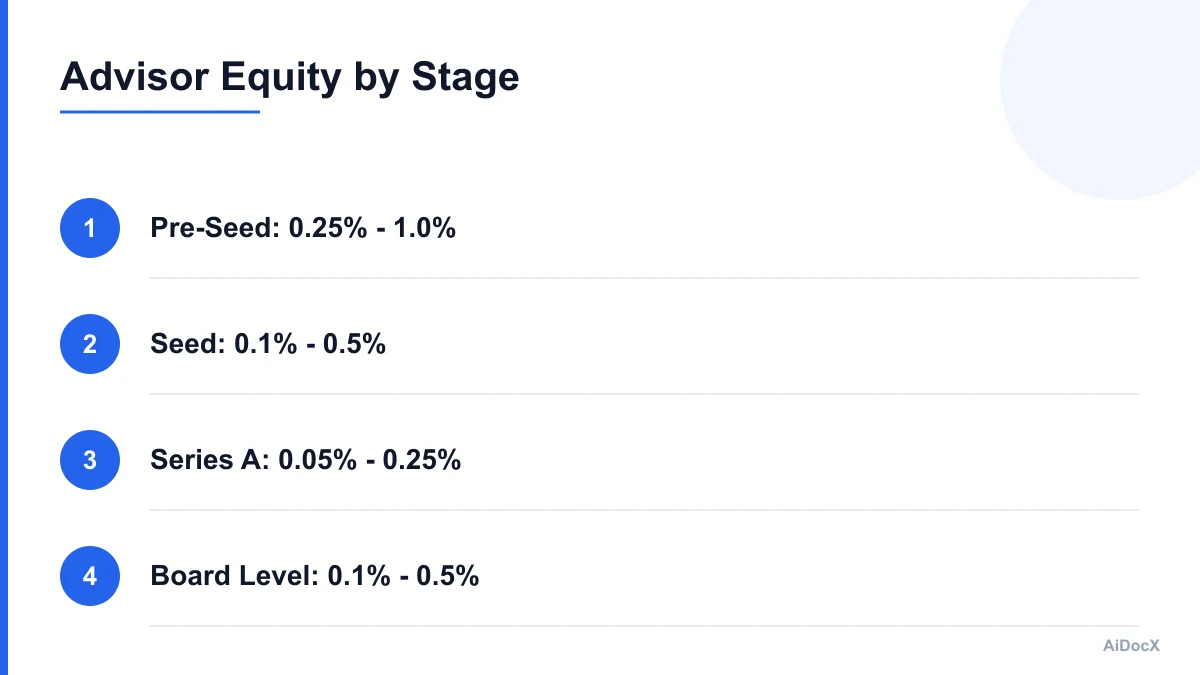
At the earliest stage, cash is tight, and advisors often take equity for the opportunity to work with a promising team. Typical grants range from 0.25% to 1.0% of fully diluted shares.
- Low Involvement: If the advisor provides occasional introductions or high-level feedback, aim for the lower end (0.25% - 0.5%).
- High Involvement: If the advisor is actively helping with product strategy, hiring key roles, or leveraging their network for early customers, you might go up to 1.0%.
Seed Stage (12-24 Months)
As you secure initial funding and traction, the value of equity increases. Grants typically shrink to 0.1% to 0.5%. At this stage, advisors are expected to provide more targeted, high-impact advice, such as helping refine your go-to-market strategy or preparing for your next fundraise.
Series A and Beyond (24+ Months)
Once you have significant valuation and institutional investors, equity becomes more expensive. Advisor grants usually fall between 0.05% and 0.25%. At this stage, advisors are often industry veterans or former executives who bring specialized knowledge or critical connections.
Factors That Influence the Grant
Beyond company stage, consider these variables when determining the percentage:
- Level of Commitment: Is the advisor available for 2 hours a month or 20? Higher commitment warrants a larger grant.
- Strategic Value: Does the advisor have access to a niche market, regulatory expertise, or key investors? Rare expertise commands higher equity.
- Reputation and Network: A well-known advisor can lend credibility to your startup, which can be invaluable for fundraising and customer acquisition.
It’s crucial to remember that equity grants should be tied to performance and time. Never give a full grant upfront. Instead, use a vesting schedule to ensure the advisor remains engaged and delivers value over time.
Structuring Vesting: The 4-Year Standard with Milestones
Vesting is the mechanism that ensures advisors earn their equity over time, protecting your startup if the relationship doesn’t work out. The standard vesting schedule for advisors mirrors that of employees and co-founders: 4 years with a 1-year cliff.
What Is a Cliff?
A cliff means that if the advisor leaves or is terminated before completing one year, they receive zero equity. At the one-year mark, they vest 25% of their total grant. After that, the remaining equity vests monthly or quarterly over the next three years.
Why the Cliff Matters
The cliff protects you from granting significant equity to an advisor who provides minimal value in the first few months. It also gives both parties time to assess if the relationship is a good fit. If the advisor isn’t helpful or available after six months, you can terminate the agreement without owing them any equity.
Milestone-Based Vesting
While time-based vesting is the norm, you can also incorporate milestone-based vesting for specific, high-impact deliverables. For example:
- 25% upon completion of a strategic roadmap.
- 25% after securing three key customer introductions.
- 25% after helping close a pilot deal.
- 25% after 12 months of continued engagement.
This approach aligns the advisor’s incentives with tangible outcomes. However, be careful not to make milestones too vague or subjective, as this can lead to disputes. Define success criteria clearly in the agreement.
Acceleration Clauses
Consider whether acceleration clauses are appropriate. In the event of a change of control (e.g., an acquisition), you might choose to accelerate vesting to ensure the advisor is rewarded for their contribution to the company’s success. However, this is less common for advisors than for employees and should be weighed carefully against your cap table health.
Essential Clauses: What Must Be In Writing
A robust advisor agreement includes more than just equity and vesting. To protect your intellectual property, confidentiality, and legal standing, ensure the following clauses are clearly defined:
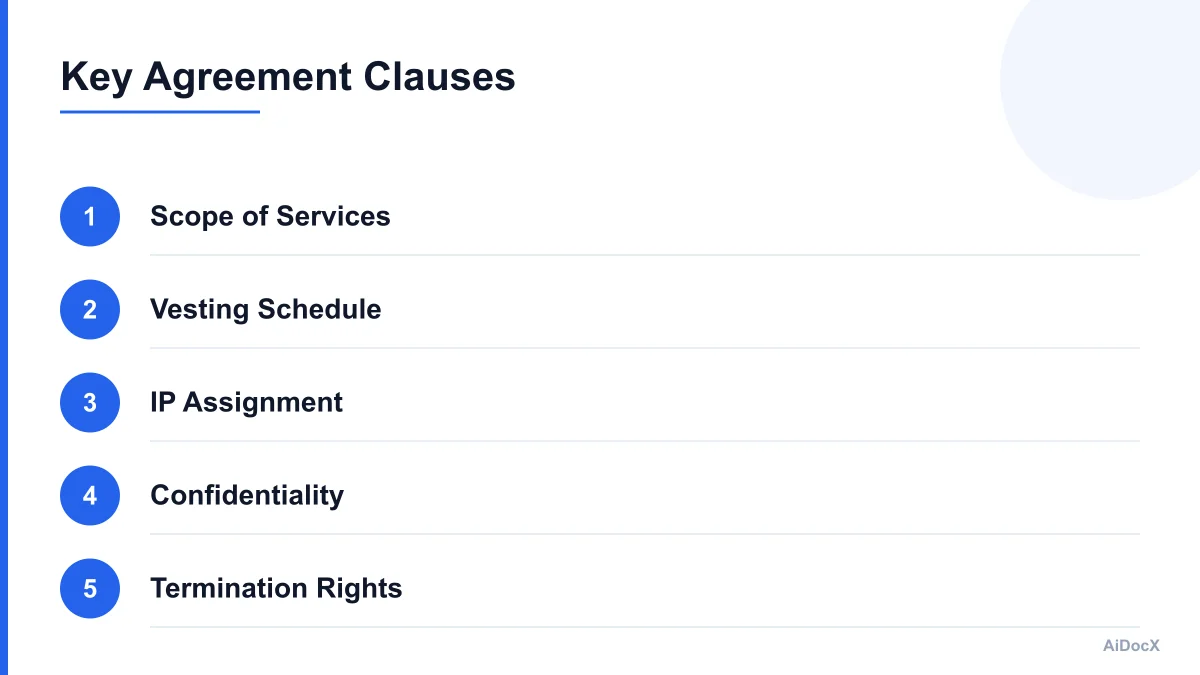
1. Scope of Services
Define the advisor’s role and responsibilities. Are they expected to attend monthly calls, review pitch decks, make introductions, or provide strategic guidance? Be specific. For example:
- "Advisor agrees to provide no more than 4 hours of strategic advice per month."
- "Advisor agrees to introduce the Company to up to 3 potential investors per quarter."
This prevents scope creep and sets clear expectations for both parties.
2. Independent Contractor Status
Clearly state that the advisor is an independent contractor, not an employee. This avoids misclassification issues, which can lead to significant legal and tax liabilities. The advisor is not entitled to benefits, such as health insurance or paid time off, and is responsible for their own taxes.
3. Intellectual Property (IP) Assignment
Ensure that any ideas, strategies, or materials shared by the advisor during the engagement belong to the company. Include an IP assignment clause that transfers ownership of any work product to the startup. This is critical for protecting your core assets and ensuring that investors can verify clear ownership.
4. Confidentiality
Advisors will have access to sensitive information, including financial data, customer lists, and product roadmaps. Include a strong confidentiality clause that prohibits the advisor from sharing this information with third parties. This clause should survive the termination of the agreement.
5. Termination
Define how either party can terminate the relationship. Typically, either party can terminate with 30 days’ written notice. Include provisions for what happens to unvested equity upon termination. In most cases, unvested equity is forfeited, and vested equity remains with the advisor.
6. Conflict of Interest
Advisors may have relationships with other companies, including competitors. Include a clause that requires the advisor to disclose any potential conflicts of interest. You might also restrict the advisor from working with direct competitors during the term of the agreement, depending on the level of involvement.
7. Compensation
While most advisors are compensated with equity, some may require a small stipend or per-project fee. Clearly state whether any cash compensation is involved. If so, specify the amount, payment schedule, and any expense reimbursement policies.
Drafting the Agreement: Best Practices for Founders
Creating an advisor agreement doesn’t have to be a daunting legal exercise. With the right tools and approach, you can draft a comprehensive document that protects your interests while maintaining a positive relationship with your advisor.
Use a Standard Template
Start with a well-drafted advisor agreement template that includes all the essential clauses mentioned above. This ensures you don’t miss critical legal protections. Many legal platforms and startup resources offer templates, but it’s important to customize them to your specific situation.
Customize the Scope and Equity
Tailor the agreement to the specific advisor. Adjust the scope of services, equity grant, and vesting schedule based on the factors discussed earlier. Avoid using a one-size-fits-all approach, as each advisor relationship is unique.
Define Measurement Metrics
If you’re using milestone-based vesting, define clear, measurable metrics. For example, instead of saying "Advisor will help with fundraising," say "Advisor will introduce the Company to at least 5 qualified venture capital firms." This reduces ambiguity and makes it easier to evaluate performance.
Get It Signed Early
Don’t wait until the advisor has started providing value to draft the agreement. Have the agreement signed before the first engagement. This sets the tone from the beginning and ensures that both parties are legally bound from day one.
Review with Legal Counsel
While templates are a great starting point, it’s always wise to have a lawyer review your final agreement, especially if the equity grant is significant or the advisor’s role is complex. A legal review can catch subtle issues that could cause problems later.
Common Mistakes to Avoid
Even experienced founders make mistakes when structuring advisor agreements. Avoid these common pitfalls to protect your startup and your relationship with the advisor.
Mistake 1: Giving Too Much Equity
Founders often overestimate the value of an advisor’s contribution and grant excessive equity. This can dilute the cap table and make future fundraising difficult. Stick to industry standards and be conservative in your grants.
Mistake 2: No Vesting or Cliff
Giving equity upfront without vesting is a major risk. If the advisor stops contributing after a few months, you’ve lost equity without gaining value. Always use a vesting schedule with a cliff.
Mistake 3: Vague Scope of Work
Ambiguous language like "Advisor will provide strategic guidance" is too broad. Define specific activities, time commitments, and deliverables to prevent scope creep and disputes.
Mistake 4: Ignoring IP Rights
Failing to include an IP assignment clause can lead to disputes over ownership of ideas and strategies. Always ensure that the company owns all work product created during the engagement.
Mistake 5: Not Terminating Poor Relationships
If an advisor isn’t delivering value, don’t hesitate to terminate the relationship. Continuing a non-performing advisor relationship wastes time and equity. Use the termination clause in your agreement to end the relationship professionally.
How AiDocX Simplifies the Process
Drafting an advisor agreement from scratch can be time-consuming and complex. AiDocX simplifies this process by providing a smart, AI-powered platform that drafts a comprehensive advisor agreement tailored to your specific needs. With AiDocX, you can:
- Generate a Custom Agreement: Input your company details, advisor name, equity grant, and vesting schedule, and AiDocX generates a legally sound agreement.
- Ensure Compliance: The platform incorporates standard legal clauses and best practices for advisor agreements, ensuring you don’t miss critical protections.
- Streamline Signing: Once the agreement is drafted, AiDocX facilitates the signing process, ensuring that both parties sign electronically and securely.
By using AiDocX, you can move from handshake to signed agreement quickly and efficiently, reducing the risk of future disputes and ensuring that your advisor relationship starts on the right foot.
Checklist: Before You Sign the Advisor Agreement
Before finalizing and signing an advisor agreement, use this checklist to ensure you’ve covered all bases:
- Define the scope of services and time commitment clearly.
- Determine the equity grant based on company stage and advisor value.
- Include a 4-year vesting schedule with a 1-year cliff.
- Add an IP assignment clause to protect company ownership.
- Include a confidentiality clause to protect sensitive information.
- Specify termination rights and procedures.
- Clarify independent contractor status and tax responsibilities.
- Review the agreement with legal counsel if necessary.
- Ensure both parties sign the agreement before engagement begins.
Conclusion
Building a successful startup requires the right support, and advisors can play a pivotal role in your journey. However, the value of an advisor is only realized when the relationship is structured correctly. By offering fair equity, implementing a robust vesting schedule, and including essential legal clauses, you can protect your startup and foster a productive, long-term partnership.
Don’t leave advisor relationships to chance. Use a clear, written agreement to set expectations, protect your intellectual property, and ensure that both parties are aligned on goals and deliverables. With the right structure in place, your advisors can become invaluable allies in your growth journey.
If you’re ready to formalize your advisor relationships, consider using AiDocX to draft your advisor agreement. With its AI-powered drafting and seamless signing process, AiDocX helps you get from handshake to contract quickly and confidently, ensuring that your startup’s cap table and legal standing are protected from day one.
Ready to automate your documents with AI?
Start free with AiDocX — AI contract drafting, meeting minutes, consultation notes, e-signatures, and more in one platform.
Get Started FreeMore from AiDocX Blog
Affiliate Agreement Template (2026): Protect Your Business When Paying Commissions
Free affiliate agreement template for 2026: key clauses, FTC disclosure requirements, affiliate vs referral agreement compared, a worked example, and a copy-paste version.
James September 22, 2026 11 min
AI Receipt Generator (2026): Create Professional Payment Receipts in Seconds
Generate professional payment receipts with AI in seconds. Receipt vs invoice vs credit note explained, the fields to include, a worked example, and a copy-paste template.
James September 22, 2026 9 min
Bill of Sale Template (2026): Free Generator for Cars, Trailers & Personal Property
Free bill of sale template for 2026: the fields to include, state notarization rules, federal odometer disclosure, a worked example, and a copy-paste version.
James September 22, 2026 10 min