Statement of Work Template: Stop Scope Creep in 2026
Use this Statement of Work template to define deliverables, timelines, and acceptance criteria. Protect your revenue from scope creep with clear, legally sound project scoping.
 James · Content Manager August 19, 2026 12 min read
Statement of Work Template: Stop Scope Creep in 2026
Scope creep is the silent killer of freelance margins. It happens when a client’s expectations drift beyond the original agreement, not because of malice, but because the boundaries were never clearly defined. Without a formalized document that explicitly lists what is included—and, just as importantly, what is excluded—you are left negotiating from a position of weakness. A Statement of Work (SOW) is not just legal paperwork; it is the primary tool for managing client expectations and protecting your time.
This guide provides a comprehensive framework for creating an SOW that holds up to scrutiny. We will break down the specific components required to lock in scope, define acceptance criteria to prevent endless revisions, and establish a clear process for handling changes. By the end of this article, you will have a repeatable process for scoping projects that ensures you get paid for the work you actually do.
Why Verbal Agreements Fail Freelancers
In the early days of freelancing, it is common to rely on email chains, Slack messages, or verbal conversations to agree on project details. While this works for small, low-stakes tasks, it creates significant liability for larger engagements. The fundamental problem with informal agreements is ambiguity. When a client says, "I want a professional look," that phrase means different things to different people. One client might mean "modern minimalist," while another might mean "corporate and dense."
When disputes arise, the burden of proof falls on you. If a client claims you missed a deliverable that was discussed in a casual meeting but never written down, you have no documentation to prove otherwise. A formal SOW shifts the dynamic from "he said/she said" to "the document says." It creates a shared source of truth that both parties have signed off on.
Furthermore, informal agreements rarely address the mechanics of payment tied to progress. If you are working on a monthly retainer or a milestone-based project, you need clear triggers for when invoices are sent. Without these triggers, you may find yourself doing weeks of work before you have the leverage to demand payment. The SOW formalizes these triggers, turning "when the work is done" into "when Milestone 1 is accepted."
The Anatomy of a Bulletproof SOW
A robust Statement of Work is more than a list of tasks. It is a structured document that covers the entire lifecycle of the project. While specific legal requirements vary by jurisdiction, the following five sections form the backbone of any effective SOW for consulting or creative services.
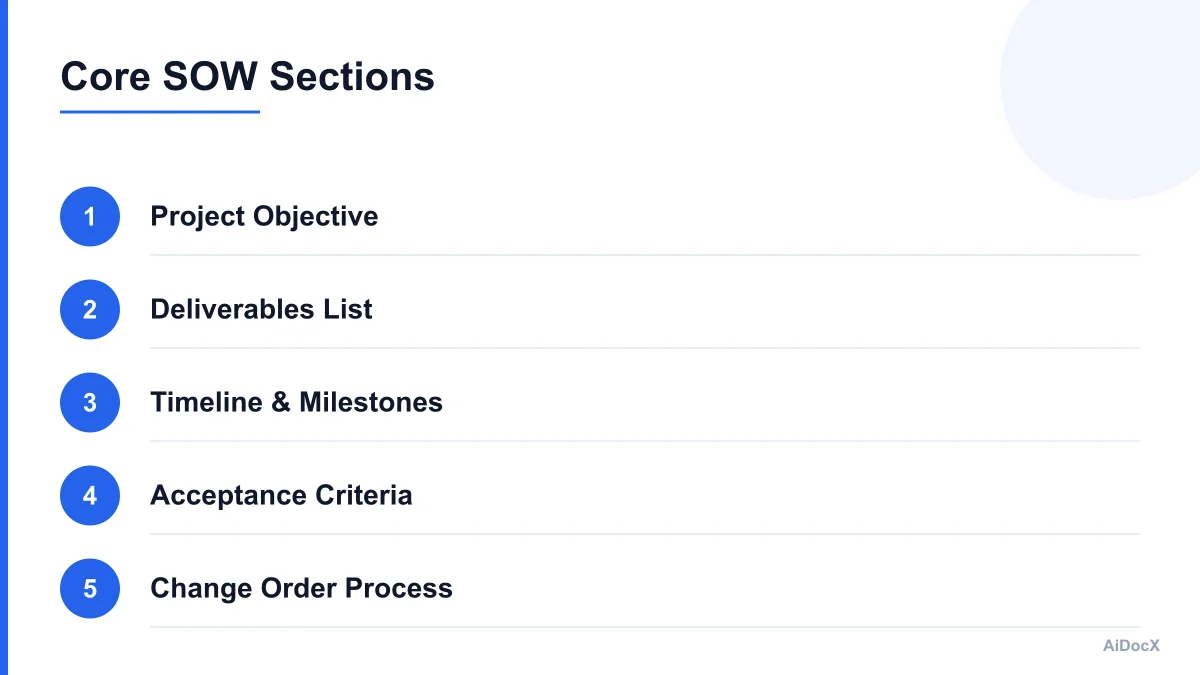
1. Project Objective and Background
This section sets the context. It explains why the project is happening. It should include a brief description of the client’s business or problem and the specific goals they hope to achieve. This is crucial for alignment. If the objective is "increase brand awareness," the deliverables might differ significantly from an objective of "generate immediate sales." Misalignment on the objective is the root cause of most scope disputes.
2. Scope of Work (Deliverables)
This is the heart of the document. It lists every tangible output you will produce. Avoid using vague verbs like "manage," "oversee," or "handle." Instead, use specific nouns and quantities. For example, instead of "Manage social media," write "Create 12 static graphic posts and 4 short-form video edits for Instagram and LinkedIn." If you are providing consulting services, list the specific workshops, reports, or audits you will deliver.
3. Timeline and Milestones
Time is a resource that must be protected. This section outlines the start date, end date, and key intermediate milestones. Each milestone should have a due date and a description of what constitutes completion. For instance, "Draft Proposal" is a milestone. "Final Approved Proposal" is a different milestone. Breaking the project into phases allows for feedback loops and prevents the client from seeing the final product for the first time at the end of a three-month engagement.
4. Acceptance Criteria
This is the most overlooked and most critical section. It defines how the client will know the work is complete. Without clear criteria, "done" is subjective. For a website, acceptance criteria might include "Loads in under 2 seconds on 4G," "Is responsive on mobile, tablet, and desktop," and "Contains all copy provided in the Content Brief." For consulting, it might be "Delivers a 10-page strategy document including three actionable recommendations." When acceptance criteria are met, the work is considered complete, and the corresponding payment is due.
5. Change Order Process
Scope changes are inevitable. The key is to manage them. This section outlines how changes to the scope, timeline, or cost will be handled. It typically requires that any change be proposed in writing, approved by both parties, and signed as a Change Order before work begins. This prevents the client from adding small tasks ("Just one more slide") that accumulate into significant unpaid labor.
Defining Deliverables: Specific vs. Vague
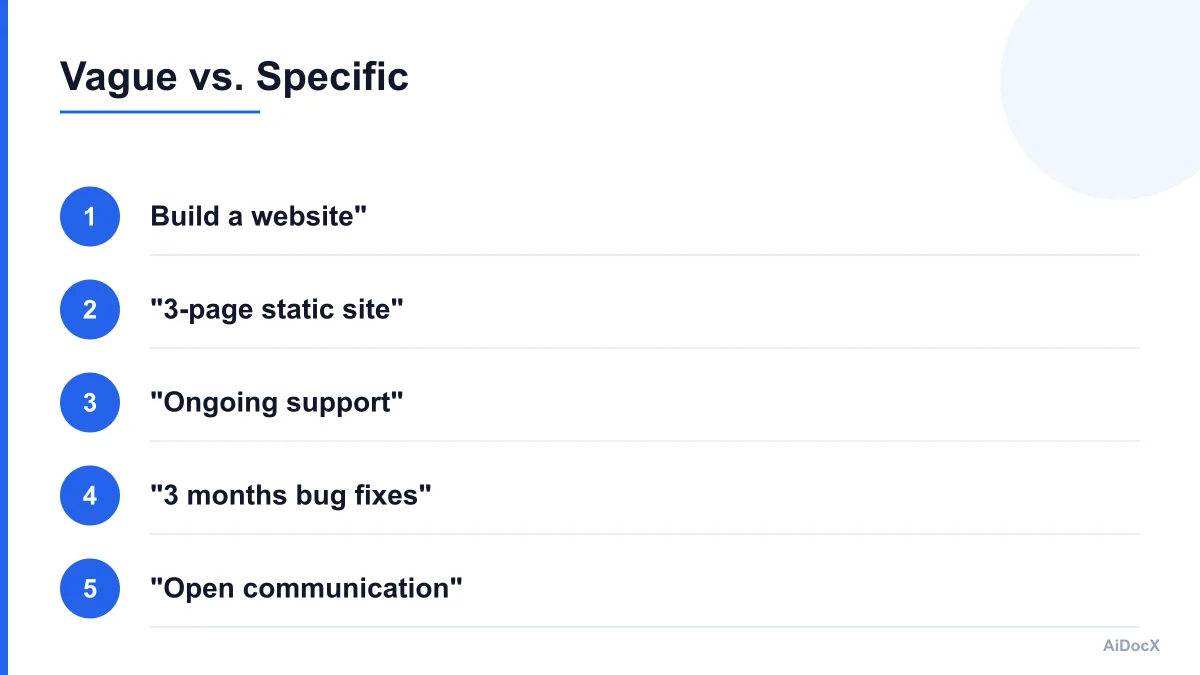
The difference between a professional SOW and a liability risk often comes down to the precision of language. Vague language invites interpretation; specific language enforces standards. Below is a comparison of common freelance scenarios and how to phrase them effectively.
| Vague Language (Risk) | Specific Language (Safe) |
|---|---|
| "Create a logo" | "Design 3 unique logo concepts, with up to 2 rounds of revisions on the selected concept." |
| "Write website copy" | "Write 1,500 words of copy for the Home, About, and Services pages, adhering to the provided brand voice guide." |
| "Provide SEO support" | "Perform a technical SEO audit and implement on-page optimizations for the top 10 priority pages." |
| "Manage social media" | "Schedule and post 3 times per week to Facebook and Twitter. Monitor comments for 2 hours daily." |
| "Consult on strategy" | "Attend two 90-minute strategy workshops and deliver a written action plan within 5 business days." |
Notice that the specific language includes quantity, quality standards, and revision limits. Revision limits are particularly important. Unlimited revisions are a recipe for burnout. By limiting revisions (e.g., "2 rounds of revisions"), you create a natural checkpoint where the client must commit to a direction. If they want more changes, it triggers a change order.
Structuring Timelines and Milestones
A timeline is not just a list of dates; it is a management tool. It helps you plan your workload and helps the client understand what to expect. When structuring your timeline, consider the following best practices:
- Include Buffer Time: Never schedule back-to-back tasks without buffer. If a deliverable is due on Friday, schedule the final review for Wednesday. This accounts for unexpected delays, client feedback loops, or personal emergencies.
- Define Dependencies: Clearly state what is required from the client to keep the timeline on track. For example, "Client must provide final copy by Day 5 to allow for design implementation." If the client delays, the timeline shifts. This protects you from being blamed for delays caused by their inaction.
- Milestone Payments: Tie payments to milestones, not just the end of the project. A common structure is 30% upfront, 40% at the midpoint, and 30% on final delivery. This ensures cash flow and aligns incentives. If a milestone is accepted, the payment is due. If it is not accepted, you work together to resolve the issues based on the acceptance criteria.
Acceptance Criteria: The Key to Closing Projects
Many freelancers struggle with "endless revisions" because they never define what "finished" looks like. Acceptance criteria act as a contract for quality. They remove the emotional component from feedback and replace it with objective standards.
How to write effective acceptance criteria:
- Make it Measurable: Use numbers where possible. "Under 500ms load time," "95% Lighthouse score," "10 slides."
- Be Functional: Focus on what the item does, not just how it looks. "The contact form submits data to the CRM" is a functional criterion. "The design looks nice" is not.
- Reference External Standards: If applicable, reference industry standards or previous work. "The color palette must match the attached brand guidelines."
- Limit Subjectivity: If a deliverable is inherently subjective (like branding), define the process for approval. "The client will provide feedback within 5 business days. Failure to provide feedback will be interpreted as acceptance."
By including acceptance criteria, you shift the burden of proof. If the client claims the work is not done, you can point to the criteria. If the work meets the criteria, the client must pay. This reduces the anxiety of the final delivery phase.
Handling Scope Creep and Change Orders
Scope creep is not always malicious. Clients often realize mid-project that they need something else, or they get new information that changes their needs. The problem is not the change itself, but the lack of a process to handle it.
A standard Change Order clause should include:
- Written Request: All changes must be requested in writing (email is sufficient).
- Impact Assessment: You will assess the impact of the change on cost and timeline within 2 business days.
- Approval: No work on the change will begin until the client signs the Change Order.
- Pricing: Changes are billed at your standard hourly rate or a fixed fee, whichever is higher.
Example Change Order Clause:
"Any changes to the Scope of Work defined in Section 2 must be submitted in writing. Freelancer will provide a written estimate of additional costs and timeline adjustments within 48 hours. Work on the change will commence only upon client’s written approval of the estimate. Approved changes will be billed as additional fees to the total project cost."
This clause protects you from "quick asks." If a client says, "Can you just tweak this one thing?" you can reply, "Sure, I’ll send over a change order for that tweak." Often, when clients see the cost and the formal process, they realize the "small" change is not so small, or they decide to wait for the next project phase.
Common Scope Creep Traps
Even with a good SOW, certain patterns can lead to scope creep. Being aware of these traps helps you proactively manage them.
- The "While You're At It" Request: Clients often bundle small requests with major deliverables. "Can you also fix this typo while you're updating the homepage?" If it’s not in the SOW, it’s not included. Politely decline and offer a change order.
- Role Confusion: Clients may expect you to do tasks that fall outside your expertise. A web designer might be asked to write the copy. A copywriter might be asked to design the layout. Your SOW should explicitly state your role. "Freelancer will provide design services. Copywriting is not included unless specified in a Change Order."
- Platform Confusion: If you are using a project management tool (like Asana or Trello), ensure that tasks added to the board are only those defined in the SOW. If a client adds a task to the board, treat it as a change request, not an instruction.
- The "Feedback Loop" Drag: Revisions are part of the process, but endless feedback is not. Limit the number of rounds. After the second round, if the client is still not happy, it is likely a fundamental misalignment of objectives. At that point, a strategic conversation is needed, not just more edits.
Streamlining the Process with AI Tools
Creating a detailed SOW from scratch for every project is time-consuming. Many freelancers avoid it because it takes hours to draft, review, and format. This is where technology can help.
Tools like AiDocX allow you to generate a structured SOW from a plain-English project brief. You input the key details—client name, project goals, deliverables, and timeline—and the platform generates a professional document with pre-filled sections for acceptance criteria and change orders. This reduces the drafting time from hours to minutes. Furthermore, it ensures consistency across your portfolio. Every SOW follows the same logical structure, making it easier for you to review and for clients to understand. Once the SOW is generated, you can send it for e-signature directly from the platform, creating a digital trail of agreement. This efficiency allows you to spend less time on administrative overhead and more time on billable work.
SOW Checklist: Before You Start
Before you send the SOW to the client, run through this checklist to ensure nothing is missed.
- Project Objective is clear: Does the client know why they are hiring you?
- Deliverables are quantified: Are there numbers (words, pages, hours, revisions) attached to every task?
- Timeline includes buffers: Is there slack in the schedule for feedback and unexpected issues?
- Acceptance Criteria are defined: How will the client know the work is done?
- Exclusions are listed: What are you not doing? (e.g., "Copywriting not included," "Hosting fees not included")
- Change Order process is stated: How will changes be handled?
- Payment terms are tied to milestones: When is the money due?
- Client responsibilities are listed: What does the client need to provide to keep the project moving?
Conclusion
A Statement of Work is not a barrier to client relationships; it is the foundation of a professional one. By clearly defining deliverables, timelines, and acceptance criteria, you demonstrate competence and respect for both your time and the client’s budget. Scope creep is not an inevitable part of freelancing—it is a symptom of poor scoping.
Use the framework above to build your own SOW template. Start with the next project you take on. Draft the SOW before you start any work. Send it for signature. And when the project ends, you will have a clear record of what was agreed upon, what was delivered, and what was paid. This discipline will protect your margins, improve your client relationships, and allow you to focus on the work you love, rather than the politics of scope.
Ready to simplify your project scoping? Consider using AiDocX to generate your next SOW. Turn your project brief into a signed, legally sound document in minutes, and get back to doing what you do best.
Ready to automate your documents with AI?
Start free with AiDocX — AI contract drafting, meeting minutes, consultation notes, e-signatures, and more in one platform.
Get Started FreeMore from AiDocX Blog

How to Read a Business Contract: A Founder's Checklist (2026)
A practical way to review parties, scope, money, IP, liability, and exit terms before signing a business contract.
 MinjiLee October 7, 2026 9 min
ESIGN vs eIDAS: What Founders Should Know About E-Signatures (2026)
What U.S. ESIGN and EU eIDAS actually say, where exceptions apply, and what founders should keep to document an electronic signing.
MinjiLee October 7, 2026 7 min
Does Document Automation Pay Off? An ROI Worksheet for Founders (2026)
Estimate document automation ROI with your own volume, time, labor, and software costs. Includes a clearly labeled example and break-even formula.
 Chloe October 7, 2026 8 min