2026 E-Commerce ToS Template: Protect Your Online Store
Discover the essential clauses for your 2026 online store Terms of Service. Avoid chargebacks and legal risks with this practical guide for Southeast Asian sellers.
 James · Content Manager August 19, 2026 10 min read
2026 E-Commerce ToS Template: Protect Your Online Store
Many small business owners in Thailand, Indonesia, and other Southeast Asian markets launch their Shopify or WooCommerce stores with a "Buy Now" button but no legal safety net. They assume the platform's default settings are enough, or they copy-paste a generic SaaS agreement from the internet. This is a dangerous gamble. Without a specific, localized Terms and Conditions (ToS) page, you are vulnerable to chargebacks, consumer protection lawsuits, and platform bans.
This guide breaks down exactly what needs to be in your 2026 e-commerce ToS. We will move beyond vague legal jargon and focus on the operational realities of selling online in the region. We will look at how to handle cross-border shipping, specific return policies, and digital privacy to ensure your store is legally sound and operationally clear.
Why "Default" Terms Fail in Southeast Asia
If you are selling on Shopee, Lazada, or your own standalone store, you are likely operating under specific local consumer protection laws. In Thailand, the Consumer Protection Act is strict regarding misleading practices and return rights. In Indonesia, the Consumer Protection Law mandates clear disclosure of product conditions and transaction terms.
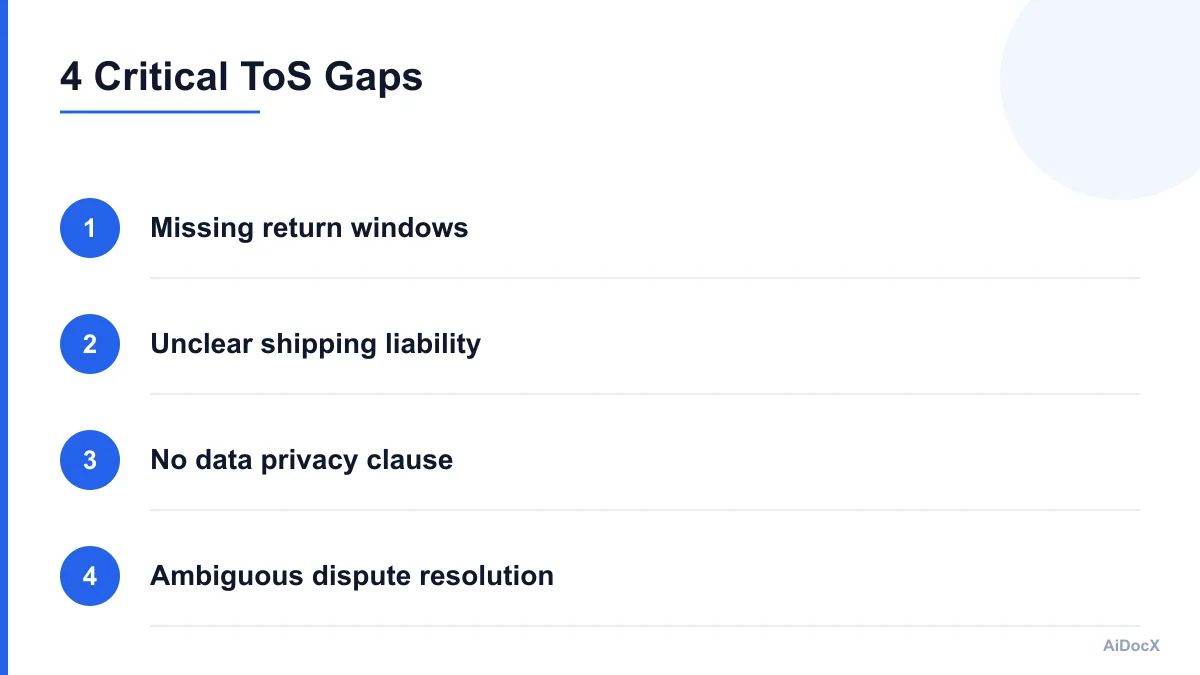
Using a generic, US-centric, or SaaS-focused template fails for three main reasons:
- Jurisdiction Mismatch: A template citing California law is useless for a dispute in Jakarta. It creates confusion about which court has jurisdiction.
- Operational Mismatch: SaaS templates focus on subscription renewals and data usage. E-commerce templates must focus on physical goods, shipping liabilities, and product defects.
- Platform Specifics: If you are selling on a marketplace, you must align your ToS with the marketplace’s own rules. If you are on a standalone site, you bear full legal responsibility for the transaction.
The risk is not just theoretical. A common scenario in the region involves a customer claiming a product was "not as described" because the ToS did not explicitly state that colors may vary due to screen calibration. If your ToS is silent on this, the burden of proof falls on you, often leading to a forced refund and a chargeback fee.
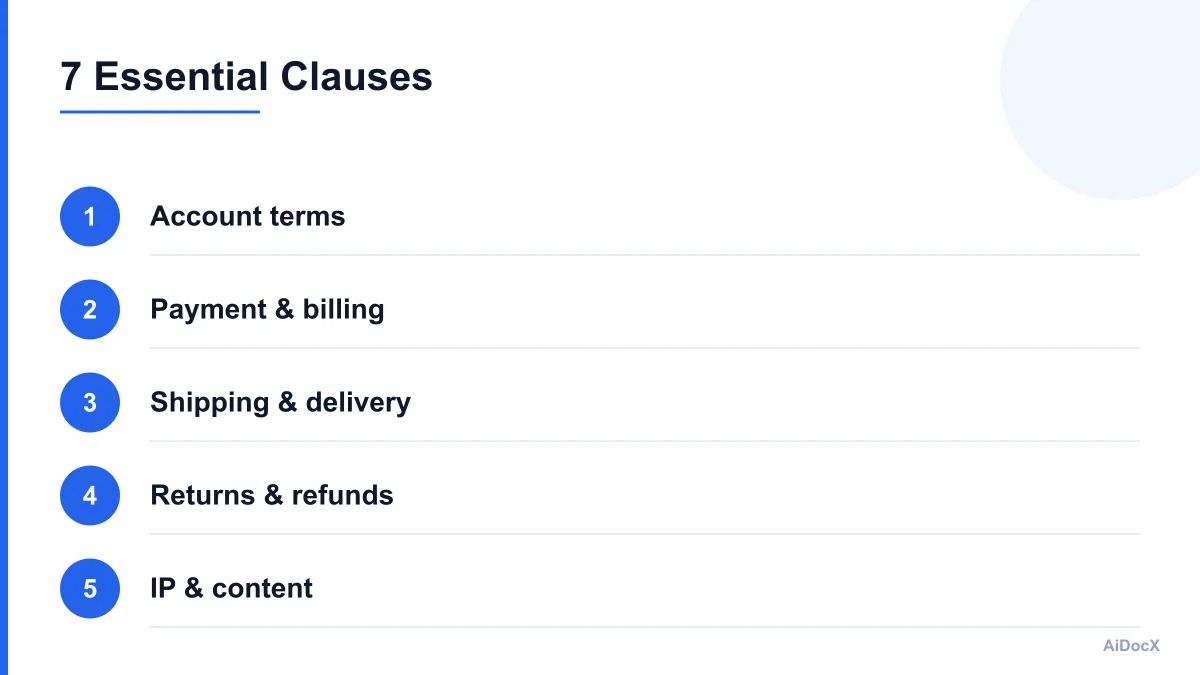
The 7 Non-Negotiable Clauses
Your ToS is a contract. For it to be enforceable, it must be clear and specific. Here are the seven clauses that must be present in any serious e-commerce document.
1. Account Registration and Eligibility
Define who can buy from you. State that users must provide accurate information and that you reserve the right to refuse service to anyone. This is crucial for preventing fraud. Include a clause stating that minors (under 18) may only use the site with parental supervision, as this is a common legal requirement in both Thailand and Indonesia.
2. Payment and Billing
Be explicit about accepted payment methods (credit cards, e-wallets like TrueMoney or GoPay, bank transfers). Clarify that prices are in your base currency and that currency conversion fees are the customer’s responsibility. Crucially, state that you reserve the right to refuse an order if you suspect fraud or if the payment method is declined. This protects you from "friendly fraud" chargebacks.
3. Shipping and Delivery
This is the most frequent source of disputes. You must define:
- Processing Time: How long it takes to pack and hand over to the courier.
- Estimated Delivery: Use phrases like "estimated" to avoid guaranteeing specific dates.
- Risk of Loss: State clearly that risk of loss transfers to the customer once the item is handed to the carrier.
- Lost Packages: Explain the process if a package is lost. Do you replace it? Do you refund? Be specific. For example: "If a package is lost in transit, we will issue a replacement or a full refund at our discretion within 14 days of confirmation from the carrier."
4. Returns, Refunds, and Exchanges
This section must align with local consumer law. In many Southeast Asian countries, you are required to accept returns for defective goods. For "change of mind" returns, you can set stricter rules.
- Window: Define the return window (e.g., 7 days or 14 days from delivery).
- Condition: Items must be in original packaging, unused, and with tags attached.
- Restocking Fee: If you charge a restocking fee, state it clearly (e.g., 10%).
- Exclusions: List items that are non-returnable (e.g., personalized goods, hygiene products, digital downloads).
5. Intellectual Property and Content
State that all images, text, and logos on your site are your property. Customers may not scrape your site for data or use your content for commercial purposes. This is increasingly important as AI tools are used to generate product descriptions and images; ensure you own the rights to the content you display.
6. Limitation of Liability
This clause limits your financial exposure. You should state that you are not liable for indirect, incidental, or consequential damages. For example, if a product fails and causes damage to other property, your liability should be limited to the price of the product, not the cost of the damaged property. Note: In some jurisdictions, you cannot limit liability for gross negligence or willful misconduct. Keep this clause reasonable to remain enforceable.
7. Governing Law and Dispute Resolution
Specify the country where your business is registered. For a Thai seller, this is Thailand. For an Indonesian seller, it is Indonesia. Include a clause that disputes will be resolved in the courts of that jurisdiction. Alternatively, consider a clause that encourages mediation or arbitration before litigation, which can save time and money.
Handling Cross-Border and Local Logistics
If you are selling within your home country, the above covers most bases. But if you are selling to neighbors (e.g., a Thai seller shipping to Malaysia, or an Indonesian seller shipping to Singapore), your ToS needs additional nuance.
Customs and Duties
If you ship internationally, you must clarify who pays customs duties and import taxes. In many cases, the buyer is responsible for these fees. If you do not state this, customers may refuse delivery when they are asked to pay customs at the border, leading to a return shipment and lost revenue.
Example Clause:
"All international shipments are subject to local customs regulations. The customer is responsible for any import duties, taxes, or fees imposed by their local customs authority. These fees are not included in the listed price or shipping cost."
Shipping Delays
Cross-border shipping is prone to delays. Your ToS should state that you are not responsible for delays caused by customs clearance, carrier strikes, or natural disasters. Use the term "Force Majeure" to cover these events.
Currency Fluctuations
If you accept multiple currencies, state that prices are converted at the rate on the day of purchase. You are not responsible for exchange rate fluctuations between the purchase date and the delivery date.
Data Privacy and Cookie Consent
With the rise of digital transactions, data privacy is a top concern. Even if you are not a large corporation, you are collecting customer data: names, addresses, phone numbers, and payment details.
What to Include
- Data Collection: State what data you collect and why (e.g., "We collect your email address to send order updates").
- Third-Party Sharing: Disclose that you share data with payment processors (Stripe, PayPal, local e-wallets) and shipping carriers.
- Cookies: Explain that you use cookies to track cart contents and personalize recommendations.
- User Rights: State that users can request to view or delete their data.
Local Laws
- Thailand: The Personal Data Protection Act (PDPA) requires consent for data processing.
- Indonesia: The Personal Data Protection Law (PDP Law) is now in effect and requires similar transparency.
If you use a Shopify or WooCommerce theme, ensure your privacy policy is linked in the footer. Your ToS should reference this privacy policy but remain focused on the transaction. Do not duplicate the entire privacy policy in the ToS; keep the ToS focused on the sale.
Common Mistakes and How to Avoid Them
Even with a good template, sellers make mistakes that render their ToS ineffective or misleading.
- Hiding the ToS: Do not bury the ToS in a tiny font in the footer. It should be linked in the footer and, ideally, presented as a checkbox during checkout ("I agree to the Terms and Conditions"). If a customer does not check the box, they cannot complete the purchase. This creates a clear record of consent.
- Vague Language: Avoid phrases like "reasonable time" or "fair amount." Be specific. "Within 5 business days" is better than "promptly."
- Ignoring Platform Rules: If you sell on Shopee, your ToS must not contradict Shopee’s Seller Terms. If there is a conflict, the platform terms usually prevail. Your ToS should state that in case of conflict, the platform terms apply.
- Not Updating for Changes: If you change your return policy from 7 days to 14 days, you must update your ToS and notify your customers. Continuing to use the old terms can be seen as misleading.
- Using Untranslated Templates: If your store is in Thai or Indonesian, your ToS must be in that language. A ToS in English is not legally binding for a local consumer who does not understand English. Ensure you have a professional translation.
How to Generate a Custom ToS in Minutes
Writing a ToS from scratch is time-consuming and risky if you lack legal expertise. This is where AI-powered document tools come in.
Traditional templates are static. They don't know that you ship from Bangkok or that you accept TrueMoney Wallet. They don't know that you have a 14-day return window.
AiDocX solves this by using an AI template builder specifically designed for e-commerce. Instead of copying a generic document, you answer five simple questions:
- What is your return window?
- Who pays for return shipping?
- Which payment methods do you accept?
- Do you ship internationally?
- What is your governing law?
The AI then generates a complete, tailored Terms and Conditions page. It handles the legal phrasing, includes the necessary local clauses, and formats it ready to be pasted into Shopify, WooCommerce, or any other platform. This ensures that your ToS is not just a generic document, but a reflection of your actual business operations.
Checklist: Before You Go Live
Before you launch your store or update your ToS, run through this checklist to ensure you are covered.
- Jurisdiction Check: Does the ToS specify the correct country and legal system?
- Language Check: Is the ToS available in the primary language of your customers?
- Return Policy Alignment: Does the ToS match the return policy displayed on your product pages?
- Shipping Clarity: Are processing times and delivery estimates clearly defined?
- Payment Terms: Are declined payments and fraud refusal rights clearly stated?
- Privacy Link: Is there a clear link to your Privacy Policy?
- Consent Mechanism: Do you have a checkbox at checkout requiring users to agree to the ToS?
- Update Log: Do you have a date stamp showing when the ToS was last updated?
Conclusion: Protect Your Business with Clear Terms
Your Terms and Conditions page is not just a legal formality; it is an operational tool. It sets expectations for your customers, protects you from chargebacks, and ensures compliance with local regulations. In the competitive e-commerce landscape of 2026, clarity is your best defense.
Do not rely on default settings or generic templates. Take the time to review your ToS. If you are looking for a faster, more accurate way to generate a compliant document, consider using an AI-driven tool that understands the specifics of your store. A well-crafted ToS can save you thousands of dollars in disputes and legal fees, allowing you to focus on growing your business.
Disclaimer: This article is for informational purposes only and does not constitute legal advice. Laws vary by jurisdiction and change over time. Consult with a qualified attorney in your specific country before finalizing your legal documents.
Ready to automate your documents with AI?
Start free with AiDocX — AI contract drafting, meeting minutes, consultation notes, e-signatures, and more in one platform.
Get Started FreeMore from AiDocX Blog
How to Read a Business Contract: A Founder's Checklist (2026)
A practical way to review parties, scope, money, IP, liability, and exit terms before signing a business contract.
 MinjiLee October 7, 2026 9 min
ESIGN vs eIDAS: What Founders Should Know About E-Signatures (2026)
What U.S. ESIGN and EU eIDAS actually say, where exceptions apply, and what founders should keep to document an electronic signing.
MinjiLee October 7, 2026 7 min
Does Document Automation Pay Off? An ROI Worksheet for Founders (2026)
Estimate document automation ROI with your own volume, time, labor, and software costs. Includes a clearly labeled example and break-even formula.
 Chloe October 7, 2026 8 min