Waiver and Release of Liability Template 2026: Small Business Guide
Protect your small business from injury claims. Learn when you need a liability waiver, key legal elements, and how to implement digital signatures efficiently in 2026.
 James · Content Manager August 8, 2026 11 min read
Waiver and Release of Liability Template 2026: When a Small Business Actually Needs One
Running a small business that involves physical activity, equipment rental, or in-person services carries inherent risks. Whether you host yoga classes, rent out party equipment, or offer personal training, the possibility of customer injury is not a matter of "if" but "when." A well-drafted liability waiver is not about preventing accidents; it is about managing the legal aftermath when they inevitably occur. In 2026, with evolving digital consent laws and increased litigation awareness, relying on a handwritten slip of paper is no longer sufficient. This guide outlines exactly when you need a liability waiver, what makes it legally robust, and how modern digital tools can streamline the process.
What Exactly Is a Liability Waiver?
A liability waiver, also known as a release of liability, assumption of risk agreement, or exculpatory clause, is a legal contract between you (the business) and your customer (the participant). By signing this document, the customer voluntarily agrees to relieve you of legal responsibility for certain types of harm that might occur during their interaction with your business.
It is crucial to understand what a waiver does not do. A waiver does not protect you from negligence. If you fail to maintain safe equipment, ignore known hazards, or act recklessly, a waiver generally will not shield you from liability. Instead, a waiver is designed to protect you from claims arising from the inherent risks of the activity. For example, if a customer trips over their own feet while hiking with your guided tour company, the waiver helps demonstrate that they understood and accepted that risk.
Think of a liability waiver as a risk allocation tool. It clarifies that the customer is taking on the responsibility for their own safety within the bounds of the activity, rather than placing that burden on the business owner. Without this agreement, a customer who gets injured could sue for damages, forcing you into costly legal battles even if you had no fault in the incident.
Why Your Business Needs One in 2026
The legal landscape for small businesses has shifted significantly. In previous years, many business owners operated under the assumption that a simple "sign here" form was enough. Today, courts and insurers are scrutinizing these documents more closely. Here is why having a proper waiver is non-negotiable in 2026:
- Deterrence Against Frivolous Lawsuits: The mere existence of a signed waiver often discourages customers from pursuing litigation. Knowing they signed an agreement acknowledging the risks makes it harder for them to claim they were unaware of potential dangers.
- Insurance Requirements: Most business liability insurance policies require you to have active waivers on file for high-risk activities. If you get sued and cannot produce a valid waiver, your insurer may deny coverage, leaving you personally liable for legal fees and settlements.
- Standardization and Consistency: Relying on memory or informal verbal agreements creates gaps in protection. A standardized template ensures that every participant, regardless of when they sign up, receives the same level of legal protection.
- Digital Compliance: With the rise of digital transactions, courts are increasingly accepting electronic signatures. However, these signatures must be properly authenticated. A digital waiver system ensures you have a timestamped, verifiable record of consent, which is far more defensible in court than a handwritten note.
When Do You Actually Need a Liability Waiver?
Not every business interaction requires a waiver. A retail store selling shoes, for instance, typically does not need customers to sign waivers for purchasing items. However, if your business involves physical exertion, specialized equipment, or environments where injury is a plausible outcome, a waiver is essential.
Consider these scenarios where a liability waiver is critical:
- Fitness and Wellness Classes: Yoga studios, cross-fit gyms, martial arts dojos, and dance classes involve physical exertion. Participants may suffer strains, falls, or impacts. A waiver clarifies that participants engage in these activities at their own risk.
- Equipment Rentals: If you rent out trampolines, go-karts, camping gear, or party tents, you need a waiver. The customer must acknowledge that they are responsible for the safe use of the equipment and any injuries resulting from misuse.
- Guided Tours and Adventures: Hiking guides, kayaking instructors, and escape room hosts operate in environments where external factors (weather, terrain, puzzle complexity) can lead to injury. A waiver protects the guide from liability for inherent risks of the environment.
- Events and Competitions: Organizing a 5K run, a dance competition, or a workshop with hands-on activities introduces risk. Participants need to acknowledge that they are participating voluntarily and assume responsibility for their safety.
If your business involves any physical interaction, the use of equipment by customers, or activities where injury is a foreseeable possibility, you need a liability waiver.
Key Elements of a Valid Liability Waiver
A generic "I am not responsible for anything" statement is often legally insufficient. To be enforceable, a liability waiver must be clear, specific, and comprehensive. Here are the essential components every waiver should include:
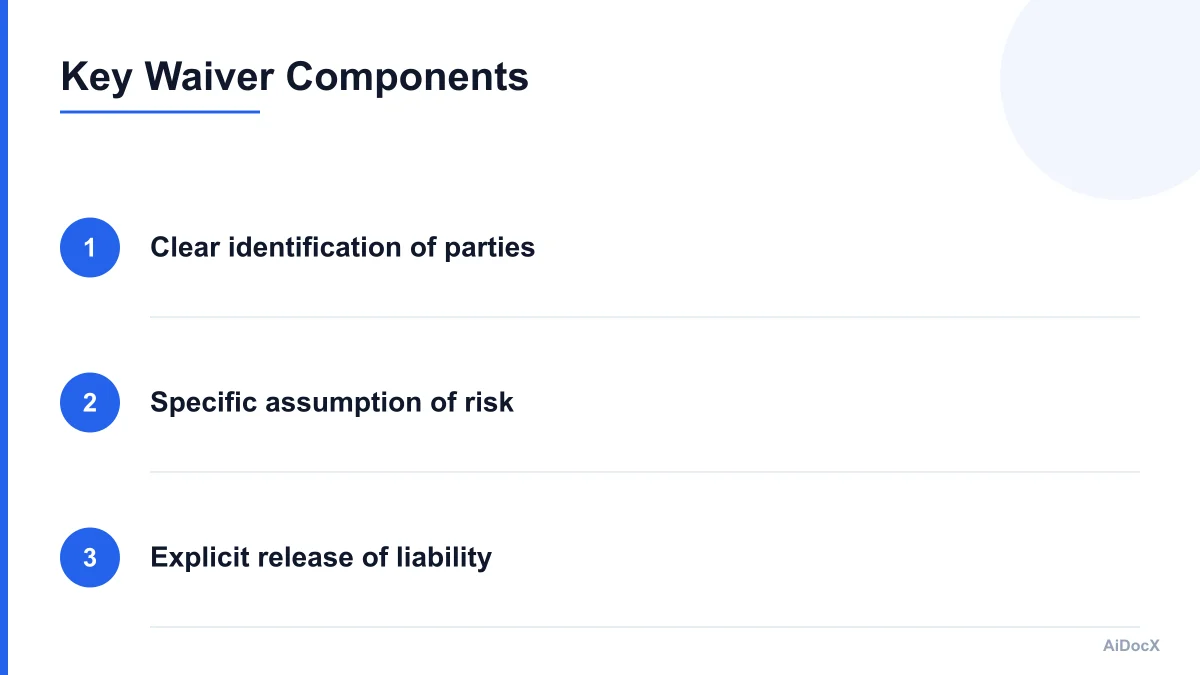
1. Clear Identification of Parties
The document must clearly state who is releasing whom from liability. It should identify your business by its legal name and the participant by their full legal name. This prevents ambiguity about who is bound by the agreement.
2. Specific Description of Risks
Vague language is the enemy of enforceability. Instead of saying "risks involved," list specific risks relevant to your activity. For a yoga studio, this might include "muscle strain, joint injury, or falls." For a rental company, it might include "equipment malfunction, improper assembly, or weather-related hazards." The more specific you are, the stronger your legal position.
3. Explicit Release of Liability
The waiver must explicitly state that the participant is releasing your business, its owners, employees, and agents from liability for injuries, damages, or losses. This should cover both personal injury and property damage.
4. Assumption of Risk
The participant must acknowledge that they are voluntarily participating and fully understand the risks involved. This is known as "assumption of risk." By signing, they confirm they have assessed these risks and chosen to proceed anyway.
5. Indemnification Clause
This clause requires the participant to indemnify (reimburse) your business for any legal costs or damages if a third party sues because of the participant's actions. For example, if a participant injures another customer, this clause helps protect your business from being dragged into that lawsuit.
6. Governing Law and Jurisdiction
Specify which state laws govern the agreement and where any legal disputes must be resolved. This prevents participants from filing lawsuits in jurisdictions that are unfavorable to your business.
7. Signature and Date
A waiver is only valid if it is signed and dated by the participant (or their legal guardian if a minor). The signature serves as proof that the participant read and agreed to the terms.
Common Mistakes That Invalidate Waivers
Even the best-intentioned waivers can be thrown out of court due to common drafting errors. Avoid these pitfalls to ensure your waiver holds up:
- Overly Broad Language: Courts dislike waivers that attempt to release liability for all types of harm, including gross negligence or intentional misconduct. If a waiver tries to cover everything, it may be deemed unconscionable and invalid. Focus on specific, inherent risks.
- Lack of Clarity: If the language is dense, confusing, or hidden in fine print, a court may rule that the participant did not have a meaningful opportunity to understand the terms. Use plain language and clear headings.
- Failure to Obtain Signature: A unsigned waiver is worthless. Ensure that every participant signs before participating. Verbal agreements are difficult to prove in court.
- Applying Waivers to Minors Incorrectly: Minors generally cannot sign binding contracts. A parent or legal guardian must sign on behalf of the minor. Ensure your waiver includes a specific section for guardians to sign for children under 18.
- Outdated Information: Using a template from 2015 may not account for current state laws or digital signature standards. Regularly review and update your waiver to reflect current legal requirements.
How to Implement Digital Waivers Efficiently
In 2026, paper waivers are becoming obsolete. They are prone to loss, damage, and forgery. Digital waivers offer superior security, ease of access, and compliance. Here is how to implement them effectively:
1. Choose a Reliable Digital Signature Platform
Use a platform that complies with the ESIGN Act and UETA (Uniform Electronic Transactions Act). These laws ensure that electronic signatures have the same legal standing as handwritten signatures. Look for platforms that provide audit trails, showing when the document was viewed, signed, and by whom.
2. Integrate Waivers into Your Booking Process
Do not ask participants to sign a waiver separately. Integrate it into your online booking system. When a customer books a class or rents equipment, the waiver should appear as a required step before payment or confirmation. This ensures that no participant starts an activity without a waiver on file.
3. Use Mobile-Friendly Forms
Most customers will sign on their smartphones. Ensure your waiver form is optimized for mobile devices. Large text, clear buttons, and easy navigation are essential for a smooth user experience.
4. Store and Secure Data
Ensure your digital waiver platform stores data securely in compliance with data privacy laws (such as GDPR or CCPA, if applicable). You should be able to retrieve signed waivers quickly in the event of a dispute.
5. Regularly Review and Update
Set a reminder to review your waiver annually. Consult with a legal professional to ensure it still aligns with current laws and your specific business practices.
AiDocX drafts a liability waiver in minutes and collects a signature on the spot from any device, so no participant starts an activity without one on file. This seamless integration reduces friction for your customers while ensuring you are legally protected.
Step-by-Step Guide to Creating Your Waiver
Creating a robust liability waiver does not have to be complicated. Follow these steps to draft a document that protects your business:
- Identify Your Specific Risks: List every possible way a customer could get injured or suffer property damage during your service. Be as specific as possible.
- Draft the Release Language: Write a clear statement releasing your business from liability for these specific risks. Avoid overly broad language.
- Include Assumption of Risk: Clearly state that the participant understands and accepts these risks.
- Add Indemnification: Include a clause requiring the participant to cover your legal costs if they cause harm to others.
- Specify Governing Law: State the state and county where your business is located.
- Create a Signature Section: Include fields for the participant's name, date, and signature. If minors are involved, add a separate section for the parent/guardian.
- Review and Finalize: Have a legal professional review your draft to ensure it is enforceable in your jurisdiction.
- Digitize and Integrate: Upload the waiver to a digital signature platform and integrate it into your booking flow.
Checklist: Is Your Waiver Ready for 2026?
Before you rely on your liability waiver, use this checklist to ensure it is comprehensive and legally sound:
- The waiver clearly identifies your business and the participant.
- Specific risks associated with your activity are listed.
- The release of liability clause is explicit and not overly broad.
- An assumption of risk clause is included.
- An indemnification clause protects you from third-party claims.
- The governing law and jurisdiction are specified.
- There is a section for minors' guardians to sign.
- The waiver is easily accessible and mobile-friendly.
- You have a system in place to store and retrieve signed waivers.
- A legal professional has reviewed the document for your state.
Conclusion
A liability waiver is a vital tool for any small business that involves physical activity, equipment rental, or in-person services. It is not a shield against negligence, but it is a powerful deterrent against frivolous lawsuits and a requirement for many insurance policies. In 2026, the standard for legal protection has shifted towards digital, verifiable, and comprehensive agreements.
By understanding the key elements of a valid waiver, avoiding common mistakes, and implementing digital signature solutions, you can protect your business and focus on what you do best. Do not wait for an incident to occur before addressing your legal protections. Start drafting your waiver today, use tools like AiDocX to streamline the process, and ensure that every customer signs off on their risks before participating. Your peace of mind—and your business's future—depend on it.
Ready to automate your documents with AI?
Start free with AiDocX — AI contract drafting, meeting minutes, consultation notes, e-signatures, and more in one platform.
Get Started FreeMore from AiDocX Blog

Affiliate Agreement Template (2026): Protect Your Business When Paying Commissions
Free affiliate agreement template for 2026: key clauses, FTC disclosure requirements, affiliate vs referral agreement compared, a worked example, and a copy-paste version.
James September 22, 2026 11 min
AI Receipt Generator (2026): Create Professional Payment Receipts in Seconds
Generate professional payment receipts with AI in seconds. Receipt vs invoice vs credit note explained, the fields to include, a worked example, and a copy-paste template.
James September 22, 2026 9 min
Bill of Sale Template (2026): Free Generator for Cars, Trailers & Personal Property
Free bill of sale template for 2026: the fields to include, state notarization rules, federal odometer disclosure, a worked example, and a copy-paste version.
James September 22, 2026 10 min