
Why Most Sales Proposals Get Ignored — 7 Data-Backed Fixes for 2026
80% of proposals never get a response. Learn 7 research-backed strategies to make your proposals stand out, get read, and close deals faster in 2026.
 Anna · Sales Manager February 25, 2026 10 min read
Why Most Sales Proposals Get Ignored — 7 Data-Backed Fixes for 2026
You spent three hours crafting the perfect proposal. You agonized over the pricing table, rewrote the executive summary twice, and triple-checked every number. You hit send. Then... silence. One day passes. Three days. A week. You send a polite follow-up. More silence. Eventually you move on to the next prospect, wondering if they even opened the file.
If this sounds painfully familiar, you are not alone. According to research from RAIN Group, roughly 80% of sales proposals never receive a meaningful response. Gartner estimates that the average B2B buying committee now includes six to ten decision-makers, which means your proposal is competing for attention across a crowd of busy people who are simultaneously evaluating three or four competing offers.
The problem is rarely the quality of your solution. It is usually the proposal itself — how it is structured, when it is sent, and what happens (or does not happen) after it lands in someone's inbox.
Here are seven research-backed fixes that top-performing sales teams are using in 2026 to turn ignored proposals into closed deals.
Why Most Proposals Fail Before They Are Read
Before we get into the fixes, it helps to understand the root causes. After studying proposal engagement data across thousands of documents, a few patterns emerge repeatedly.
They are too long. Decision-makers do not have 45 minutes to read your 30-page masterpiece. They want to understand the key points in under five minutes and then dig deeper only if the initial impression is strong.
They lack personalization. When your proposal reads like a template — because it is one — the recipient can tell immediately. Generic proposals signal that you did not invest the effort to understand their specific situation, so why should they invest the effort to read it?
The timing is wrong. Sending a proposal at 4:55 PM on a Friday is a burial, not a delivery. Your document gets pushed down the inbox over the weekend and forgotten by Monday morning.
There is no visibility after sending. Most sales teams have zero insight into whether a proposal was opened, which pages were read, or whether it was forwarded to other stakeholders. Without document tracking and analytics, follow-ups are blind guesses. You either follow up too soon (annoying) or too late (irrelevant).
Let us fix all of that.
Fix 1: Lead with the Executive Summary, Not the Background
Here is a common mistake: starting your proposal with two pages of company history, your mission statement, and a list of awards your company has won. Nobody reads this. More importantly, it signals that the proposal is about you, not about the prospect's problem.
The first page of your proposal should be an executive summary that answers three questions in plain language:
- What problem are we solving for you specifically?
- What are we recommending?
- What result should you expect?
Research from Forrester shows that proposals that lead with the buyer's problem (rather than the seller's credentials) receive 32% more engagement. Your credentials matter, but they belong later in the document — after you have demonstrated that you understand the prospect's world.
A practical format for your first page: two to three sentences on the prospect's challenge, one paragraph on your recommended approach, and a single sentence on the expected outcome with a concrete metric. If a busy executive reads nothing else, they should walk away understanding the core value proposition.
Fix 2: Keep It Under 8 Pages
There is a persistent myth in sales that longer proposals demonstrate more thoroughness and therefore win more deals. The data says the opposite.
A 2024 analysis by Proposify across more than 1.4 million proposals found that proposals under eight pages had a 2.6 times higher close rate than proposals over 20 pages. Better Proposals reported similar findings: the average winning proposal length was between six and eight pages.
Why? Shorter proposals are more likely to be read in full. They force you to prioritize what actually matters. And they respect the reader's time — which is a form of professionalism that decision-makers notice.
This does not mean stripping out important details. It means being ruthless about what qualifies as important. Technical specifications, detailed implementation timelines, and terms and conditions can go in appendices or linked reference documents. The core proposal should be a concise, persuasive argument for why working together makes sense.
If you currently send 15-page proposals, challenge yourself to get the next one under eight. Cut the company history section. Remove the generic industry overview. Tighten the case studies to one paragraph each. Your close rate will thank you.
Fix 3: Personalize the First Page
Personalization is not just inserting the prospect's company name into a template with merge fields. Real personalization means demonstrating that you have done your homework and understand the prospect's specific situation.
Reference something concrete: a recent earnings call comment, a LinkedIn post from the decision-maker, a specific challenge they mentioned during your discovery call, or a metric from their industry that applies directly to their business. This should appear on the first page — ideally in the first two paragraphs.
According to McKinsey, companies that excel at personalization generate 40% more revenue from those activities than average performers. In the context of proposals, personalization reduces the cognitive distance between "this is a sales document" and "this is relevant to my problem." When a prospect sees their own words and challenges reflected back to them, they lean in rather than tune out.
One effective technique: open with a direct quote from your discovery call. "During our conversation on February 10th, you mentioned that contract review is taking your legal team an average of four hours per agreement..." This immediately anchors the proposal in the prospect's reality rather than your sales pitch.
Fix 4: Send on Tuesday Through Thursday, Before 11 AM
Timing matters more than most salespeople realize. Your proposal's chance of being read depends heavily on when it arrives.
Data from HubSpot's analysis of millions of sales emails shows that Tuesday through Thursday mornings — specifically between 8 AM and 11 AM in the recipient's local time zone — are the highest-engagement windows for business documents. Monday mornings are dominated by inbox triage from the weekend. Friday afternoons are mental checkout time. Proposals sent during these low-attention windows are disproportionately likely to be buried and forgotten.
GetAccept's research on proposal engagement corroborates this, showing that proposals opened within the first hour of receipt have a 3.4 times higher close rate than proposals that sit unopened for more than 24 hours. The implication: you want your proposal to arrive when the recipient is most likely to open it immediately.
If your discovery call ends on a Monday, resist the urge to send the proposal that same evening. Take the time to refine it and send it Tuesday morning. Those extra 12 hours of polish, combined with better timing, will outperform a rushed Monday night delivery almost every time.
Fix 5: Track When They Open It
This is where most sales teams have a massive blind spot. You would never run a marketing campaign without tracking open rates and click-through rates. Yet the majority of salespeople send their most important documents — the proposals that directly determine revenue — with zero visibility into what happens next.
Document tracking tools solve this by giving you real-time data on when your proposal is opened, how long the recipient spends on each page, and whether the document is forwarded to other people. This is not theoretical. It is operational intelligence that changes how and when you follow up.
Several platforms offer this capability. DocSend has been a popular choice for investor decks and sales collateral, providing per-page analytics and link-level controls. PandaDoc combines proposal creation with built-in tracking and e-signature workflows. AiDocX offers document tracking with page-level analytics and real-time open notifications — with a free tier that includes two tracked links, which is enough to test the approach on your next couple of proposals.
The specific tool matters less than the practice. If you are currently sending proposals as email attachments with no tracking, switching to any tracked-link solution will give you a significant informational advantage over competitors who are still operating blind.
One underrated benefit of tracking: it reveals which pages prospects spend the most time on. If every prospect lingers on your pricing page and skips your case studies, that tells you something important about where their concerns lie. Over time, this data helps you build better proposals — not just follow up more effectively on current ones.
Fix 6: Follow Up Within 24 Hours of the First View
The single biggest factor in proposal-to-deal conversion is not the proposal itself. It is what happens after the prospect engages with it. Gong.io's research found that following up within one hour of a prospect engaging with your content makes you seven times more likely to have a meaningful conversation than waiting 24 hours. Even within a same-day window, faster follow-up correlates strongly with higher win rates.
The challenge, of course, is knowing when that engagement happens. This is where document tracking moves from nice-to-have to essential. When you receive a notification that your prospect just opened your proposal at 2:15 PM and spent three minutes on the pricing page, you have a narrow window of high relevance. A well-timed follow-up at that moment — "Hi Sarah, I wanted to check if you had any questions about the pricing structure" — feels helpful rather than pushy because the proposal is literally on their screen or fresh in their mind.
Most tracking tools, including DocSend and AiDocX, send real-time email or push notifications when documents are opened. Some integrate with Slack or CRM systems so the alert goes directly to where your sales team already works. The key is setting up these notifications and actually acting on them — not letting them pile up unread in a separate inbox.
Without tracking, your follow-up timing is essentially random. You pick an arbitrary number of days to wait and send a generic check-in. With tracking, your follow-up is precise, contextual, and timed to the moment of maximum interest. This is one of the highest-leverage changes a sales team can make, and it requires almost no additional effort once the tooling is in place.
Fix 7: Put Social Proof on Page 2
If your executive summary on page one does its job, the prospect's next thought is: "Can they actually deliver on this?" Page two is where you answer that question with evidence.
Social proof — case studies, testimonials, client logos, and measurable results — is the most persuasive element in any B2B proposal. Research from Edelman's Trust Barometer consistently shows that peer recommendations and demonstrated results outweigh marketing claims by a wide margin. Yet many proposals bury their case studies on page eight or ten, well past the point where most readers have stopped paying close attention.
Move your strongest proof to page two. Choose one or two case studies that are directly relevant to the prospect's industry or challenge. Keep each one to a single paragraph with a concrete outcome: "We helped [Company] reduce contract review time from four hours to 25 minutes, saving their legal team 120 hours per quarter." Specific numbers are more credible than vague claims.
If you have recognizable client logos, include three to five on page two as well. Logo bars create an instant credibility signal that requires no reading effort. The prospect sees familiar names and subconsciously registers that you are a proven vendor.
The goal is to build enough confidence by the end of page two that the reader is motivated to continue through the rest of the proposal. If they stop reading after two pages, they should still walk away with a positive impression.
When to Follow Up: The Optimal Timing Window
Even with the best proposal and tracking data, you still need a follow-up cadence for prospects who do not respond after the initial view. Here is what the data suggests:
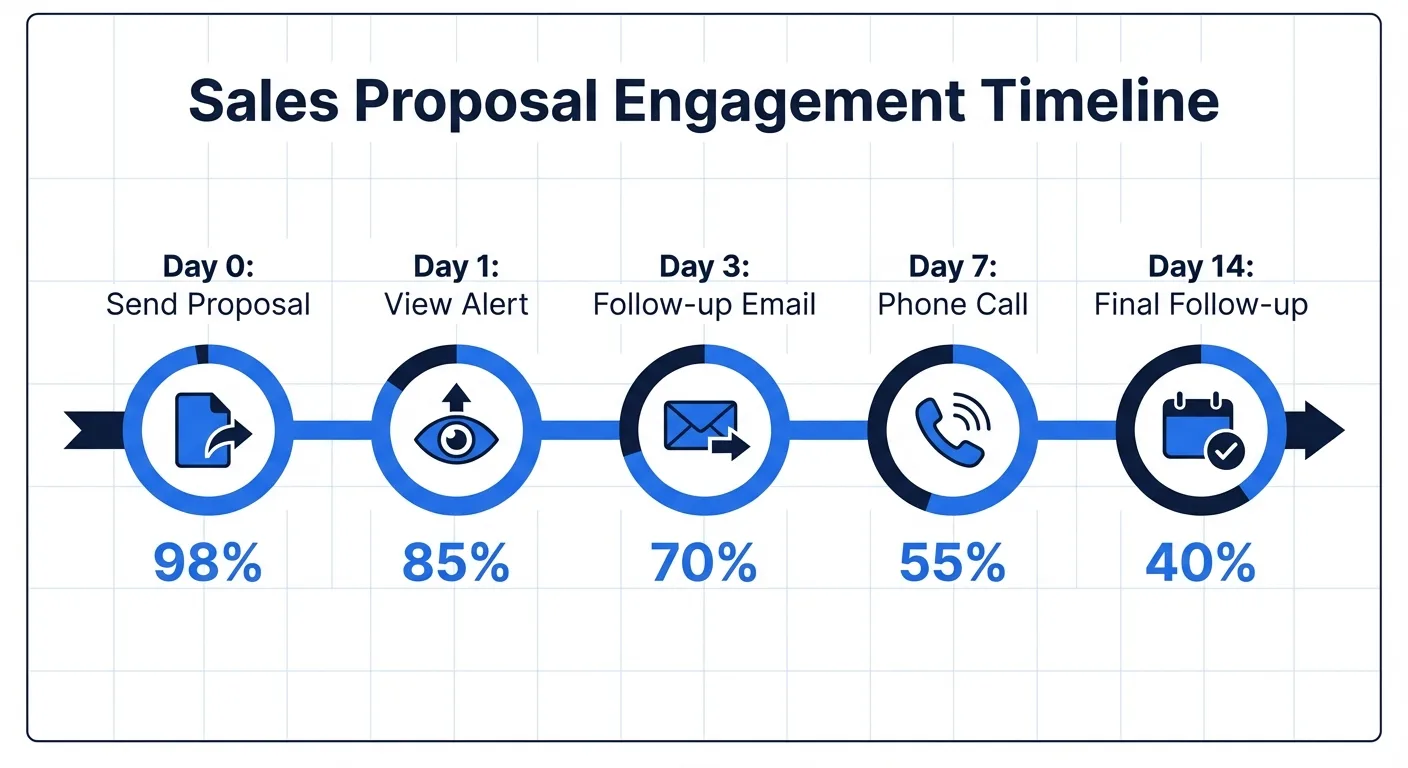
First follow-up: 24 hours after the first open. As discussed above, this should be contextual and specific. Reference what they might have seen (without being creepy about it): "I wanted to follow up on the proposal and see if the pricing model works for your budget timeline."
Second follow-up: 3 to 4 days after the first. If you have not heard back, send a brief note that adds new value — a relevant case study, an industry benchmark, or an answer to a common objection. Do not just repeat "checking in."
Third follow-up: 7 to 10 days after the first. This is your final active follow-up. Acknowledge that timing may not be right and offer a specific alternative: "If this quarter does not work for budget reasons, I am happy to reconnect in Q3. Would it be helpful if I sent over our updated ROI calculator in the meantime?"
After the third follow-up: Move to a nurture sequence. Add the prospect to a monthly or quarterly touchpoint list rather than continuing direct follow-ups. Some deals take six months to close. Staying visible without being pushy is the long game.
Across all follow-ups, brevity wins. Keep follow-up emails under 100 words. Busy executives scan; they do not read. A three-sentence follow-up with a clear call to action will always outperform a five-paragraph email rehashing the proposal.
Putting It All Together
None of these seven fixes are individually revolutionary. Lead with the executive summary. Keep it short. Personalize the opener. Time the delivery. Track engagement. Follow up with precision. Prove your credibility early.
But applied together, they represent a fundamentally different approach to the proposal process — one driven by data, empathy for the reader's time, and strategic timing rather than hope and guesswork.
If you want to start implementing these changes today, begin with the lowest-effort, highest-impact fix: tracking. Simply switching from blind email attachments to tracked document links gives you visibility that most of your competitors lack. Tools like AiDocX offer free document tracking for up to two links — enough to test the approach on your next two proposals and see the difference real-time engagement data makes in your follow-up game.
The proposals you send this week will either be read or ignored. These seven fixes tilt the odds heavily in your favor.
Ready to automate your documents with AI?
Start free with AiDocX — AI contract drafting, meeting minutes, consultation notes, e-signatures, and more in one platform.
Get Started FreeMore from AiDocX Blog
AI Addiction Counseling Notes: Templates & Automation Guide for 2026
Complete guide for addiction counselors on writing MI session records, relapse prevention plans, and CBT notes — with AI automation tips and HIPAA 42 CFR Part 2 compliance.
 SophieKim March 13, 2026 13 min
AI Counseling Notes Guide (2026): Free Templates + Auto-Generate in Minutes
Complete guide to writing counseling notes in 2026. Includes copy-paste templates for psychology, legal, sales, and general counseling, plus how to auto-generate structured records with AI.
SophieKim March 13, 2026 12 min
AI Domestic Violence Counseling Notes (2026): Templates + Safety Guide for DV Advocates
Complete guide to domestic violence counseling documentation in 2026. Includes intake records, danger assessment checklists, safety plan templates, and how to automate records with AI while protecting victim privacy.
SophieKim March 13, 2026 13 min