Board Meeting Minutes Template 2026: Startup Guide
Master board meeting minutes for 2026. Learn what startups must document to stay investor- and lawyer-ready, with a free template and best practices.
 James · Content Manager August 3, 2026 14 min read
Board Meeting Minutes Template 2026: What Startups Must Document to Stay Investor- and Lawyer-Ready
Running a board meeting is no longer just a formality; it is a critical governance event that shapes the trajectory of your startup. For founders who have recently closed a seed round, the expectations from investors and legal counsel have shifted significantly. The days of vague, handwritten notes or chaotic Slack threads as the official record are over. In 2026, precision, clarity, and legal defensibility are the new standards for board documentation.
Investors view your minutes as a proxy for operational maturity. Lawyers scrutinize them for liability exposure and compliance adherence. If your board records are disorganized, it raises red flags during due diligence, potentially delaying fundraising or even jeopardizing valuation. This guide provides a comprehensive framework for creating board meeting minutes that satisfy both strategic stakeholders and legal requirements. You will learn what to document, how to structure it, and why automated tools can save you from the nightmare of reconstructing decisions months later.
Why Standard Note-Taking Fails in Seed Rounds
Many founders make the mistake of treating board meetings as informal check-ins rather than formal governance sessions. They rely on personal memory, casual voice memos, or fragmented chat logs to capture what happened. While this might work for early-stage brainstorming, it falls apart under the scrutiny of institutional investors and legal auditors.
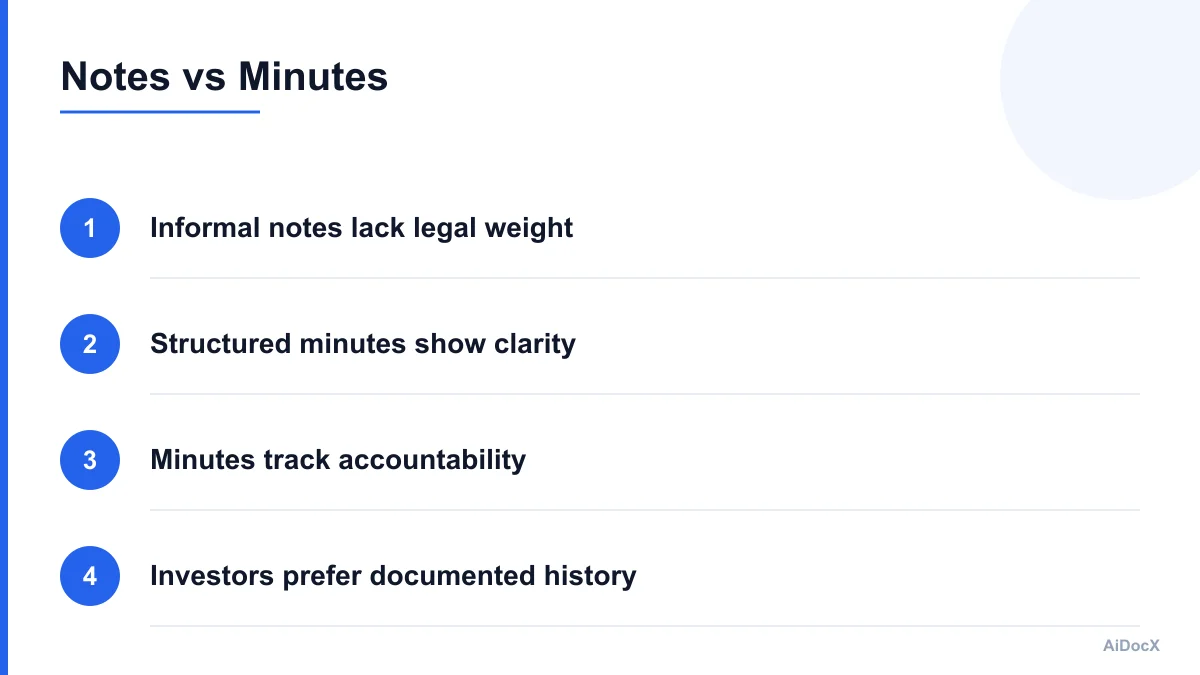
The primary issue with informal note-taking is ambiguity. A statement like "We discussed the need for a new CFO" is not actionable. Who was assigned this task? By when? What was the budget approved for the search? Without specific details, the "discussion" disappears into the ether. This lack of clarity creates a governance gap where responsibilities are unclear, and decisions are unenforceable.
Furthermore, informal notes often lack the formal structure required for legal protection. Board minutes serve as a legal record of the company’s actions. If a dispute arises between shareholders or if regulators question a strategic decision, well-documented minutes provide evidence that the board acted in good faith and within its fiduciary duties. Poorly documented meetings offer no such shield.
Investors also use minutes to assess the health of the board relationship. If they see that decisions are constantly revisited because they were never clearly recorded, they perceive a lack of leadership discipline. Consistent, high-quality minutes signal that the founder respects the board’s role and values structured decision-making. This builds trust and reduces the perceived risk of investment.
Finally, the volume of information in a seed-stage startup can be overwhelming. Founders are juggling product development, hiring, and fundraising. Relying on memory to capture every nuance of a two-hour board meeting is unrealistic. Without a standardized system, critical details are lost, leading to misalignment between the board and the executive team. This is where moving from informal notes to structured documentation becomes not just a best practice, but a necessity for survival and growth.
The Essential Structure of 2026 Minutes
Creating effective board minutes does not require a law degree, but it does require a consistent and comprehensive structure. In 2026, the standard template has evolved to include digital elements and explicit action tracking. The goal is to create a document that is easy to read, legally robust, and actionable.
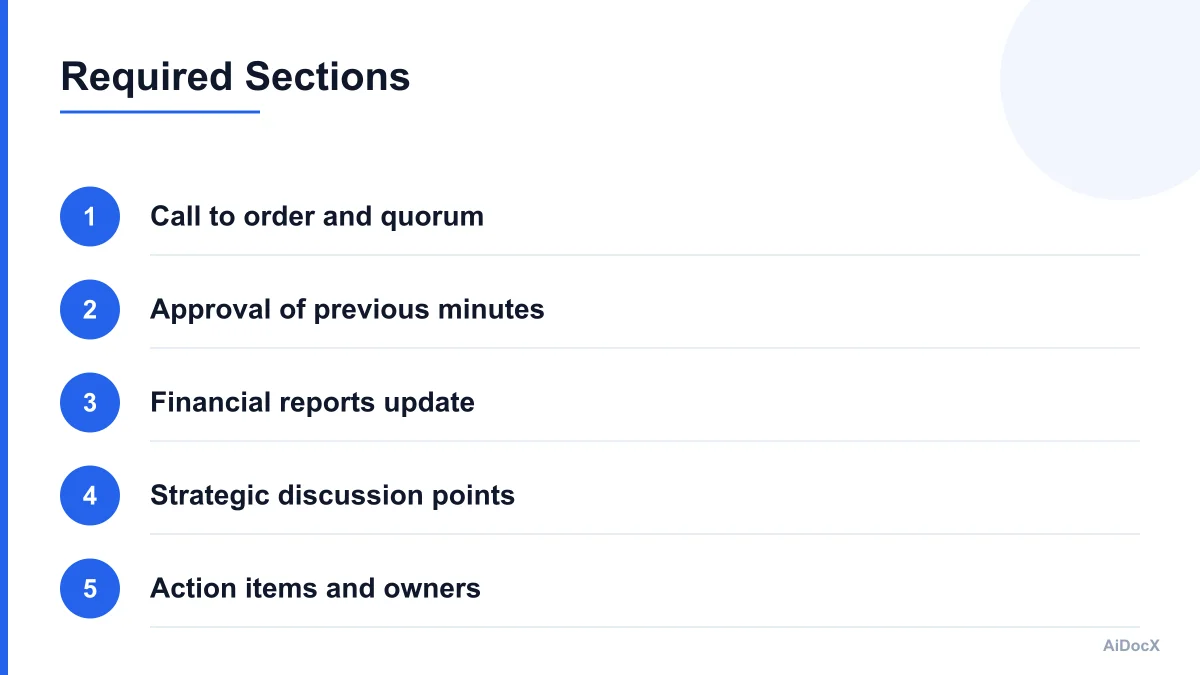
A robust minutes template should include the following core components:
1. Header Information This section establishes the context of the meeting. It must include:
- Company Name
- Type of Meeting (Regular, Special, Virtual, In-Person)
- Date and Time (including time zone)
- Location (or virtual platform link)
- Attendees (Board members, Executive team, Guests)
- Absentees (Board members who did not attend)
- Chairperson and Secretary (if applicable)
2. Call to Order and Quorum Document the exact time the meeting started and confirm that a quorum was present. This is a critical legal formality. If a quorum is not established, any decisions made may be invalid.
3. Approval of Previous Minutes Record whether the minutes from the previous meeting were approved as presented or with corrections. If corrections were made, note the specific changes. This creates a continuous chain of documentation.
4. Officer and Committee Reports Summarize the reports presented by the CEO, CFO, and any committee chairs. Do not transcribe every word. Instead, highlight key metrics, significant achievements, and critical issues raised. For example, instead of listing every line item in the budget, summarize the variance from the forecast and the reason for it.
5. Discussion and Resolutions This is the most important section. For each agenda item, document:
- The topic discussed
- Key points of debate (summarized neutrally)
- The final decision or resolution
- Voting results (if applicable)
Avoid recording personal opinions or emotional reactions. Focus on the factual outcome of the discussion. Use clear, active language. Instead of "It was decided that we would hire," use "The Board approved the hiring of [Name] as [Title]."
6. Action Items List every action item resulting from the meeting. Each item must include:
- Description of the task
- Responsible person
- Deadline
- Status (Open, In Progress, Closed)
This section transforms the meeting from a discussion into execution. It holds the executive team accountable and allows the board to track progress in subsequent meetings.
7. Adjournment Record the time the meeting ended and the date and time of the next scheduled meeting.
8. Signature Block Include a space for the Chairperson and Secretary (or designated officer) to sign and date the minutes. This formalizes the document and confirms its accuracy.
By adhering to this structure, you create a document that is both informative and legally sound. It provides a clear history of your company’s governance and ensures that all stakeholders are aligned on decisions and responsibilities.
Common Mistakes Founders Make When Documenting
Even with a good template, founders often fall into traps that undermine the value of their minutes. Understanding these common pitfalls is essential for maintaining high standards.
Over-Transcribing One of the most frequent errors is attempting to record every word spoken. Minutes are not a transcript. Transcripts are lengthy, difficult to read, and often irrelevant. Minutes should be a concise summary of the key points and decisions. If you find yourself writing paragraphs of dialogue, you are likely including too much detail. Focus on the "what" and the "why," not the "how it was said."
Vague Action Items Phrases like "Management will review the budget" are useless. Who is management? When will it be reviewed? What is the outcome? Vague action items lead to confusion and inaction. Always assign specific responsibilities to specific individuals with clear deadlines.
Delaying Distribution Minutes should be distributed to all board members within a week of the meeting. Delaying distribution allows memories to fade and creates opportunities for misinterpretation. Quick distribution ensures that all stakeholders are on the same page and can provide feedback while the discussion is still fresh.
Ignoring Dissenting Views If a board member votes against a resolution or raises a significant objection, it must be recorded. Omitting dissenting views can create legal liabilities, especially if the decision later proves detrimental. Documenting dissent shows that the board considered all perspectives and that the decision was made with full knowledge of the risks.
Inconsistent Formatting Using different templates for each meeting makes it difficult to track trends and historical data. Consistency in formatting helps board members quickly find the information they need. Use a standard template for every meeting, and stick to it.
Neglecting Confidentiality Board minutes often contain sensitive information, such as financial data, strategic plans, and personnel issues. Ensure that minutes are stored securely and that access is restricted to authorized individuals. Use encrypted storage and limit distribution to those who need to know.
By avoiding these common mistakes, you can ensure that your minutes are accurate, useful, and legally defensible. This not only protects the company but also enhances the effectiveness of the board.
How to Capture Decisions Accurately
Capturing decisions accurately requires a proactive approach. It is not enough to wait until the end of the meeting to summarize what happened. Effective minute-taking begins before the meeting and continues after.
Pre-Meeting Preparation Send the agenda and supporting documents to board members well in advance. This allows them to review the material and prepare their questions. When the meeting begins, the discussion will be more focused, making it easier to capture decisions.
During the Meeting Assign a dedicated minute-taker. This person should not participate actively in the discussion but should focus on recording the key points. Use a template to ensure consistency. If a decision is made, pause the conversation briefly to confirm the details. Ask clarifying questions if necessary. For example, "Just to confirm, the Board approves hiring Jane Doe as CFO with a salary of $X, effective immediately?"
Post-Meeting Review Draft the minutes as soon as possible after the meeting, ideally within 24-48 hours. Review the notes for accuracy and completeness. Send the draft to the Chairperson or a designated board member for review. Incorporate any feedback or corrections. Once finalized, distribute the minutes to all attendees and store them in the company’s secure document repository.
Use Technology to Assist While manual note-taking is possible, technology can significantly improve accuracy and efficiency. Tools like AiDocX turn a recorded board meeting straight into a structured minutes document, so founders never scramble to reconstruct decisions during due diligence. These tools can transcribe the meeting, identify key decisions, and extract action items automatically. This reduces the burden on the founder and ensures that no detail is missed.
By following these steps, you can ensure that your minutes accurately reflect the decisions made by the board. This provides a clear and reliable record of your company’s governance.
Legal and Compliance Considerations for 2026
In 2026, the legal and compliance landscape for startups is more complex than ever. Data privacy laws, environmental, social, and governance (ESG) reporting requirements, and international regulations all impact how board minutes should be documented.
Data Privacy With regulations like GDPR and CCPA, you must be careful about what personal data is included in board minutes. Avoid including sensitive personal information about employees or customers unless it is strictly necessary. If such information is included, ensure it is stored securely and that access is restricted.
ESG Reporting Many investors now require ESG reporting. If your board discusses ESG initiatives, ensure that these discussions are clearly documented. This includes decisions related to sustainability goals, diversity initiatives, and community engagement. Accurate documentation of ESG efforts can enhance your company’s reputation and attract socially responsible investors.
International Regulations If your startup operates in multiple jurisdictions, you must comply with the laws of each country. This may affect how you document certain decisions, such as those related to data transfer, labor laws, or tax compliance. Consult with legal counsel to ensure that your minutes meet all relevant regulatory requirements.
Fiduciary Duties Board members have fiduciary duties of care and loyalty. Minutes can be used as evidence to demonstrate that these duties were fulfilled. By documenting the process of decision-making, including the information considered and the alternatives evaluated, you can protect both the company and the board members from legal claims.
Record Retention Maintain a clear record retention policy. Determine how long board minutes should be kept and how they should be stored. Typically, minutes should be kept indefinitely, as they provide a historical record of the company’s governance. Ensure that your storage system is secure and accessible for future reference.
By staying informed about legal and compliance requirements, you can ensure that your board minutes are not only useful but also legally sound. This protects your company and builds trust with investors and stakeholders.
The Role of Automation in Modern Governance
Automation is transforming how startups manage board governance. While human oversight remains essential, technology can handle the tedious aspects of minute-taking, allowing founders to focus on strategy.
Transcription and Summarization AI-powered tools can transcribe board meetings in real-time and generate summaries of key points. This reduces the time spent on note-taking and ensures that nothing is missed. Advanced AI can also identify action items and decisions, making it easier to draft the minutes.
Template Automation Automation can fill in the standard parts of the minutes template, such as the header information and call to order. This ensures consistency and reduces the risk of errors. Founders can then focus on customizing the content for each meeting.
Version Control and Storage Automated systems provide version control and secure storage for board minutes. This makes it easy to track changes and retrieve historical documents. It also ensures that minutes are backed up and protected from loss or damage.
Integration with Other Tools Many governance platforms integrate with other tools, such as calendar apps, project management software, and financial systems. This allows for seamless data flow and reduces the need for manual entry. For example, action items from board minutes can be automatically added to a project management tool.
Enhanced Security Automated platforms often offer advanced security features, such as encryption, multi-factor authentication, and access controls. This ensures that sensitive board information is protected from unauthorized access.
By leveraging automation, startups can improve the efficiency and accuracy of their board governance. This not only saves time but also reduces the risk of errors and omissions. As technology continues to evolve, the role of automation in governance will only grow, making it an essential tool for modern startups.
Preparing for Due Diligence and Investor Audits
When you raise a Series A or B round, investors will conduct due diligence on your company. This includes a review of your board minutes. How you handle this process can impact the outcome of the fundraising.
Organize Your Records Before starting the fundraising process, organize your board minutes in a clear and accessible manner. Use a digital repository that allows for easy searching and filtering. Group minutes by date and type of meeting. Ensure that all documents are up-to-date and complete.
Review for Consistency Review your minutes for consistency in formatting and content. Ensure that all action items have been followed up on and that decisions are clearly documented. If there are any gaps or inconsistencies, address them before the due diligence begins.
Anticipate Questions Investors will likely ask questions about specific decisions made by the board. Be prepared to explain the rationale behind these decisions. Use your minutes as a reference to provide accurate and detailed responses. If you cannot find the information in the minutes, it may raise concerns about your governance practices.
Highlight Strengths Use your minutes to highlight the strengths of your governance. For example, if your board has a strong track record of strategic planning and risk management, point this out. Provide examples of how the board has added value to the company.
Be Transparent If there are any issues or controversies in your board history, be transparent. Do not try to hide them. Instead, explain how they were resolved and what steps were taken to prevent them from recurring. Investors appreciate honesty and a willingness to learn from mistakes.
By preparing your board minutes for due diligence, you demonstrate that your company is well-governed and transparent. This builds trust with investors and can facilitate a smoother fundraising process.
Action Checklist for Founders
To ensure that your board meeting minutes are investor- and lawyer-ready, follow this checklist before every meeting:
- Send agenda and supporting documents to board members at least 5 days in advance.
- Confirm that a quorum is present at the start of the meeting.
- Assign a dedicated minute-taker who is not actively participating in the discussion.
- Use a standardized template for all board meetings.
- Record all key decisions, including the rationale and voting results.
- Document specific action items with assigned owners and deadlines.
- Note any dissenting views or objections raised by board members.
- Distribute draft minutes to the Chairperson for review within 48 hours.
- Finalize and distribute minutes to all attendees within one week.
- Store finalized minutes in a secure, encrypted document repository.
- Review minutes for compliance with data privacy and ESG regulations.
- Track action items in a project management tool to ensure follow-up.
Conclusion
Board meeting minutes are more than just a record of what was said; they are a critical tool for governance, accountability, and legal protection. For startups in 2026, the expectations for documentation are higher than ever. Investors and lawyers look for clarity, consistency, and completeness in board records. By following the structure and best practices outlined in this guide, you can create minutes that satisfy these requirements and enhance the effectiveness of your board.
Remember, the goal is not to create a perfect document, but to create a useful one. Focus on capturing decisions and action items accurately, and use technology to streamline the process. Tools like AiDocX can help you turn a recorded board meeting straight into a structured minutes document, so founders never scramble to reconstruct decisions during due diligence. This allows you to focus on what matters most: building your company.
Start implementing these practices today. Your future self, and your investors, will thank you.
Ready to automate your documents with AI?
Start free with AiDocX — AI contract drafting, meeting minutes, consultation notes, e-signatures, and more in one platform.
Get Started FreeMore from AiDocX Blog

AI Press Release Generator: Write One in Minutes (+ Template)
Learn what a press release is, the AP-style format, and how to use an AI press release generator to draft one in minutes with a fill-in template.
James September 21, 2026 10 min
Angel Investment Agreement (2026): Key Terms + Template Guide
Angel investor agreement explained: the four structures founders actually sign, key terms, securities basics, a closing checklist and a summary term sheet.
James September 21, 2026 12 min
Artist Commission Contract Template (2026): Free Template + Guide
Free artist commission contract template with license tiers, deposit, revision, refund and AI-training clauses, plus a guide to getting it e-signed.
James September 21, 2026 12 min