Free Construction Contract Template: What to Include in 2026
Create a free construction contract template with clear scope, payment terms, change orders, timelines, warranties, and practical tips for safer projects.
 James · Content Manager August 21, 2026 14 min read
Free Construction Contract Template: What to Include in 2026
A construction contract turns a project conversation into a shared understanding of the work, price, schedule, and responsibilities. For small general contractors, renovation businesses, and subcontractors, a clear agreement can prevent payment disputes and confusion before they become expensive. This guide explains what a free construction contract template should include, which mistakes to avoid, and how to customize one quickly for your next project.
Why You Need a Written Construction Contract
Many construction projects begin with a quote, a few text messages, and a handshake. That may feel efficient when the job is small and the client seems trustworthy. Problems usually appear later, when someone remembers the agreement differently.
A written contract gives both parties a reference point. It answers practical questions such as:
- What exactly will be built, repaired, installed, or removed?
- Which materials are included in the price?
- When will work start and finish?
- How much is due upfront, and when are progress payments due?
- What happens if the client requests additional work?
- Who is responsible for permits, inspections, utilities, cleanup, and access?
- What happens when weather, delayed materials, or hidden damage affects the schedule?
- How will defects or warranty claims be handled?
A contract is not only protection for the contractor. It also helps the customer understand what they are buying. A homeowner is less likely to assume that painting, demolition, disposal, permits, or final cleaning are included if those items are clearly addressed.
For subcontractors, the agreement is especially important because payment often depends on another party's schedule and interpretation of the prime contract. A subcontract should identify the assigned work, approved materials, deadlines, payment process, insurance requirements, and the relationship with the general contractor.
The best contract is not necessarily the longest one. It is the one that describes the project clearly enough that a reasonable person can determine whether a request is included, extra, delayed, or outside the agreement.
What a Construction Contract Must Include
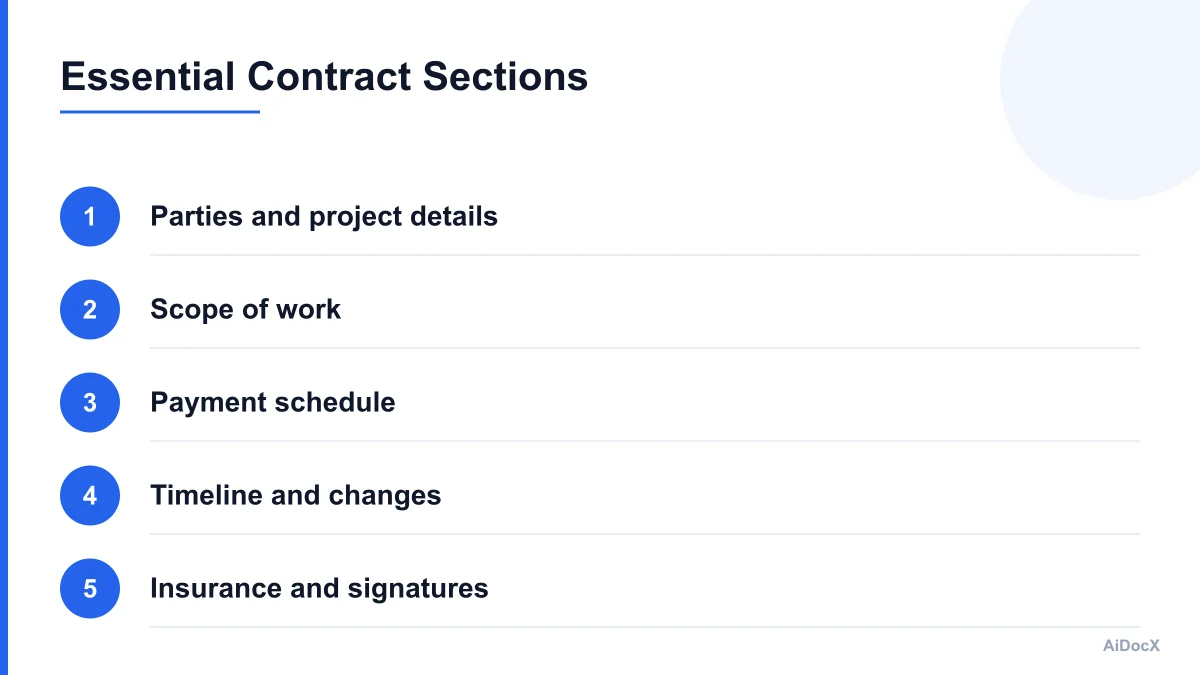
A free construction contract template should provide a reliable structure, but you still need to adapt it to the project and local requirements. At a minimum, include the following sections.
1. The parties and project details
Start with the legal names and contact information of everyone signing. Use a business's registered name when possible, not only a trade name or an employee's name.
Include:
- Contractor or construction company name
- Client or property owner name
- Subcontractor name, if applicable
- Business addresses, phone numbers, and email addresses
- Project address
- Description of the property or work area
- Contract date
- Expected start date and estimated completion date
If the client is a company, identify the person authorized to sign. If more than one owner controls the property, confirm whether all required owners must sign.
Be precise about the project address. "The Smith kitchen remodel" is less useful than "Kitchen renovation at 125 Oak Street, Unit 3B, including cabinets, flooring, and electrical work described in Exhibit A."
2. Scope of work and exclusions
The scope is the core of the contract. It should describe what the contractor will do and, just as importantly, what the contractor will not do.
Avoid broad wording such as "complete renovation" or "all work necessary." Instead, break the work into observable tasks. For example:
- Remove existing upper and lower kitchen cabinets
- Protect adjacent flooring and furniture during demolition
- Install client-selected cabinets from the approved supplier
- Install quartz countertop according to the approved layout
- Paint walls with two coats of the specified color
- Install six recessed lights using existing circuits
- Remove construction debris at the end of each work phase
List exclusions separately. Common exclusions include:
- Structural engineering
- Asbestos, lead, mold, or other hazardous-material remediation
- Repair of concealed damage
- Utility upgrades
- Permit fees
- Appliances
- Landscaping or exterior restoration
- Work outside the listed rooms or areas
- Touch-up work caused by other contractors
Attach drawings, specifications, material schedules, allowances, or estimates as exhibits. If a quote or proposal is part of the agreement, state that clearly and identify which document controls if there is a conflict.
A useful scope test is this: could another contractor read the description and price the same work? If not, add measurements, quantities, brands, model numbers, finish standards, or installation methods.
3. Materials, allowances, and client selections
Construction disputes often start with materials. A client may assume a fixture, tile, countertop, or appliance is included because it appears in a picture or conversation. The contract should explain who chooses, buys, delivers, stores, and installs materials.
For each significant material, identify:
- Product or material type
- Brand, model, grade, color, or finish
- Quantity or estimated quantity
- Whether the contractor or client supplies it
- Expected delivery date
- Who bears the risk of damage before installation
- What happens if the product is discontinued or unavailable
Use allowances when the final selection is not known. An allowance is a stated budget for an item, such as a $2,000 plumbing-fixture allowance. Explain what happens when the actual cost is higher or lower.
Example:
"Client receives a $2,000 allowance for plumbing fixtures. The contract price will increase or decrease by the difference between the allowance and the contractor's documented purchase cost, plus the markup stated in Section 7."
Do not hide the markup. If the contractor adds a handling or procurement fee, state the percentage or fixed amount. If the client supplies materials, specify whether the contractor is responsible for defects, missing parts, incorrect measurements, or delays caused by those materials.
4. Price and payment schedule
State the contract price in numbers and words where practical. Identify whether the price is fixed, time-and-materials, cost-plus, or a combination.
For a fixed-price project, list:
- Base contract amount
- Taxes, permit fees, and allowances
- Approved alternates
- Optional work
- Credits
- Total estimated or guaranteed price
Then define when payment is due. A simple schedule might include:
- Deposit due at signing
- Progress payment after demolition
- Progress payment after rough-in inspection
- Progress payment after substantial completion
- Final payment after agreed punch-list items are complete
Avoid writing only "payment due upon completion." Completion can be disputed, and the contractor may carry costs for months. Use objective milestones and specific due dates or time periods.
Also address:
- Accepted payment methods
- Late-payment charges, if permitted by applicable law
- Returned-payment fees
- Whether payment is conditional on inspection or approval
- Right to suspend work after notice of nonpayment
- Whether retainage applies
- Final payment procedure
Do not include a payment term that conflicts with local laws or an existing prime contract. Public and commercial projects may have special payment rules, notice requirements, or retainage limits. Have a local attorney review the clause if the project is significant.
5. Schedule, delays, and access
Give the project an estimated start and completion date, but explain what can change those dates. Construction schedules depend on material availability, inspections, weather, client decisions, site access, and work by other contractors.
The contract should cover:
- Expected mobilization date
- Estimated duration
- Working hours
- Client access obligations
- Inspection and approval timing
- Material-selection deadlines
- Delays caused by the client
- Delays caused by other trades
- Weather and events outside the contractor's control
- Procedure for updating the schedule
A practical clause might require the client to make selections within five business days after a written request. If the client misses the deadline, the contractor may adjust the schedule and document resulting costs.
Do not promise an exact completion date unless you control the relevant dependencies. "Substantial completion is expected by June 30, subject to approved changes, material delays, inspections, weather, and other events outside the contractor's reasonable control" is more accurate than an unconditional promise.
Define substantial completion. It usually means the work is usable for its intended purpose, even if minor punch-list items remain. Without that definition, the client may withhold the entire final payment over small unfinished items.
6. Change orders and additional work
Every project needs a change-order process. Clients change their minds, hidden conditions appear, and materials become unavailable. A written change order prevents a casual request from becoming an argument about price and schedule.
A change-order form should state:
- Description of the requested change
- Reason for the change
- Added or deducted cost
- Effect on the completion date
- Materials and labor affected
- Approval signatures or electronic acceptance
- Date the change becomes effective
Explain whether the contractor may proceed before the change order is signed in an emergency. Otherwise, write that additional work is not authorized until the parties approve it in writing.
A text message can sometimes document approval, but a standard form is easier to track. If you accept electronic approvals, identify the approved method, such as email confirmation, a client portal, or an electronic signature.
Use a separate procedure for concealed conditions. For example, removing drywall may reveal damaged framing or outdated wiring. The contract can require the contractor to stop the affected work, photograph the condition, provide a price and schedule adjustment, and wait for written authorization unless immediate action is needed to protect people or property.
Do not use change orders to correct work that was already included in the original scope. If the contract says "install trim throughout the house," charging extra for ordinary trim installation may damage trust and create a dispute.
7. Responsibilities, insurance, and risk
Clearly assign responsibilities instead of assuming that industry custom will fill the gaps.
The contract may address:
- Who obtains permits
- Who schedules inspections
- Who provides temporary power, water, lighting, or toilets
- Who protects existing finishes
- Who moves furniture or personal property
- Who provides site security
- Who handles daily cleanup and final disposal
- Who coordinates other contractors
- Who is responsible for damage caused by each party
- Whether workers are employees or independent subcontractors
State the contractor's insurance coverage accurately. Common policies include general liability and workers' compensation, but coverage varies by business and jurisdiction. Never promise insurance protection that does not exist.
For subcontractors, include license information, certificates of insurance, safety obligations, required notices, lien-waiver procedures, and the relationship between the subcontract and the prime contract. Avoid accepting broad obligations from a general contractor without understanding what the prime contract requires.
Indemnity, limitation-of-liability, dispute-resolution, and attorney-fee clauses can have significant legal effects. Use jurisdiction-appropriate language and obtain professional advice before copying aggressive provisions from an online form.
Common Construction Contract Pitfalls
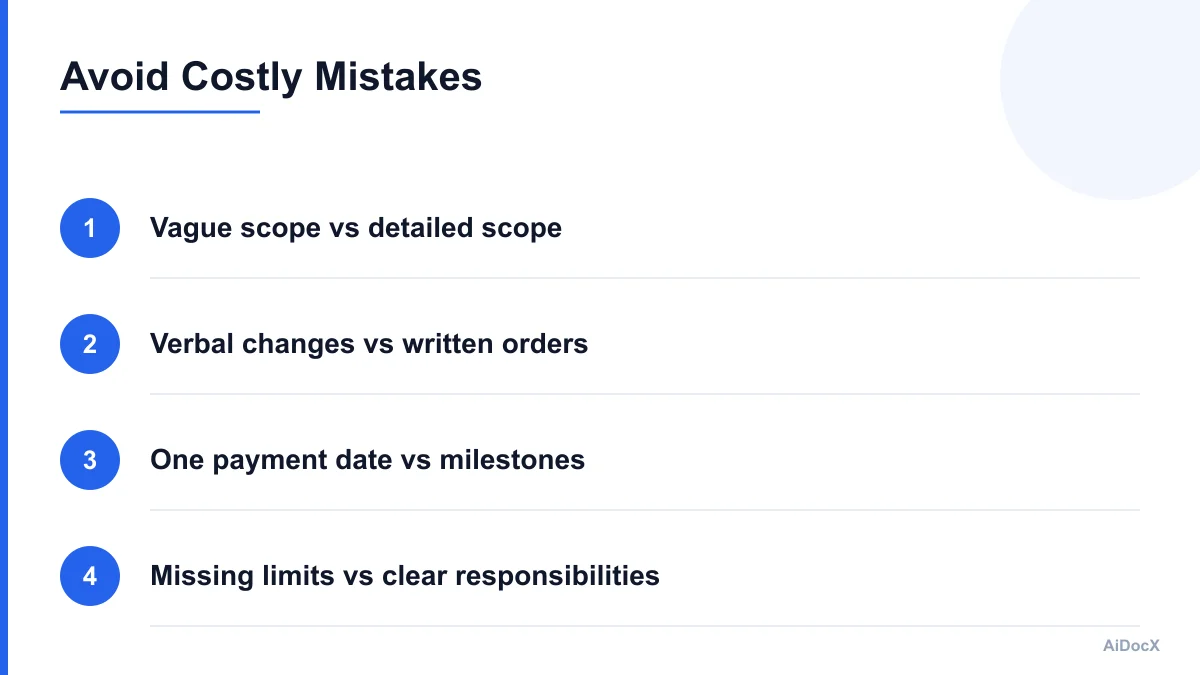
A template can create false confidence if it is completed carelessly. These are some of the most frequent problems.
Vague descriptions
"Install flooring" does not specify the material, pattern, subfloor preparation, transitions, baseboards, or disposal. A better description might state the product, square footage, installation method, leveling allowance, and included trim.
Missing exclusions
If demolition, painting, permits, haul-away, or repair of hidden damage is excluded, say so. Silence often leads clients to assume the item is included.
Verbal change requests
A client may say, "While you're here, can you also replace the hallway floor?" If you agree without documenting the price and schedule effect, you may later struggle to collect payment.
Unclear allowances
An allowance without a markup rule or selection deadline leaves the final price uncertain. Define the allowance, purchasing process, and adjustment method.
One-sided payment terms
A deposit and one final payment put unnecessary strain on cash flow and make the definition of completion more important. Use milestones that reflect actual work and costs.
No process for delays
A contract that promises a date but says nothing about delayed materials, client decisions, inspections, or weather is difficult to administer fairly.
Copying another company's contract
A form found online may reference the wrong state, license rules, payment laws, insurance requirements, or business structure. Use it as a starting framework, not as legal advice.
Failing to sign every exhibit
If the scope, drawings, estimate, or finish schedule is not identified and acknowledged, the parties may disagree about whether it was part of the deal. Number exhibits and attach the final versions.
Ignoring consumer-protection rules
Residential construction contracts may require specific notices, cancellation rights, disclosures, registration information, or lien notices. Requirements vary by location and project type. Check the rules that apply where the work is performed.
How to Create and Customize a Template Quickly
You do not need to write every contract from a blank page. Build a reusable base, then customize only the project-specific parts.
Step 1: Choose the project type
Start with a template designed for the work:
- Residential remodeling
- New residential construction
- Small commercial improvement
- Specialty subcontracting
- Repair and maintenance
- Time-and-materials service
A kitchen remodel and a roofing subcontract may need different exhibits, warranties, payment terms, and responsibilities.
Step 2: Create standard company terms
Prepare approved language for recurring items:
- Payment methods and due dates
- Standard working hours
- Cleanup expectations
- Warranty process
- Change-order procedure
- Suspension for nonpayment
- Insurance requirements
- Dispute escalation
Review these terms with a construction attorney in your jurisdiction. Once approved, keep them consistent rather than rewriting them from memory for every client.
Step 3: Fill in project-specific fields
Customize the parties, address, scope, materials, price, schedule, allowances, exclusions, and attachments. Do not leave blanks that could be interpreted later. If a section does not apply, write "Not applicable" instead of deleting it without explanation.
Step 4: Run a scope and price review
Read the contract as if you were the client. Then read it as if you were a subcontractor pricing the job. Look for:
- Tasks mentioned in the proposal but absent from the contract
- Materials shown in drawings but not priced
- Items included in one place and excluded in another
- Quantities that do not match the estimate
- Allowances without adjustment rules
- Dates that conflict with selection deadlines
- Payment milestones that cannot be measured
Step 5: Review it together
Before signing, walk through the scope, exclusions, payment schedule, schedule assumptions, change orders, and warranty. This conversation often reveals misunderstandings while they are still easy to fix.
Step 6: Sign and store the final version
Make sure both parties receive the same completed version, including exhibits and approved changes. Use a consistent file name such as:
2026-06-14_Smith-Kitchen-Remodel_Construction-Contract_v1.pdf
Store the signed agreement, estimates, drawings, selections, change orders, invoices, photos, and messages together. A contract is most useful when you can quickly find the document that supports a payment or scope decision.
Tools such as AiDocX can help generate and e-sign a construction contract in minutes, especially when you are working from a repeatable template and need a clear record of the final agreement.
Free Template Structure You Can Reuse
A practical construction contract template can follow this order:
- Contract title and effective date
- Contractor and client information
- Project address and description
- Scope of work
- Materials and client selections
- Exclusions and assumptions
- Contract price and allowances
- Payment schedule
- Schedule and access
- Change-order procedure
- Permits and inspections
- Site conditions and concealed damage
- Responsibilities and cleanup
- Insurance and licensing
- Warranty and correction procedure
- Suspension or termination
- Dispute resolution and governing law
- Notices and communication
- Entire agreement and amendments
- Signatures
- Exhibits and attachments
The order can change, but the concepts should remain easy to find. Use defined terms consistently. If you call someone the "Owner" in one section and the "Client" in another, state whether those terms mean the same person.
Keep the contract readable. Short paragraphs, descriptive headings, tables for payment schedules, and numbered exhibits make the document easier to use in the field. Avoid shrinking the font or hiding important terms in dense legal language.
Contract Review Checklist
Use this checklist before sending the agreement for signature:
- Correct legal names and contact information
- Accurate project address and work areas
- Detailed scope with measurable tasks
- Clear exclusions and assumptions
- Materials, allowances, and selection deadlines
- Contract type and total price
- Deposit and milestone payment dates
- Late-payment and suspension terms reviewed
- Start date, completion estimate, and delay rules
- Written change-order process
- Permit, inspection, access, and cleanup responsibilities
- Concealed-condition procedure
- Insurance and licensing information verified
- Warranty period and claim process
- Termination and dispute provisions reviewed
- All drawings and exhibits attached
- Every blank completed or marked not applicable
- Both parties signed the same final version
- Signed copy stored with project records
A checklist cannot replace legal review, but it can prevent many administrative mistakes that lead to avoidable disputes.
Final Thoughts
A free construction contract template is most valuable when it makes the project specific. Describe the work in measurable terms, separate included work from exclusions, set milestone payments, document changes, and assign responsibilities before construction begins. Then review the finished agreement for local legal requirements and keep the signed contract with the rest of the project record.
For a faster workflow, customize a reusable template, send it for electronic signature, and save the completed agreement before scheduling labor or ordering materials. A few minutes of careful documentation at the start can protect your time, cash flow, and client relationships throughout the project.
Ready to automate your documents with AI?
Start free with AiDocX — AI contract drafting, meeting minutes, consultation notes, e-signatures, and more in one platform.
Get Started FreeMore from AiDocX Blog
Weekly Status Report Template: 4 Formats + Examples
Copy one of four weekly status report templates for individual work, projects, leadership, or blockers. See a worked example and a practical review checklist.

How to Read a Business Contract: A Founder's Checklist (2026)
A practical way to review parties, scope, money, IP, liability, and exit terms before signing a business contract.
 MinjiLee October 7, 2026 9 min
ESIGN vs eIDAS: What Founders Should Know About E-Signatures (2026)
What U.S. ESIGN and EU eIDAS actually say, where exceptions apply, and what founders should keep to document an electronic signing.
MinjiLee October 7, 2026 7 min