Amendment vs Addendum: How to Modify a Signed Contract in 2026
Amendment vs addendum: know the difference, avoid legal risks, and modify signed contracts correctly. Includes a checklist and 2026 best practices.
 James · Content Manager July 4, 2026 6 min read
Amendment vs Addendum: How to Modify a Signed Contract in 2026
Business owners frequently need to update contracts after signing. Whether a project scope shifts, pricing changes, or a new deliverable is added, the original agreement often requires a formal tweak. However, using the wrong document type can create ambiguity or even void parts of your deal.
Understanding the distinction between an amendment and an addendum is essential for protecting your interests. This guide breaks down when to use each, the legal requirements for modification, and best practices for execution in 2026.
Amendment vs. Addendum: Key Differences
While both documents modify a signed contract, they serve different purposes. Confusing the two can lead to unintended changes in your agreement.
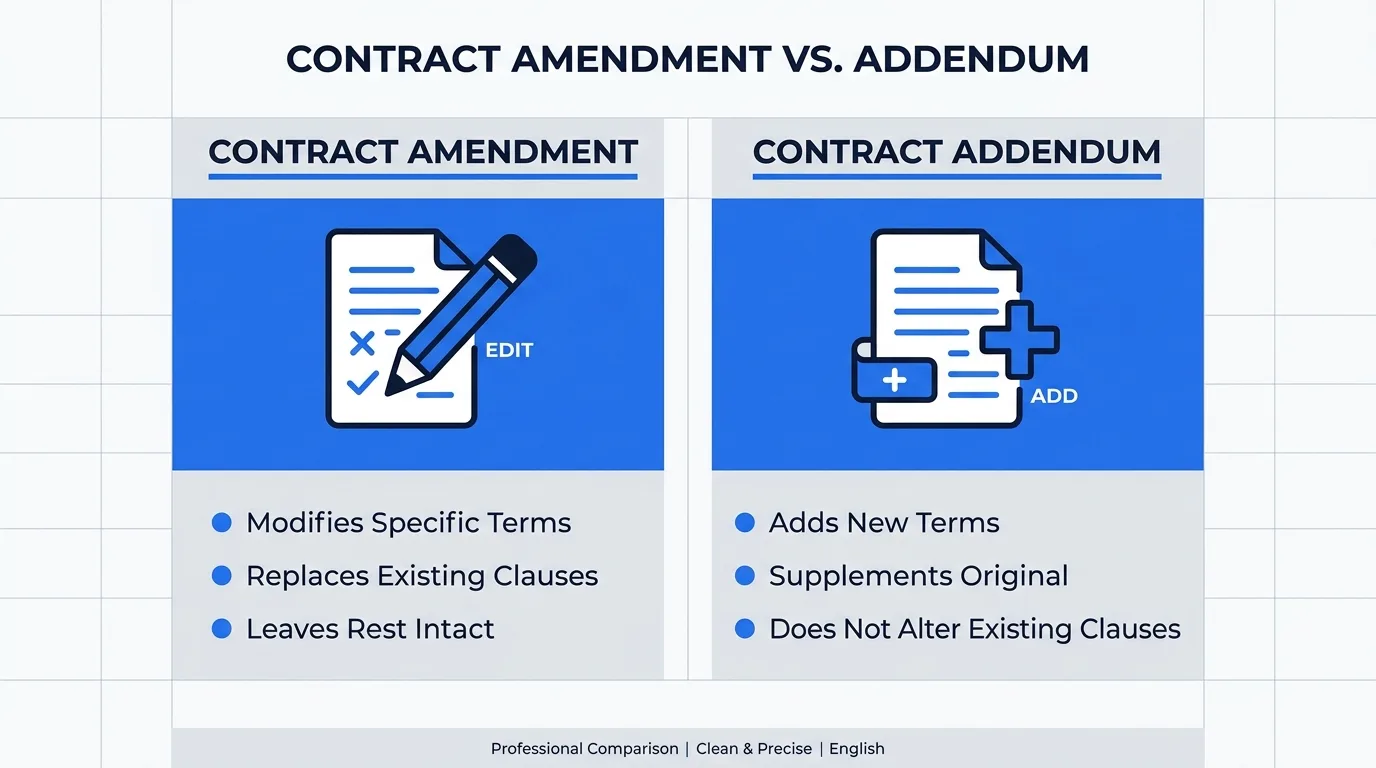
An amendment modifies specific terms within the original contract. It changes, adds, or deletes language but leaves the rest of the agreement intact. Think of it as a surgical edit. If you need to update a payment schedule, extend a deadline, or adjust a liability cap, an amendment is the correct tool.
An addendum supplements the original contract by adding new terms without altering existing ones. It attaches to the agreement and becomes part of it. Addendums are ideal for introducing new deliverables, additional parties, or supplementary schedules that were not part of the initial negotiation.
The core difference lies in impact: amendments change what was agreed upon; addendums expand what was agreed upon.
When to Use an Amendment vs. Addendum
Choosing the right document depends on the nature of the change. Here are common scenarios to help you decide.
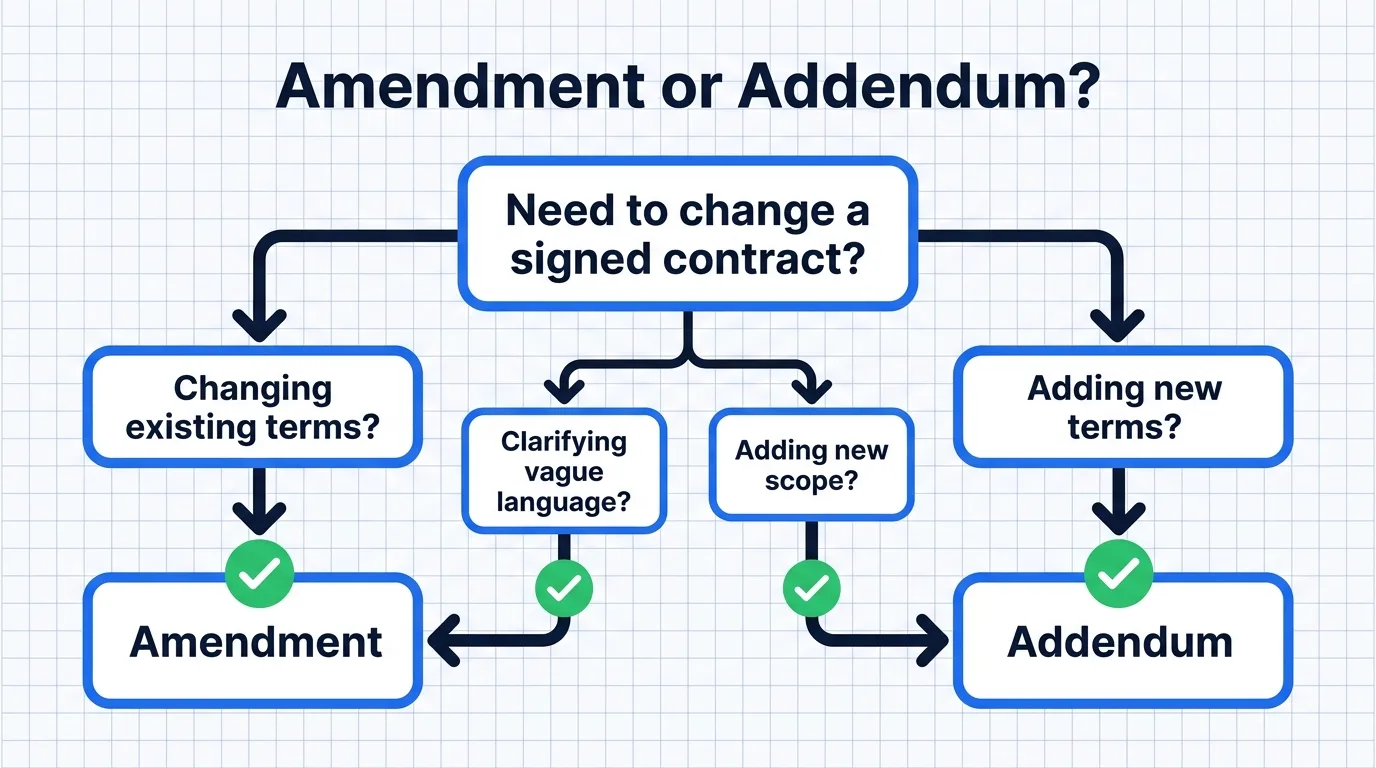
Use an Amendment when:
- Pricing changes: You need to adjust rates, discounts, or payment terms.
- Timelines shift: A launch date moves, or the contract term needs extension.
- Scope is reduced: You are removing a service or deliverable originally promised.
- Clarification is needed: Vague language must be tightened to reflect mutual intent.
- Compliance updates: New regulations require specific clause updates.
Use an Addendum when:
- New scope is added: Additional services or products are being included.
- Parties change: A new partner, vendor, or stakeholder needs to join the agreement.
- Supplementary info is required: Technical specs, SLAs, or data appendices are being attached.
- Separate workstreams are defined: You need to outline a distinct phase without rewriting the main contract.
Legal Requirements for Modifying a Signed Contract
Modifying a contract is a legal act. To ensure your change is enforceable, it must meet specific criteria.
1. Mutual Consent Both parties must agree to the change. Unilateral modifications are generally unenforceable unless the original contract explicitly grants that right.
2. Consideration In many jurisdictions, a contract modification requires new consideration—something of value exchanged to support the change. For example, if you extend a deadline, you might offer a small discount as consideration. However, many modern courts and statutes (like the UCC in the US) relax this requirement for good-faith changes.
3. Written Form Most contracts include a clause stating that modifications must be in writing. Even if your original agreement doesn't have this clause, putting changes in writing prevents "he said, she said" disputes. Verbal agreements to change a contract are risky and often inadmissible.
4. Reference to Original Contract The modification document must clearly identify the original agreement by date, title, and parties. This links the change to the master contract and ensures it integrates properly.
Drafting Your Change Document: Best Practices
A well-drafted amendment or addendum minimizes confusion and streamlines execution. Follow these structural guidelines.
- Title and Date: Clearly label the document (e.g., "First Amendment to Service Agreement") and include the date of execution.
- Recitals: Briefly state the background, referencing the original contract date and parties.
- Specific Changes: List the exact clauses being modified. Quote the original text and provide the new text. Avoid vague language like "update section 4"; instead, write "Section 4.2 is hereby deleted and replaced with..."
- Ratification Clause: Include a statement confirming that all other terms of the original contract remain in full force and effect. This prevents accidental voiding of unrelated sections.
- Integration Note: If the original contract contains an "entire agreement" or "integration" clause, the amendment should explicitly state it supersedes prior negotiations or integrates with the original to maintain that clause's validity.
For efficiency, platforms like AiDocX let you generate an amendment or addendum and re-sign in minutes, reducing the time spent on manual drafting and formatting.
Getting Signatures: Execution and Storage
Once drafted, the modification must be executed properly.
Signatures All parties to the original contract must sign the amendment or addendum. If the original required board approval or a specific signatory authority, maintain that same protocol. Digital signatures are widely accepted and legally binding in 2026, provided they meet e-signature standards like ESIGN or eIDAS.
Dating and Counterparts Ensure every signature page is dated. If parties sign at different times, note the effective date of the modification. Counterpart signatures allow parties to sign separate copies, which together form one binding document.
Storage Store the modification with the original contract. The amendment does not replace the original; it sits alongside it. A disorganized filing system can lead to version control issues. Use a centralized contract repository to keep the complete chain of documents accessible.
Common Mistakes to Avoid
Even experienced business owners make these errors when updating contracts.
- Verbal Changes: Agreeing to a change over a call without documenting it. Always follow up with a written modification.
- Vague Language: Using terms like "reasonable time" or "as needed" in the amendment without defining them.
- Forgetting Consideration: Assuming no consideration is needed without verifying local law.
- Incomplete References: Failing to cite the original contract correctly, which can break the link between documents.
- Missing Signatures: Sending the document for signature but forgetting a party, leaving the modification unenforceable.
- Ignoring Integration Clauses: Drafting an amendment that contradicts the original's entire agreement clause without addressing it.
Quick Checklist: Updating a Contract
Use this checklist to ensure your contract modification is complete and enforceable.
- Review the original contract for modification restrictions or notice requirements.
- Determine if the change requires an amendment (modify terms) or addendum (add terms).
- Draft the document with clear references to the original agreement.
- Quote original text and provide new text for all changes.
- Include a ratification clause to preserve unchanged terms.
- Verify consideration requirements under applicable law.
- Obtain signatures from all required parties.
- Date all signatures and note the effective date.
- Store the executed modification with the original contract in a secure repository.
Modifying a signed contract doesn't have to be a legal minefield. By choosing the right document type, following proper execution steps, and maintaining clear records, you can adapt your agreements with confidence. AiDocX helps you streamline this process, from generation to signature, so you can focus on your business rather than administrative bottlenecks.
Ready to automate your documents with AI?
Start free with AiDocX — AI contract drafting, meeting minutes, consultation notes, e-signatures, and more in one platform.
Get Started FreeMore from AiDocX Blog
Machine Shop Job Traveler Template: Routing Sheet + Example
Copy a machine shop job traveler template for small job shops. Includes a routing sheet, filled example, traceability fields, sign-offs, and setup tips.
Weekly Status Report Template: 4 Formats + Examples
Copy one of four weekly status report templates for individual work, projects, leadership, or blockers. See a worked example and a practical review checklist.

How to Read a Business Contract: A Founder's Checklist (2026)
A practical way to review parties, scope, money, IP, liability, and exit terms before signing a business contract.
 MinjiLee October 7, 2026 9 min