Contract Termination Letter Template for 2026
Use this contract termination letter template to end a vendor or service agreement correctly, including notice periods, cure clauses, delivery, and common mistakes.
 James · Content Manager August 21, 2026 15 min read
Contract Termination Letter Template for 2026
Ending a business contract is rarely as simple as writing "we are cancelling" and sending an email. A vendor, supplier, or service agreement may require a specific notice period, delivery method, cure opportunity, or termination reason. This contract termination letter template explains how to review those requirements, write a clear notice, and reduce the risk of a breach claim.
Read the Contract Before Writing
The safest termination letter starts with the signed agreement, not with a generic online template. Your contract controls the process unless another document, amendment, applicable law, or negotiated settlement changes it. A letter that sounds professional can still be ineffective if it uses the wrong notice period or relies on a termination right the contract does not provide.
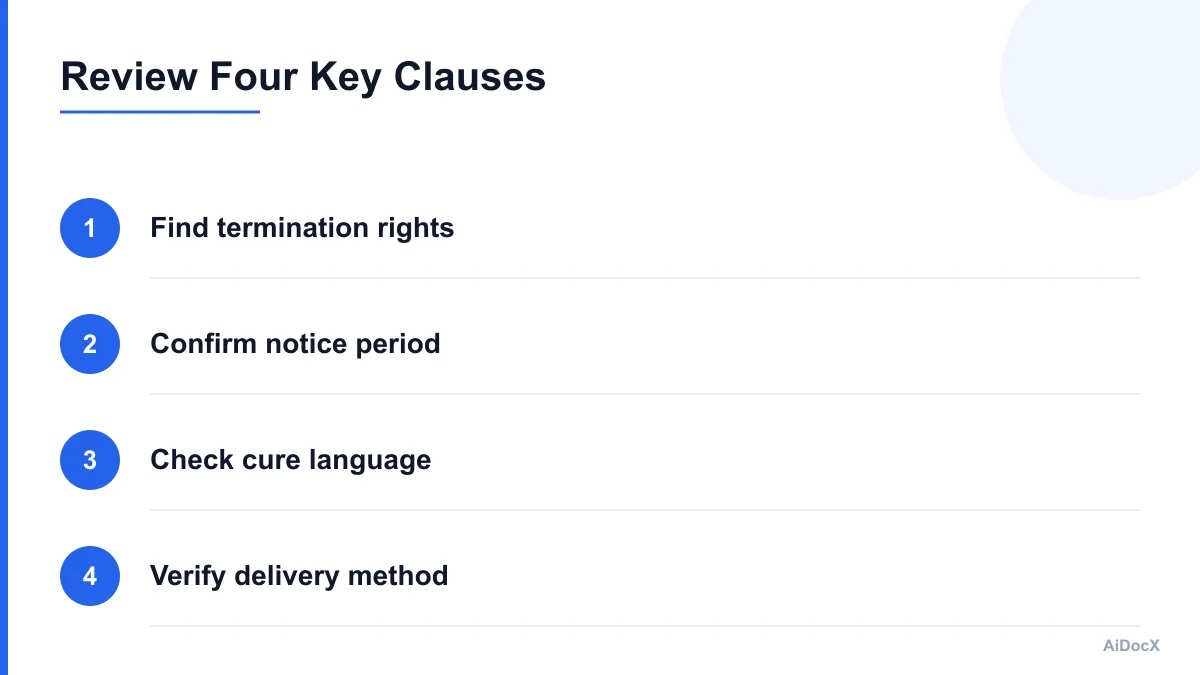
Before drafting, locate the fully executed version of the contract and every document that may modify it. That may include order forms, statements of work, renewal notices, change orders, service schedules, pricing addenda, data-processing agreements, and written amendments. Confirm that you are reviewing the version signed by both parties, not an internal draft or a vendor's standard terms saved in the wrong folder.
Start by searching for headings such as:
- Term and renewal
- Termination
- Termination for convenience
- Termination for cause or default
- Breach and remedies
- Notice
- Dispute resolution
- Effect of termination
- Transition assistance
- Confidentiality and data return
- Survival
- Fees, refunds, and final payment
Read the surrounding paragraphs, definitions, and schedules. A definition of "Business Day," for example, may change the date calculation. A notice clause may define when delivery is effective. A service order may contain a shorter cancellation window than the master services agreement, or the master agreement may say that the order controls if there is a conflict.
Create a short termination fact sheet before writing the letter:
- Legal names of both contracting parties
- Contract title, date, and reference number
- Relevant order or statement-of-work numbers
- Contract start date and current renewal term
- Available termination right
- Required notice period
- Cure period, if any
- Required delivery method and address
- Proposed termination effective date
- Outstanding invoices, credits, equipment, or data
- Internal owner responsible for the transition
The contract may allow termination for convenience, meaning one party can end the relationship without alleging a breach after giving the required notice. It may also allow termination for cause, default, insolvency, repeated service failures, or another specified event. These are different routes with different risks. Do not describe a convenience termination as a breach termination merely because you are dissatisfied with the service.
If the agreement does not include a clear termination provision, do not assume that you can always end it immediately. Under the Uniform Commercial Code, for example, a contract for the sale of goods without a specified termination time may require reasonable notice, but that rule is not a universal answer for every service, software, employment, real estate, or cross-border agreement. The governing law, contract type, and facts matter. UCC § 2-309 is one example of why a missing contractual deadline does not automatically mean "no notice is required."
Identify the Right Termination Route
Once you understand the agreement, decide which contractual route matches your reason for leaving. The route should appear clearly in your internal approval notes and, where appropriate, in the letter itself.
Termination for convenience
A convenience clause generally permits termination without proving that the other party did something wrong. It may say that either party can terminate "for any reason or no reason" on 30, 60, or 90 days' written notice. It may apply only after the initial term, only to certain services, or only if all invoices are current.
A convenience notice is usually the cleanest option when it is available. It avoids unnecessary factual disputes about performance and reduces the chance that an allegation in the letter becomes a separate source of conflict. The letter should state that you are exercising the identified contractual right and give the effective date calculated under the agreement.
Termination for cause
A cause-based termination relies on a specified event, such as a material breach, failure to meet service levels, unauthorized disclosure, insolvency, or a change of control. The contract may require you to identify the breach, provide a cure period, and wait until the cure period expires before sending a final termination notice.
Use this route only when the facts and procedure are documented. If the supplier delivered late twice but the contract requires repeated failures, written escalation, and 30 days to cure, the letter should not overstate the situation as an immediate material breach. A dispute about the facts can become a dispute about whether the termination itself was valid.
Non-renewal
Some businesses are not terminating an active term; they are declining renewal. That distinction matters. A non-renewal notice may need to be sent 30 days before the renewal date, while a mid-term termination may require a specific contractual right or payment.
Use the contract's terminology. If the agreement says "notice of non-renewal," use that phrase. Do not call it "termination effective immediately" if the contract treats the relationship as continuing until the end of the current term.
Mutual termination
If both parties agree to end the relationship, a short unilateral letter may not be enough. A mutual termination agreement can address the final service date, unpaid amounts, refunds, transition support, data deletion, continuing confidentiality, releases, and any surviving obligations.
A mutual agreement is often useful when the contract's exit mechanics are unclear or when both sides want a faster end date. Have the person with authority to bind the business sign it, and make sure the document states which provisions survive termination.
Calculate the Notice Period Correctly
The notice period is one of the most common sources of avoidable error. "Thirty days' notice" may not mean the same thing as "30 calendar days before the next renewal date." The agreement may count from receipt, dispatch, the next business day, or a specified notice date.
Read the clause for four details:
- What event starts the clock?
- Are the days calendar days or business days?
- Is the notice effective on delivery or deemed delivery?
- Must the notice arrive before a renewal or billing cutoff?
For example, suppose a contract allows termination for convenience on 60 days' written notice and says notice is effective when received at the address in the notice clause. If the intended end date is September 30, sending the letter on August 1 may not be enough if the counterparty receives it on August 3. If the agreement counts business days, holidays may also matter.
Build the calculation from the contract, then add a practical buffer. If the agreement requires 60 days, sending 65 or 70 days ahead can reduce the risk of a delivery dispute. A buffer does not replace the contractual rule, but it gives you room for courier delays, incorrect recipient details, weekends, and questions about when receipt occurred.
Document the calculation in your contract-management record:
- Date the notice is signed
- Date and time it is sent
- Delivery method
- Date and time delivery is confirmed
- Contractual notice period
- Calculated effective date
- Renewal or billing date
- Person who verified the calculation
Be precise about the effective date. "This letter serves as notice that the agreement will end in 60 days" may be less clear than "The agreement will terminate at 11:59 p.m. local time on September 30, 2026, which is the date calculated under Section 8.2." If the contract does not specify a time zone or exact time, avoid inventing unnecessary precision and ask counsel if the timing is disputed.
Do not backdate the letter. Do not claim that notice was received when you have no evidence. If delivery fails, the notice period may not have started. When timing is important, use the specified method plus a reasonable backup method, while making clear that the contractual method controls.
Handle Cure Clauses Without Creating a New Problem
A cure clause gives the allegedly breaching party an opportunity to fix a stated problem before termination. It usually requires written notice describing the breach and a period—such as 10, 15, or 30 days—to cure it. Some clauses allow immediate termination for certain serious breaches, while others require a cure opportunity for every breach.
The cure notice and the final termination notice are related but different documents. A cure notice says, in substance, "Here is the breach; fix it by this deadline or we may terminate." A termination notice says, "The cure period has expired without the required cure, so we are terminating under the agreement."
A strong cure notice should:
- Identify the contract and affected service or order
- Quote or accurately paraphrase the relevant obligation
- Describe specific facts, dates, and failures
- Explain why the failure is a breach
- State the required cure
- State the deadline for cure
- Identify where the response must be sent
- Reserve contractual and legal rights
- Avoid declaring the breach cured or incurable before the deadline
Do not use vague accusations such as "your performance has been unacceptable." Write facts that a neutral reviewer could understand: "The monthly reconciliation file due on May 5 was not delivered as of May 12, despite the written escalation sent on May 7." Then connect the fact to the contract: "Section 4.3 requires delivery by the fifth calendar day of each month."
The cure requirement may be more than an apology or a promise. If the contract requires restoration of service, replacement of defective goods, repayment of an overcharge, or a written remediation plan, state what would reasonably constitute a cure. Avoid setting a cure demand that is impossible, unrelated to the breach, or more extensive than the contract allows.
Some agreements distinguish between breaches that can be cured and breaches that cannot. Others say that repeated breaches are material even if each individual failure is eventually corrected. A supplier may cure one late shipment but still violate a repeated-failure provision. Review the entire clause before deciding whether a cure has occurred.
Government contract rules illustrate the importance of following the specified process, although they do not automatically apply to private contracts. Federal acquisition regulations generally require a written cure notice for certain default terminations and specify a cure period; they also emphasize that the notice should identify the failure and allow the required time to remedy it. 48 CFR § 49.402-3. Your private agreement may use different language, so treat this as a procedural example, not a universal rule.
If the counterparty cures before the deadline, be careful about sending a termination letter based on the original breach. You may still have rights for repeated or separate breaches, but the analysis depends on the contract and governing law. If the breach is serious, the cure is disputed, or the deadline is approaching, have a lawyer review the proposed notice.
Use This Contract Termination Letter Template
The following template is designed for a straightforward termination under an express contractual right. Replace bracketed text with information from the signed agreement. If you are terminating for cause, adapt the breach and cure language carefully rather than inserting allegations into the convenience version.
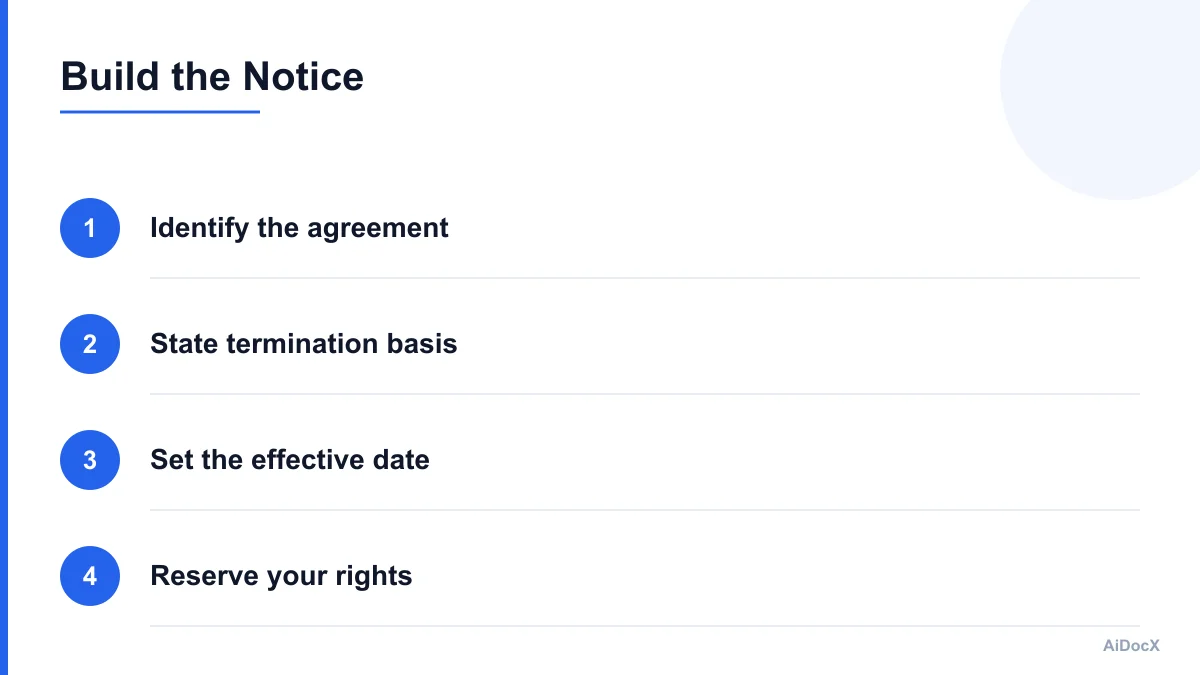
Date: [Month Day, Year]
Via [required delivery method]
[Counterparty legal name] [Notice address] [Email address, if permitted]
Re: Notice of Termination of [Agreement title], dated [agreement date]
Dear [name or title]:
[Your legal name] ("[short name]") provides this written notice under Section [number] of the [Agreement title] dated [date] between [your legal name] and [counterparty legal name] (the "Agreement").
Under Section [number], [your legal name] may terminate the Agreement for convenience by providing [number] [calendar/business] days' written notice. We are exercising that right. The Agreement will terminate effective [date and, if specified, time], calculated in accordance with the Agreement and subject to any provisions that survive termination.
Until the effective date, the parties should continue performing their respective obligations under the Agreement. Please provide written confirmation of any outstanding invoices, credits, prepaid amounts, equipment, credentials, records, or other items that must be resolved before termination.
Please also confirm the process and timing for [returning or deleting confidential information and personal data / transferring records / returning equipment / completing transition services], as required by Sections [numbers].
This notice is provided without waiving any rights, remedies, claims, defenses, or obligations under the Agreement or applicable law. Nothing in this letter should be construed as an admission regarding any disputed matter.
Please direct questions and written confirmation to:
[Name] [Title] [Company] [Email] [Phone]
Sincerely,
[Authorized signer] [Title] [Your legal name]
For a termination for cause, replace the convenience paragraph with a factual breach section. Identify the clause, describe the breach, state the cure deadline, and say what will happen if the breach is not cured. If the cure period has already expired, identify the earlier cure notice and the date of delivery. Do not write "you have failed to cure" unless you have confirmed both the deadline and the facts supporting that conclusion.
A practical cause-based paragraph might read:
"On [date], we notified you that [specific failure] breached Section [number]. The notice was delivered by [method] and received on [date]. The contractual cure period expired on [date]. As of [date], [specific failure] has not been cured because [brief factual explanation]. Accordingly, under Section [number], we terminate the Agreement effective [date]."
The final letter should be short enough to understand quickly, but complete enough to prove what right you exercised and when. Attach only documents that help establish the notice, breach, cure, or calculation. Avoid attaching an entire internal complaint history if it contains irrelevant, privileged, or confidential material.
Send the Notice and Manage the Exit
A correctly written letter can still fail if it is sent to the wrong person or through the wrong channel. Follow the notice clause exactly. It may require personal delivery, courier, certified mail, registered post, a named legal department, or a specific email address. "Send it to your usual account manager" is not a substitute for the contractual address unless the agreement says it is.
Use a delivery method that creates a record. Save the signed letter, the final attachment, tracking information, delivery confirmation, email headers, and any acknowledgment. If the contract allows email but does not define when email is received, send it during business hours and request confirmation. If the required address appears outdated, document your reasonable efforts and ask counsel about backup delivery.
Coordinate the termination letter with the operational plan. Give internal teams a date-based checklist covering:
- Last day for new orders
- Final service or delivery date
- Access shutoff
- Data export and deletion
- Equipment return
- Open support tickets
- Final invoice review
- Credits, deposits, and refunds
- Customer communications
- Replacement supplier onboarding
- Insurance or compliance records
- Retention of the contract file
Do not shut off access or stop paying before the effective date unless the contract permits it or legal counsel directs you to do so. A premature stop-work action may create a new breach, even if the termination notice itself was valid. Keep paying undisputed amounts according to the agreement and separately document disputed charges.
If the supplier needs transition assistance, identify the contract section and propose a schedule. Termination does not always end every obligation on the same day. Confidentiality, intellectual property, data protection, audit, indemnity, payment, dispute resolution, and record-retention provisions often survive. The letter should preserve those obligations rather than imply that the entire relationship disappears immediately.
AiDocX can help with the document-review step by generating a termination letter from the signed contract stored in the workspace and pulling in the actual notice-period and cure-clause language. That reduces the risk of drafting a notice that accidentally contradicts the agreement, but the final dates, facts, authority, and legal strategy still need human review.
Avoid These Common Termination Letter Mistakes
The most expensive mistakes are usually small wording or process errors.
Saying "effective immediately" without a right to do so
Immediate termination may be permitted for a narrowly defined serious breach, insolvency event, security incident, or other trigger. It is not automatically available because the relationship is inconvenient or the service is disappointing. If the contract requires notice, use the required notice period.
Mixing convenience and cause theories
A letter that says "we are terminating for convenience because you materially breached" creates unnecessary ambiguity. Choose the correct contractual route. If you want to preserve both possibilities, have counsel draft language that does so without making inconsistent factual admissions.
Misstating the cure deadline
A cure period may begin on receipt, not the date printed on the letter. It may exclude weekends or require a longer period for certain breaches. Calculate it from the contract and preserve evidence of delivery.
Giving a cure notice that is too vague
The counterparty cannot reasonably cure "poor service." Identify the obligation, the failure, the date, and the outcome required. Vague language can make the notice harder to enforce and harder for operations teams to act on.
Promising a release or refund
Do not write "all obligations are settled" unless the business has approved a settlement. Termination and release are different concepts. A letter should not accidentally waive claims, confirm a disputed amount, or promise payment terms that finance has not accepted.
Ignoring renewal mechanics
A notice sent after automatic renewal may terminate the next term rather than the current one. Check the renewal date, cancellation window, and any minimum-spend commitment before choosing the effective date.
Forgetting related agreements
A master agreement, order form, software subscription, data-processing addendum, and support plan may have separate termination mechanics. Ending one document may not end the others.
Sending sensitive allegations to a broad audience
Limit distribution to people who need the notice. Avoid copying customers, employees, or unrelated vendors on a letter containing breach allegations, pricing details, personal data, or confidential information.
Treating a template as legal advice
Templates provide structure, not a conclusion about your rights. A lawyer should review the notice when the contract is high value, the termination is for cause, the cure is disputed, the counterparty may sue, or the agreement involves regulated data, employment, real estate, intellectual property, or cross-border obligations.
Contract Termination Letter Checklist
Use this checklist before sending:
- I have the fully signed contract and all amendments.
- I confirmed the correct legal names of both parties.
- I identified the exact termination or non-renewal clause.
- I confirmed whether the right is for convenience or cause.
- I checked the current term and renewal date.
- I calculated the notice period using the contract's rules.
- I confirmed whether the period uses calendar or business days.
- I checked whether notice is effective on dispatch or receipt.
- I used the required notice method and address.
- I reviewed any cure-clause requirements.
- I described any breach with specific facts and dates.
- I set a valid cure deadline, if required.
- I chose an accurate termination effective date.
- I addressed final invoices, credits, equipment, and data.
- I preserved surviving confidentiality and other obligations.
- An authorized person approved and signed the letter.
- I saved delivery evidence in the contract record.
- Operations has a transition plan for the exit.
- Counsel reviewed the notice if the risk or value warrants it.
A contract termination letter should make three things unmistakable: the agreement being addressed, the contractual right being exercised, and the date the relationship ends. Review the signed terms first, calculate notice and cure periods from the actual language, send the notice exactly as required, and coordinate the legal notice with the operational exit. If the facts are disputed or the consequences are significant, get legal advice before sending.
Ready to automate your documents with AI?
Start free with AiDocX — AI contract drafting, meeting minutes, consultation notes, e-signatures, and more in one platform.
Get Started FreeMore from AiDocX Blog
How to Read a Business Contract: A Founder's Checklist (2026)
A practical way to review parties, scope, money, IP, liability, and exit terms before signing a business contract.
 MinjiLee October 7, 2026 9 min
ESIGN vs eIDAS: What Founders Should Know About E-Signatures (2026)
What U.S. ESIGN and EU eIDAS actually say, where exceptions apply, and what founders should keep to document an electronic signing.
MinjiLee October 7, 2026 7 min
Does Document Automation Pay Off? An ROI Worksheet for Founders (2026)
Estimate document automation ROI with your own volume, time, labor, and software costs. Includes a clearly labeled example and break-even formula.
 Chloe October 7, 2026 8 min