Free Investor Pitch Deck Template for 2026 Fundraising
Build a clear investor pitch deck with this free 2026 template, slide-by-slide guidance, download options, and practical AI customization tips.
 James · Content Manager August 21, 2026 15 min read
Free Investor Pitch Deck Template for 2026 Fundraising
A strong investor pitch deck helps a prospective backer understand what you are building, why it matters, and why your company can become valuable. This free investor pitch deck template for 2026 gives pre-seed and seed-stage founders a practical slide-by-slide structure, download options, and a repeatable way to customize the deck with AI.
The goal is not to create the most visually impressive presentation. It is to make the right information easy to find, easy to believe, and easy to discuss in a first meeting.
What Makes a Good Investor Pitch Deck in 2026?
A fundraising deck is a decision-making document. Investors use it to decide whether your company deserves a meeting, a deeper review, or an introduction to someone else. That means every slide should answer a specific question rather than simply describe your business.
For an early-stage company, the most useful questions are:
- What problem is serious enough to solve?
- Who experiences the problem, and how do you know?
- Why is your solution meaningfully better?
- Why is this market large or expanding?
- What evidence suggests customers will adopt the product?
- How can the company become a durable business?
- What will this round help you accomplish?
A pre-seed deck may have limited revenue and only early product evidence. That is acceptable. You can replace mature metrics with strong customer interviews, prototypes, design partners, waitlist growth, usage patterns, technical milestones, or founder-market fit. The important point is to label evidence accurately. Do not present a hypothesis as traction.
A seed-stage deck usually needs more operating detail. Investors may expect to see revenue, retention, conversion, sales cycles, pipeline quality, or a clear explanation of why growth is beginning to repeat. The template can stay broadly the same, but the level of proof should increase.
Aim for approximately 10 to 14 core slides. A short deck is easier to read and revise. If a topic needs additional detail, place it in an appendix rather than forcing every qualification onto the main narrative.
What to Include on Every Pitch Deck Slide
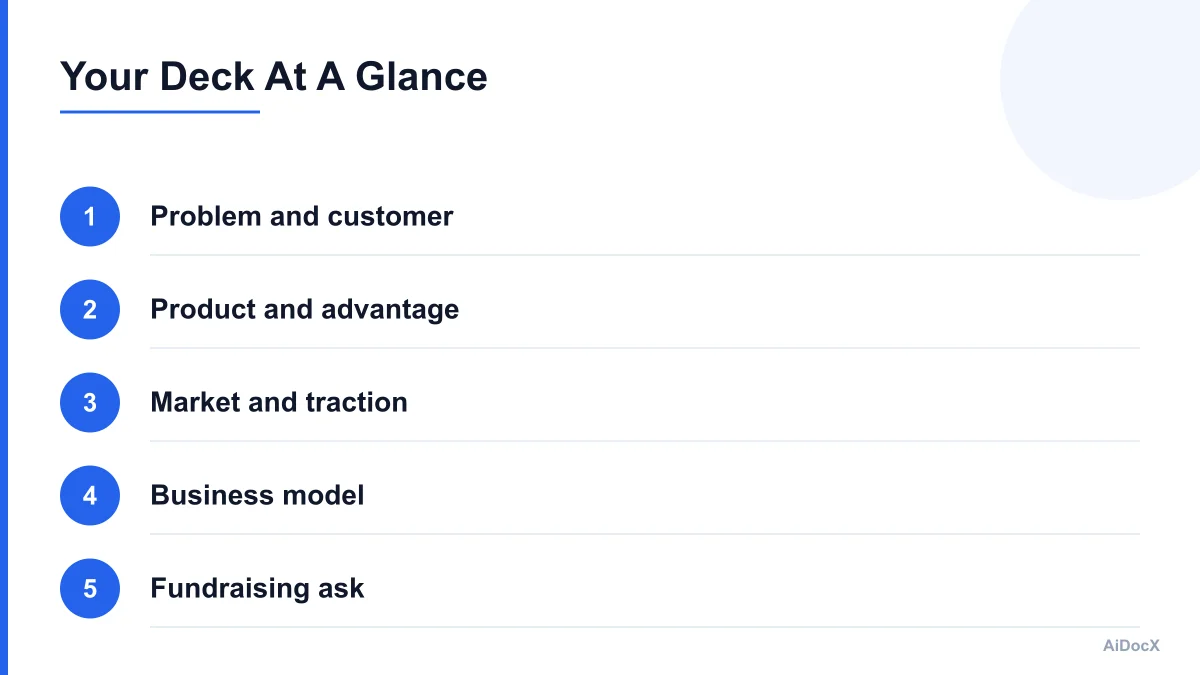
The sequence below is a flexible investor pitch deck template. You can combine or remove slides depending on your business, but the narrative should move from customer pain to business opportunity, then to evidence and the plan for using capital.
1. Cover slide
State the company name, a plain-English description of the product, and your contact information. Avoid making the reader guess what your company does from a slogan.
A useful format is:
[Company] helps [specific customer] achieve [valuable outcome] by [brief explanation of how].
For example:
LedgerLift helps independent clinics reduce unpaid invoices through automated patient billing follow-up.
Include the founder's name and email in small type. If the deck is being shared as a file, the recipient should not need to search for a separate contact page.
2. Problem slide
Describe the costly, frequent, or urgent problem your target customer faces. Use concrete situations instead of broad claims such as "businesses are inefficient" or "the industry is outdated."
A strong problem slide may include:
- The current workflow
- What makes it frustrating or expensive
- How often the problem occurs
- Who owns the budget or feels the pain
- Existing alternatives and their limitations
If you have customer research, include one short quote with permission or summarize a repeated pattern. Explain how many interviews produced the insight. "We spoke with 32 operations managers, and 24 said…" is more useful than "Customers hate the current process."
Do not make the problem sound larger than your evidence supports. Investors can tolerate an early thesis. They are less likely to trust inflated certainty.
3. Solution slide
Show how the product changes the workflow. A screenshot, short process diagram, or before-and-after comparison is often more effective than a paragraph of features.
Keep the slide focused on three ideas:
- What the user does differently
- What outcome improves
- Why the change matters financially or operationally
Do not list every feature. The solution slide is not a product catalog. Choose the capabilities that directly address the problem from the previous slide.
If the product is still being built, say so. A prototype or planned workflow can be persuasive when paired with a clear development milestone and customer feedback.
4. Product or demo slide
Give the investor enough context to understand the product experience. Use a small number of annotated screenshots or a simple three-step flow.
For software, show the moment when value is created. For example:
- A customer connects their existing data.
- The product identifies a specific opportunity.
- The customer takes an action and sees the result.
Avoid tiny screenshots that cannot be read in a PDF. If a full product demo is important, link to a short video or offer to demonstrate it live. The deck should still make sense without external media.
5. Why now and market timing
Explain what has changed to make this opportunity possible or more urgent. Relevant factors might include new regulations, falling infrastructure costs, changed buyer behavior, platform shifts, labor shortages, or a newly available distribution channel.
This slide should not be a collection of fashionable trends. Connect each change directly to your customer and product.
For example, "AI is growing" is not a market-timing argument. "New document-processing models make it possible to review thousands of supplier agreements at a cost small manufacturers can afford" is more specific.
If there is no meaningful timing advantage, combine this slide with the market slide or leave it out.
6. Market opportunity
Explain the market in a way that reflects how you will actually sell. Investors commonly see inflated top-down estimates that begin with a huge industry number and assume the startup can capture a small percentage.
A more credible approach is bottom-up:
- Number of target customers
- Annual contract value or average revenue
- Expected penetration over a defined period
- Revenue opportunity from the initial segment
For example, if your first segment contains 18,000 potential customers and the initial annual contract is $6,000, the serviceable opportunity is $108 million before expanding into adjacent segments.
You can include TAM, SAM, and SOM if the definitions are clear, but do not use the labels as a substitute for reasoning. Explain which segment you will pursue first and why it is reachable.
7. Business model and pricing
Show how money flows from customer value to company revenue. Include the pricing model, who pays, the sales motion, and any important expansion path.
Possible models include:
- Subscription per user or account
- Usage-based pricing
- Transaction fees
- Annual enterprise contracts
- Marketplace commissions
- Hardware plus recurring software
At pre-seed, you may still be testing pricing. Present the current hypothesis and what you have learned from customer conversations. If you have paid pilots, distinguish one-time pilot revenue from recurring revenue.
Seed-stage founders should add more detail about gross margin, average contract value, payback period, or sales cycle when those numbers are available. A simple pricing table is usually enough; do not turn this slide into a spreadsheet.
8. Traction and validation
Use this slide to show evidence that the business is moving. Select metrics that demonstrate customer demand, product value, or repeatable distribution.
Depending on your stage, useful proof may include:
- Monthly recurring revenue
- Growth rate
- Number of paying customers
- Retention or repeat usage
- Qualified pipeline
- Conversion from pilot to paid account
- Waitlist growth
- Usage frequency
- Partnerships or design partners
- Customer outcomes
Always include the time period and define the metric. "$40,000 in revenue" is incomplete without saying whether it is annual contract value, recognized revenue, bookings, or a one-time payment.
If you have no revenue, make the validation slide honest and specific. Include the number of interviews, signed pilot commitments, product usage, or measurable customer outcomes. A small but high-quality signal is better than a large vanity metric.
9. Competition and differentiation
Investors expect competition, including the option to do nothing. A slide that says "no competitors" usually signals that the market has not been studied closely.
Compare your company with the alternatives customers already use. Those alternatives may include spreadsheets, internal teams, agencies, legacy software, or manual processes.
A comparison table can work well, but avoid claiming that you are better on every dimension. Choose two or three attributes that matter to the buyer, such as setup time, workflow coverage, integration depth, or cost.
Explain why your advantage can persist. Possible sources include proprietary data, workflow integration, distribution, switching costs, regulatory knowledge, network effects, or a product experience that improves with usage. Features alone are rarely a durable moat.
10. Go-to-market plan
Describe how you will reach and convert the first meaningful group of customers. A credible plan should identify the buyer, the sales channel, the sales process, and the reason that channel fits the business.
Examples include:
- Founder-led sales to a narrow vertical
- Product-led sign-up followed by team expansion
- Partnerships with accountants, agencies, or platforms
- Communities and content for a specialized audience
- Outbound sales to a defined account list
- A channel partner with existing customer trust
Connect the plan to your current evidence. If your first ten customers came through founder introductions, explain how you will systematize that learning. If you have not tested a channel, call it an experiment rather than presenting it as a proven engine.
11. Team and founder-market fit
Show why this team is unusually well suited to solve the problem. Focus on relevant experience, insight, technical ability, distribution access, or previous execution.
Do not rely on impressive job titles without explaining their connection to the company. A founder who spent years dealing with the target workflow may be more relevant than a generic list of prestigious employers.
Include key hires only when they are important to the next stage. Explain which capability is missing today and what hiring it will unlock.
12. Financial outlook
Give a concise view of the next three to five years, but keep the assumptions visible. Early-stage forecasts are not expected to be precise. They are useful when they demonstrate that you understand the drivers of the business.
Include:
- Revenue
- Gross margin if relevant
- Major operating expenses
- Headcount
- Cash runway
- Key assumptions behind growth
Avoid showing a hockey-stick chart with no explanation. State what needs to happen to reach each milestone: number of customers, average contract value, conversion rate, or sales capacity.
13. Fundraising ask and use of funds
State how much you are raising, what instrument you are using if appropriate, and what the capital will accomplish. "Raising $2 million to grow the business" is too vague.
Tie the round to measurable milestones, such as:
- Launching a production version
- Reaching a defined number of paying customers
- Expanding into a specific segment
- Completing a regulatory or technical milestone
- Building a repeatable sales process
- Reaching a target revenue or retention level
A use-of-funds chart can show product, hiring, sales, and operations. The percentages should support the milestones rather than appear arbitrary.
14. Closing slide
End with a clear statement of the opportunity and a direct invitation to continue the conversation. Include contact details again. If your business has a memorable customer outcome or concise mission, this is the right place for it.
The closing slide should not introduce a new claim that the investor has not seen before. It should reinforce the narrative and make the next step obvious.
Free Download Options for a Pitch Deck Template
A free template is useful when it gives you a structure you can adapt without locking you into someone else's story. Before downloading one, check the file type, licensing terms, and whether the template is easy to edit.
Common options include:
- Google Slides for browser-based collaboration and comments
- PowerPoint for offline editing and broad compatibility
- Keynote for teams working primarily on Apple devices
- Canva for fast visual customization and reusable layouts
- Figma for collaborative design systems and component-level control
- PDF for sharing a final, non-editable version
For most first-time founders, Google Slides or PowerPoint is a practical starting point. They make it easy to duplicate versions, export a PDF, and share the deck with advisors. Canva and Figma can be helpful when visual design is central, but they can also encourage time spent on decoration before the story is ready.
Keep three versions:
- A working file with notes, assumptions, and source links.
- A shareable PDF without speaker notes or internal comments.
- A short teaser deck if you need an initial introduction before sharing full details.
Name files clearly, for example: CompanyName_InvestorDeck_2026-04-15.pdf. A dated filename helps you track what version each investor received.
How to Customize the Template With AI
AI can reduce the time required to produce a first draft, reorganize a long narrative, and identify gaps. It should not invent traction, market data, customer quotes, or financial results.
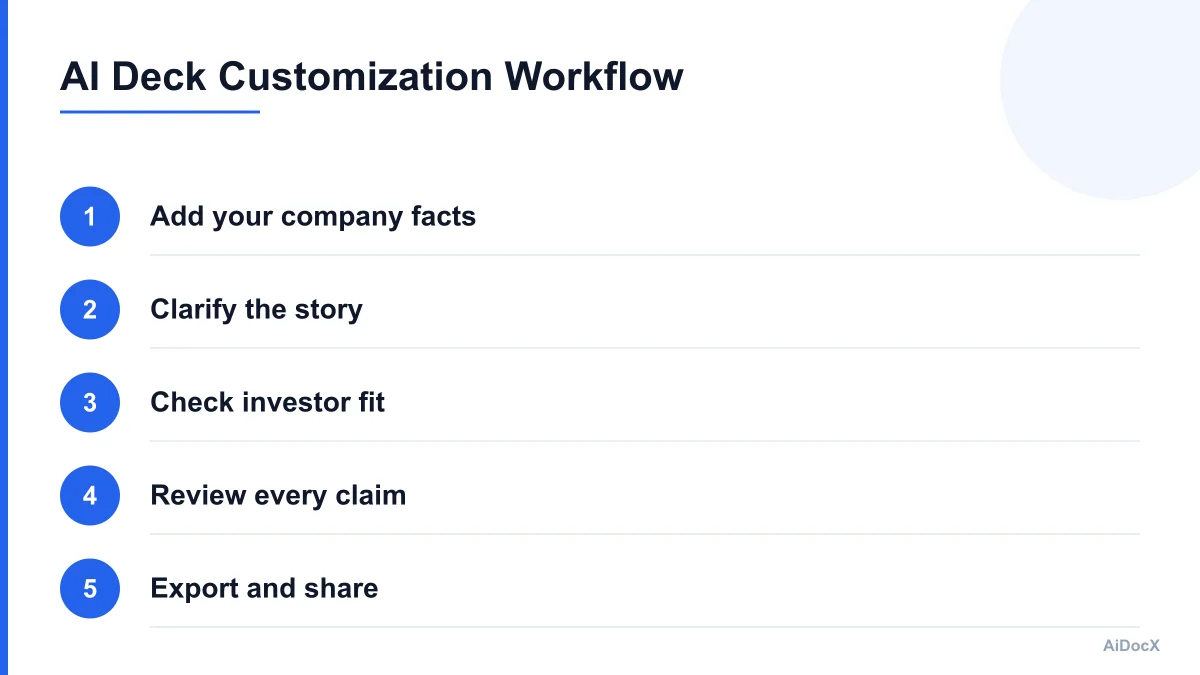
Start by assembling a source document with verified facts:
- Company description
- Target customer
- Problem evidence
- Product capabilities
- Customer conversations
- Traction metrics and dates
- Pricing assumptions
- Competitor notes
- Team biographies
- Fundraising target
- Planned milestones
Mark each item as confirmed, estimated, or unverified. This prevents a generated slide from presenting an assumption as fact.
Then ask the AI to create an outline before asking for polished copy. A useful prompt is:
Create a 12-slide investor pitch deck for a seed-stage B2B software company. Use only the facts in the source notes. For each slide, provide one headline, three supporting points, one suggested visual, and one missing-data question. Do not invent metrics.
Review the outline for narrative logic. The problem should lead naturally to the solution. The solution should connect to the market and business model. Traction should support the go-to-market plan. The fundraising ask should connect to milestones.
Next, use AI for focused revisions:
- Shorten a headline to one clear idea.
- Turn a feature list into an outcome-oriented slide.
- Find unsupported claims.
- Suggest three ways to visualize a workflow.
- Rewrite a paragraph for a technical or nontechnical audience.
- Compare the deck with an investor's stated sector focus.
- Create speaker notes without adding new facts.
AiDocX's AI pitch deck generator can help founders quickly customize a free template from their company information. For fundraising workflows that involve multiple recipients, AiDocX can also help track which investors viewed which slides, giving the team a more useful signal than simply knowing that a file was opened.
Treat AI output as an editable draft. Confirm every number, customer statement, competitor description, and market claim against your source notes. The founder remains responsible for what is sent.
Common Pitch Deck Mistakes to Avoid
The most common problems are usually strategic, not visual.
Too much text
If a slide contains several paragraphs, the investor will either skim it or stop reading. Move supporting detail into speaker notes or an appendix. Each slide should have one primary message that can be understood in a few seconds.
Generic positioning
"An AI-powered platform for the future of work" does not tell the reader who buys the product or why it matters. Use a specific customer and outcome.
Unsupported market size
Do not multiply a huge industry figure by an arbitrary percentage. Show the segment you can reach first and explain the assumptions.
Confusing activity with traction
Features shipped, meetings held, and impressions may matter, but they are not equivalent to customer demand. Label them accurately and connect them to a business outcome.
Hiding the business model
Investors should not have to infer how you make money. State who pays, how often, and what the current pricing hypothesis is.
Treating competition as an afterthought
Every customer has an alternative. Include manual work, internal builds, incumbent vendors, and inaction where relevant.
Over-designing the deck
Complex animations, tiny text, excessive colors, and inconsistent layouts make a deck harder to evaluate. Use a restrained visual system: one or two fonts, a small color palette, consistent spacing, and readable charts.
Sending one deck to everyone
A core deck can be reused, but the emphasis should change by audience. An enterprise software investor may care about sales efficiency and retention. A climate investor may focus on regulatory drivers and impact measurement. Customize the opening, evidence, and milestone slides when the investor fit warrants it.
Investor Pitch Deck Final Checklist
Use this checklist before you export and send the deck:
- The cover explains what the company does in one sentence.
- The problem is specific to a defined customer.
- Each major claim has supporting evidence or a clear label.
- The product slide shows the value-creating workflow.
- Market sizing uses stated assumptions.
- Pricing and revenue model are easy to understand.
- Traction metrics include dates and definitions.
- Competitors include the status quo.
- The go-to-market plan names a real channel.
- The team slide explains relevant founder-market fit.
- Financial projections are tied to operating assumptions.
- The fundraising ask connects to measurable milestones.
- Every slide is readable as a PDF on a laptop screen.
- Links, customer quotes, and numbers have been checked.
- The file name and version date are clear.
- The deck has been reviewed by someone outside the founding team.
How to Share the Deck During a Fundraising Round
Send the deck in a way that makes the next action easy. In an introduction email, write two or three sentences about the company, mention why you believe the investor may be a fit, and include a clear request for a meeting.
Do not send a large folder of documents before interest has been established. A pitch deck is usually the first layer of information. Financial models, customer references, technical documentation, and legal materials can follow during diligence.
Keep a simple investor tracking record with:
- Investor name and fund
- Introduction source
- Date sent
- Version sent
- Follow-up date
- Response
- Questions raised
- Next step
If you share a view-tracked deck, use engagement data as context rather than a verdict. A slide viewed for a long time may indicate interest, confusion, or that the file was left open. Combine viewing behavior with replies, questions, and meeting outcomes.
Update the deck when the company reaches a meaningful milestone, not every time a sentence changes. Too many slightly different versions create confusion. Maintain one master file and log which version each investor received.
Final Thoughts
A free investor pitch deck template is most valuable when it reduces blank-page anxiety and gives you a disciplined way to explain the company. The template should remain flexible: adapt the slide order, combine sections, and add an appendix when your business requires more detail.
Start with verified facts, build the narrative around the customer problem, and use AI to improve clarity and speed rather than manufacture certainty. A concise, evidence-based deck will give investors a better reason to continue the conversation—and give you a clearer understanding of what your company must prove in the next stage of fundraising.
Ready to automate your documents with AI?
Start free with AiDocX — AI contract drafting, meeting minutes, consultation notes, e-signatures, and more in one platform.
Get Started FreeMore from AiDocX Blog
Weekly Status Report Template: 4 Formats + Examples
Copy one of four weekly status report templates for individual work, projects, leadership, or blockers. See a worked example and a practical review checklist.
How to Read a Business Contract: A Founder's Checklist (2026)
A practical way to review parties, scope, money, IP, liability, and exit terms before signing a business contract.
 MinjiLee October 7, 2026 9 min
ESIGN vs eIDAS: What Founders Should Know About E-Signatures (2026)
What U.S. ESIGN and EU eIDAS actually say, where exceptions apply, and what founders should keep to document an electronic signing.
MinjiLee October 7, 2026 7 min