Nonprofit Bylaws Template: Draft, Approve, and File in 2026
Use this nonprofit bylaws template guide to draft clear rules, secure board approval, and avoid common 501(c)(3) application delays in 2026.
 James · Content Manager August 21, 2026 17 min read
Nonprofit Bylaws Template: Draft, Approve, and File in 2026
Nonprofit bylaws are the operating rules for your organization. They explain how the board makes decisions, how officers are appointed, how meetings work, and how the organization handles changes over time. This guide shows founders and board members what to include, how to draft and approve bylaws, and which mistakes can slow a 501(c)(3) application in 2026.
What nonprofit bylaws do (and do not) do
Bylaws translate your nonprofit's legal structure into practical governance rules. If the articles of incorporation establish the organization, the bylaws explain how that organization will function.
A good set of bylaws answers questions such as:
- Who has authority to make decisions?
- How many directors serve on the board?
- How are directors elected, removed, or replaced?
- How much notice is required before a meeting?
- What number of directors is needed for a quorum?
- How are officers selected and what do they do?
- How can the organization amend its bylaws?
- What happens if the organization dissolves?
Bylaws are also a continuity tool. Founders may understand the original plan, but future directors, staff, donors, auditors, and regulators need a written record of the organization's governance rules. Clear bylaws reduce uncertainty when leadership changes or when the board must make an urgent decision.
They are not, however, a substitute for every other formation document. State law generally determines nonprofit corporate status through the articles of incorporation or another organizing document. For federal tax exemption, the IRS looks closely at the organizing document's purpose and dissolution provisions. The IRS explains that bylaws alone generally do not satisfy the organizational test, although properly structured bylaws may sometimes be treated as an organizing document in limited circumstances. See IRS Publication 557 for the current explanation.
Bylaws also do not automatically create 501(c)(3) status. Your organization still needs to determine whether it must apply, prepare the appropriate Form 1023-series application, and submit it through Pay.gov if required. The bylaws should support the organization's actual structure and activities, but they are only one part of the application package.
A useful way to think about the documents is:
- Articles of incorporation: establish the legal entity and its permitted purposes.
- Bylaws: establish internal governance and operating procedures.
- Board resolutions: document specific decisions, such as adopting bylaws.
- Policies: provide detailed rules for conflicts of interest, whistleblowing, document retention, finance, and other operations.
- Form 1023 or Form 1023-EZ: asks the IRS to recognize federal tax-exempt status.
The best bylaws are specific enough to guide decisions but flexible enough to remain useful as the organization grows.
What to include in a nonprofit bylaws template
A nonprofit bylaws template should be a starting framework, not a document to approve without review. State nonprofit corporation laws vary, and your organization's mission, membership model, programs, and funding structure may require additional provisions.
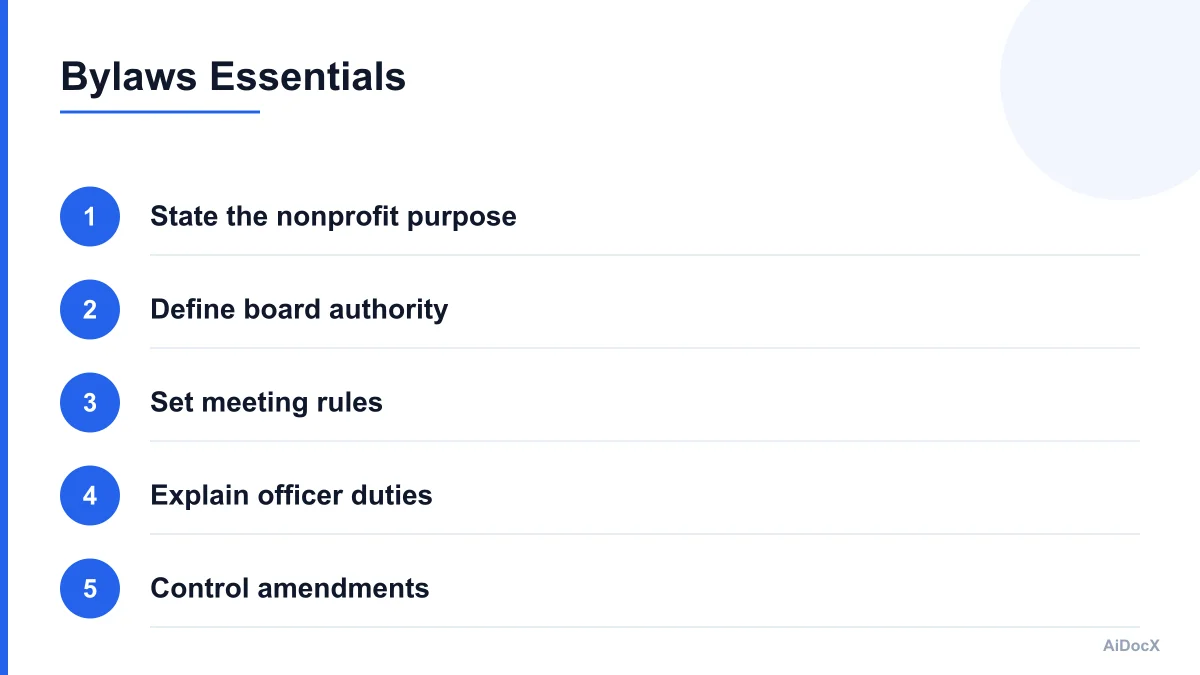
Most organizations should address the following sections.
1. Name and purpose
State the organization's legal name and, if useful, a short statement connecting the bylaws to the articles of incorporation. The purpose section in the bylaws should be consistent with the articles.
Avoid adding broad language that creates a conflict with the organization's claimed 501(c)(3) purposes. The articles, not merely the bylaws, should limit the organization's purposes to exempt purposes under section 501(c)(3). The IRS describes the required purpose and dissolution provisions in its guidance on organizing documents.
2. Board composition
Explain the number of directors or the permitted range. Identify whether the organization has voting and nonvoting directors, ex officio directors, or advisory members.
Clarify:
- Minimum and maximum board size.
- Eligibility requirements.
- Length of a director's term.
- Term limits, if any.
- Whether directors may serve consecutive terms.
- How vacancies are filled.
- How directors may resign or be removed.
- Whether the board may appoint an interim director.
If you use a range, state who determines the exact number. For example, "The board shall consist of not fewer than five and not more than eleven directors. The board may set the number of directors within that range by resolution."
Do not promise an ideal board structure that the organization cannot maintain. A five-person board with clearly defined terms is usually more workable than a template requiring twelve directors when the organization has only three active leaders.
3. Meetings and notice
Set rules for regular and special meetings. Include permitted meeting formats, such as in-person, telephone, or video conference, if state law allows them.
Cover:
- Annual meeting timing.
- Regular meeting frequency.
- Who may call a special meeting.
- Required notice period.
- How notice may be delivered.
- Whether directors may waive notice.
- Whether remote participation counts as attendance.
- How meeting minutes are approved and retained.
A practical clause might permit electronic notice and remote participation while requiring the organization to verify that participating directors can communicate with one another. Ask local counsel to confirm that the language fits your state's nonprofit corporation law.
4. Quorum and voting
Quorum is the minimum number of voting directors who must be present before the board can take official action. Voting requirements should be easy to apply in real meetings.
Specify:
- The number or percentage needed for a quorum.
- The vote needed to approve ordinary matters.
- Whether a majority means a majority of those present or of the entire board.
- Whether abstentions count in the denominator.
- Any higher vote required for removal, amendment, merger, or dissolution.
- Whether proxy voting is prohibited or permitted.
For example, "A majority of the directors then in office shall constitute a quorum. Unless a greater vote is required by law or these bylaws, an action is approved when it receives a majority of votes cast at a meeting where a quorum is present."
Do not use "majority" without explaining what it means. Ambiguous voting language can create disputes over whether a proposal passed.
5. Officers
List the officers the organization needs, such as chair, vice chair, secretary, and treasurer. Small nonprofits may combine roles where state law permits, but the president or chair and secretary are often kept separate to preserve basic checks and balances.
For each office, define:
- How the officer is elected or appointed.
- Term length.
- Whether an officer must be a director.
- Principal duties.
- Resignation and removal.
- How vacancies are filled.
- Whether the same person may hold multiple offices.
Avoid assigning legal or financial authority casually. If the treasurer is responsible for reports and oversight, state whether the treasurer is also authorized to sign checks or contracts. Signature authority can be handled in a separate financial policy or board resolution if that offers more flexibility.
6. Committees
Explain whether the board may create standing or special committees. State which committees may make recommendations and which, if any, may exercise delegated board authority.
A committee should not be given powers that state law reserves to the full board. It is also wise to specify who appoints committee members, how committee chairs are selected, and how committee reports reach the board.
7. Conflict of interest and compensation
Bylaws should address conflicts at a governance level, but a separate conflict-of-interest policy usually provides the detail needed for disclosure, recusal, review, and documentation.
Include a process requiring a director or officer to disclose a potential conflict and leave the discussion or vote when appropriate. State that the interested person's disclosure and recusal should be recorded in the minutes.
If the organization may compensate directors, officers, founders, or related parties, require approval by disinterested decision-makers and reasonable documentation. Compensation decisions should be made carefully and consistently with applicable law.
8. Records, indemnification, and amendments
Include provisions for maintaining corporate records, preparing minutes, and protecting directors and officers to the extent permitted by law. Indemnification clauses should be reviewed against state law and insurance coverage.
Finally, explain how bylaws are amended. State who may propose an amendment, how much advance notice is required, what vote is needed, and whether members, if any, must approve the change.
Bylaws Essentials
- State the nonprofit purpose
- Define board authority
- Set meeting rules
- Explain officer duties
- Control amendments
How to draft bylaws step by step
Drafting goes more smoothly when the board resolves structural questions before editing individual clauses.
Step 1: Confirm the legal and operational model
Start with the organization's state of incorporation, legal name, membership structure, planned board size, and intended activities. Determine whether the nonprofit has voting members or is board-governed without statutory members.
Review the filed articles of incorporation before drafting. Confirm that the name, purpose, registered details, and dissolution language align with the proposed bylaws. If the articles lack required 501(c)(3) language, fix that issue before treating the bylaws as complete.
Step 2: Gather state-law requirements
Use the nonprofit corporation statute and filing guidance for the state where the organization was formed. Check rules concerning:
- Required officers.
- Minimum board size.
- Director terms.
- Remote meetings.
- Member rights.
- Notice and voting.
- Interested-director transactions.
- Indemnification.
- Electronic signatures and records.
A generic online template may omit a requirement or include a provision that does not fit your jurisdiction. A short review by a nonprofit attorney is often less expensive than amending a defective structure after filing.
Step 3: Match governance rules to reality
Ask how the board will actually work. If directors live in different states, remote meetings and electronic notices should be addressed. If the founder will initially serve as both executive director and board chair, consider whether the bylaws should permit that arrangement temporarily and whether a separate independent chair is expected later.
Write rules that a future board can follow without guessing. Avoid overly detailed operational instructions in the bylaws when a board-approved policy would be easier to update.
Step 4: Draft in plain language
Use short sections and consistent terms. Choose either "director" or "board member" and define the term if both appear. Define "board," "members," "officer," and "in writing" if those terms could be interpreted in multiple ways.
Avoid copying provisions that refer to another organization, another state, or a different type of nonprofit. Search the draft for placeholders such as "[Organization Name]," "[State]," and "[Number]." Replace or remove every one before circulation.
Step 5: Compare the bylaws with the Form 1023 narrative
The board should compare governance provisions with the organization's planned activities and the answers it expects to provide on Form 1023 or Form 1023-EZ. If the application says the organization will have a five-member board but the bylaws require seven directors, resolve the difference.
Likewise, make sure the stated programs, officer roles, compensation arrangements, related-party transactions, and fundraising plans are described consistently across the documents.
Step 6: Create a clean approval copy
Prepare one clean PDF or document with:
- Organization name.
- Version date.
- Clear section numbering.
- No tracked changes or comments.
- Correct page numbers.
- A signature or certification page if your process uses one.
- A revision history if the bylaws are being amended.
AiDocX can help a team draft from a template, collect electronic signatures from board members on the same document, and retain the approved version in one secure location. The important governance practice is not the software itself; it is preserving a clear record of what the board approved and when.
How to get board approval and document adoption
Board approval is more than circulating a document and asking directors to reply "approved." The organization should create a record showing that directors received the proposed bylaws, had an opportunity to review them, and formally adopted them through the required process.
Send the draft with a decision memo
At least several days before the meeting, send:
- The proposed bylaws.
- A summary of major changes.
- The articles of incorporation.
- Any relevant state-law notes.
- A list of unresolved decisions.
- The proposed board resolution.
The decision memo should identify questions the board must answer, such as whether to use five or seven directors, whether to impose term limits, and whether the organization will have voting members.
Put adoption on the agenda
Include a specific agenda item such as "Consideration and adoption of amended and restated bylaws." The chair should explain the purpose of the vote and invite questions. If the draft has significant legal or structural implications, the board may want counsel or a governance committee to present it.
Record the motion accurately
The minutes should identify:
- The title and version date of the bylaws.
- The director who made the motion.
- The director who seconded it, if required.
- Any material discussion.
- The vote result.
- Any abstentions or recusals.
- The effective date.
A sample resolution could state:
"RESOLVED, that the board of directors adopts the Bylaws of [Organization Name], dated [date], attached to these minutes, effective as of [date], and authorizes the officers to take actions necessary to implement them."
Do not attach a draft that differs from the version actually discussed or approved.
Collect signatures consistently
If the organization uses electronic signatures, have every required signer sign the same final version. Do not create separate files that later need to be reconciled manually. Store the signed document with the meeting minutes and resolution.
The organization should be able to answer three questions months later:
- Which version was approved?
- Who approved it?
- When did it become effective?
Retain the governance record
Keep the final bylaws, signed resolution, minutes, and any amendment history with the organization's permanent corporate records. If the bylaws are amended, preserve the earlier version rather than overwriting it.
Bylaws versus articles, policies, and Form 1023
Many application delays begin with a document mix-up. Each document has a different purpose, and the IRS does not treat them as interchangeable.
| Document | Main function | Typical approval |
|---|---|---|
| Articles of incorporation | Create the nonprofit and define legal purposes | Incorporator and state |
| Bylaws | Set internal governance rules | Board of directors |
| Conflict policy | Detail disclosure and recusal procedures | Board of directors |
| Board resolution | Record a specific decision | Board of directors |
| Form 1023 or 1023-EZ | Request federal recognition of exemption | Authorized officer |
| Meeting minutes | Preserve evidence of decisions | Secretary or board |
The organizational test is especially important. The IRS generally expects the organizing document to limit the organization's purposes to section 501(c)(3) exempt purposes and to provide an appropriate dissolution provision. A statement in the bylaws, a founder's intention, or the organization's actual activities may not cure defective articles.
Before filing, compare the articles and bylaws for:
- Organization name.
- State of incorporation.
- Purpose language.
- Dissolution language.
- Member structure.
- Board structure.
- Officer names and authority.
- Effective dates.
If the organization has already filed articles without the required provisions, consult qualified counsel about amending them. Do not assume that uploading detailed bylaws will solve the problem.
Also distinguish tax exemption from state compliance. A nonprofit may need state charitable solicitation registration, annual reports, corporate renewals, payroll filings, sales-tax registrations, or other approvals. Federal recognition does not automatically complete those obligations.
Common mistakes that delay 501(c)(3) approval
A well-written bylaws document can still sit inside an inconsistent application. The following mistakes are common sources of questions, amendments, and delay.
Mistake 1: Treating bylaws as the organizing document
Applicants sometimes submit bylaws but overlook defective or missing articles of incorporation. Form 1023 generally requires an organizing document, and the document must contain the necessary purpose and dissolution provisions.
Fix: obtain the state-filed articles, verify the required clauses, and submit the correct document. Include bylaws when requested or useful, but do not rely on them to replace the articles.
Mistake 2: Copying a purpose clause that is too broad
A purpose such as "to conduct any lawful activity" may be acceptable under some state corporate statutes but is not enough by itself for the federal organizational test. A nonprofit's organizing document should limit its purposes to recognized exempt purposes.
Fix: use purpose language tailored to the organization's mission and reviewed against current IRS requirements.
Mistake 3: Missing or weak dissolution language
The organization should explain that, on dissolution, remaining assets will be distributed for one or more exempt purposes, to the federal government for a public purpose, or to another eligible recipient as permitted by law.
Fix: verify the clause in the articles, not just the bylaws. If a specific recipient is named, confirm that the language addresses what happens if that recipient is no longer qualified.
Mistake 4: Mismatched documents
An application may describe a board of three directors while the bylaws require five. The articles may use one legal name while the Form 1023 uses a different name. The narrative may describe programs that are not reflected in the organization's stated purpose.
Fix: create a document comparison table and review every name, date, number, role, and activity before submission.
Mistake 5: Ignoring actual activities
The IRS reviews what the organization plans to do, not only what its template says. Vague activity descriptions, unexplained fundraising, private benefit concerns, or commercial activities can prompt follow-up questions.
Fix: describe each significant program concretely. Explain who benefits, how the program operates, where it occurs, who delivers it, how it is funded, and how it furthers the exempt purpose.
Mistake 6: Omitting related-party details
Founder compensation, leases involving directors, family relationships, grants to insiders, and transactions with affiliated entities require careful disclosure and governance controls.
Fix: identify potential conflicts early, adopt a conflict-of-interest process, and document disinterested review and approval.
Mistake 7: Using an outdated or ineligible Form 1023-EZ assumption
Form 1023-EZ is not available to every organization. Eligibility depends on the IRS worksheet and the organization's circumstances. Choosing the shorter form without confirming eligibility can create avoidable problems.
Fix: review the current IRS eligibility requirements and use the full Form 1023 when required or when the organization's structure and activities need fuller explanation. The IRS application guidance identifies the available application routes.
Mistake 8: Failing to report material changes
If the organization changes its purposes, programs, structure, or other material facts while an application is pending, it may need to notify the IRS processing office.
Fix: assign one person to track material changes and compare them with the submitted application before taking major structural action.
Mistake 9: Submitting unreadable attachments
Scanned pages may be crooked, incomplete, unsigned when signatures are required, or impossible to read. Attachments may also omit the organization's name or EIN where the instructions call for identifying information.
Fix: combine the required attachments into a clear PDF, use descriptive file names, confirm page order, and retain the exact submitted copy.
Mistake 10: Assuming approval is automatic after filing
The organization should continue tracking its legal, tax, and governance obligations while the application is pending. Recognition may be retroactive in some circumstances, but that does not eliminate the need for accurate records and timely filings.
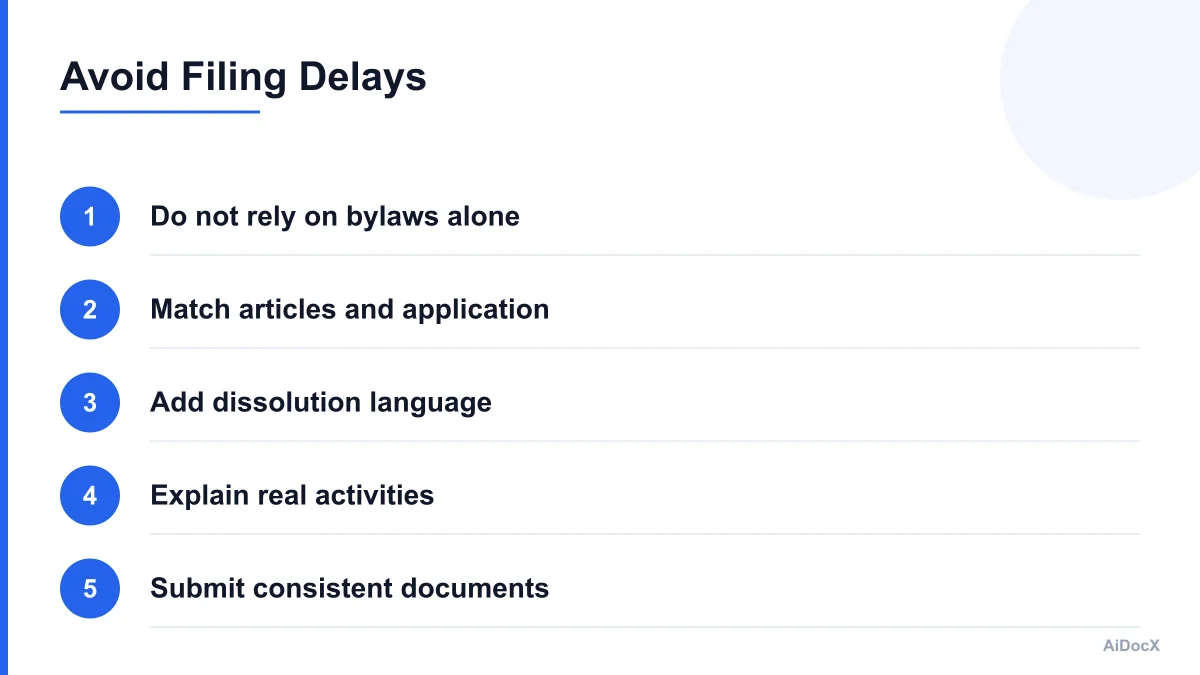
Avoid Filing Delays
- Do not rely on bylaws alone
- Match articles and application
- Add dissolution language
- Explain real activities
- Submit consistent documents
How to update bylaws after approval
Bylaws should evolve when the organization's structure changes, but amendments should be controlled. An informal edit to an old Word file can create competing versions and uncertainty about which rules apply.
Start by reviewing the amendment procedure in the current bylaws. Confirm who may propose an amendment, what notice is required, what vote is needed, and whether members or another body must approve it.
Then prepare an amendment memo explaining:
- The current provision.
- The proposed wording.
- Why the change is needed.
- Whether the change affects board composition, voting, membership, or officers.
- Whether articles, policies, contracts, or IRS disclosures are also affected.
- The proposed effective date.
Some changes belong in the articles rather than the bylaws. For example, changing the organization's legal purpose or dissolution language may require a state filing and possibly further federal review. Ask counsel before changing provisions that affect the organization's tax-exempt structure.
After adoption, keep:
- The approved amendment.
- The board resolution.
- Meeting minutes.
- The restated bylaws, if prepared.
- The previous version.
- Any state filing receipt.
- Notes about whether the IRS or another regulator must be notified.
A revision history at the end of the document can show the date and subject of each amendment without replacing the official governance record.
Final nonprofit bylaws and 501(c)(3) filing checklist
Use this checklist before the board vote and again before submitting a federal application.
- The legal name matches the state filing and EIN records.
- The articles of incorporation are available and complete.
- The articles contain suitable 501(c)(3) purpose language.
- The articles contain an appropriate dissolution provision.
- The bylaws match the organization's actual board structure.
- Voting members are clearly identified or expressly excluded.
- Director terms, vacancies, and removal rules are clear.
- Meeting notice and remote participation rules are workable.
- Quorum and voting standards are unambiguous.
- Officer duties and appointment rules are defined.
- Committee authority does not exceed legal limits.
- Conflict disclosures and recusals are documented.
- Compensation and related-party transactions receive disinterested review.
- The bylaws contain no unresolved placeholders.
- The draft has been checked against the planned Form 1023 answers.
- The board received the same final version for review.
- The adoption motion identifies the exact version and effective date.
- Minutes record the vote, abstentions, and recusals.
- Every signer signed the same final document.
- The approved version is stored with the corporate records.
- Form 1023 or Form 1023-EZ eligibility has been confirmed.
- Required attachments are complete, readable, and correctly labeled.
- A responsible person is tracking post-filing changes and deadlines.
The goal is not to make bylaws unusually long. It is to make them accurate, usable, and consistent with the organization's legal documents and actual operations. A carefully reviewed template can give the board a strong starting point, but state-law review and a document-by-document consistency check are what prevent many avoidable delays. Once approved, preserve one authoritative signed copy so future directors can see exactly which rules govern the organization.
Ready to automate your documents with AI?
Start free with AiDocX — AI contract drafting, meeting minutes, consultation notes, e-signatures, and more in one platform.
Get Started FreeMore from AiDocX Blog
Machine Shop Job Traveler Template: Routing Sheet + Example
Copy a machine shop job traveler template for small job shops. Includes a routing sheet, filled example, traceability fields, sign-offs, and setup tips.
How to Read a Business Contract: A Founder's Checklist (2026)
A practical way to review parties, scope, money, IP, liability, and exit terms before signing a business contract.
 MinjiLee October 7, 2026 9 min
ESIGN vs eIDAS: What Founders Should Know About E-Signatures (2026)
What U.S. ESIGN and EU eIDAS actually say, where exceptions apply, and what founders should keep to document an electronic signing.
MinjiLee October 7, 2026 7 min