Price Increase Letter Template 2026: Keep Customers
Use our 2026 price increase letter template to raise rates without losing clients. Includes step-by-step guidance, email scripts, and AI tools for seamless execution.
 James · Content Manager August 2, 2026 9 min read
Price Increase Letter Template 2026: How to Tell Customers About a Price Change Without Losing Them
Raising prices is one of the most nerve-wracking tasks for any small business owner. You worry about lost revenue, damaged relationships, and the awkwardness of the conversation. However, in 2026, failing to adjust your rates in line with inflation and operational costs is far more dangerous than communicating a change poorly. The key isn’t just raising the price; it’s framing the value so that your clients feel like they are part of your growth, not victims of it.
This guide provides a practical, no-nonsense approach to managing price increases. We will break down why the current economic landscape demands proactive pricing, how to structure your communication, and exactly what to say. By the end, you will have a clear template and a strategy to execute this change smoothly, preserving your reputation and your bottom line.
1. Why 2026 Is Different for Price Increases
In previous years, price increases were often viewed as a periodic inconvenience. In 2026, the business landscape has shifted. Clients are more educated about supply chain fluctuations, labor costs, and digital service premiums. They understand that "business as usual" is no longer a sustainable model for many industries. However, they also have more options than ever before. The barrier to switching vendors is lower, and the competition is global.
This environment creates two distinct challenges. First, trust is fragile. If you raise prices without context, clients assume you are simply greed-driven. Second, timing is critical. Announcing a price hike on the same day it takes effect is a guaranteed way to lose customers. In 2026, the expectation for transparency is higher. Clients want to know why their money is worth more. They want to see a correlation between the price increase and the quality, speed, or reliability of the service they receive.
Furthermore, the psychological impact of inflation has made clients more sensitive to cost. A 5% increase might feel like 10% if they are already tightening their belts. Therefore, your communication must be empathetic but firm. You are not asking for permission; you are informing them of a necessary business adjustment while reaffirming the value you provide. The goal is to make the price increase feel like a natural evolution of your partnership, not a sudden shock.
2. Timing Your Announcement Correctly
When you send a price increase letter matters as much as what you write. Sending it too early can lead to "decision fatigue," where clients procrastinate on renewing or signing new contracts. Sending it too late leaves you with no leverage and forces you to absorb costs or lose clients instantly.
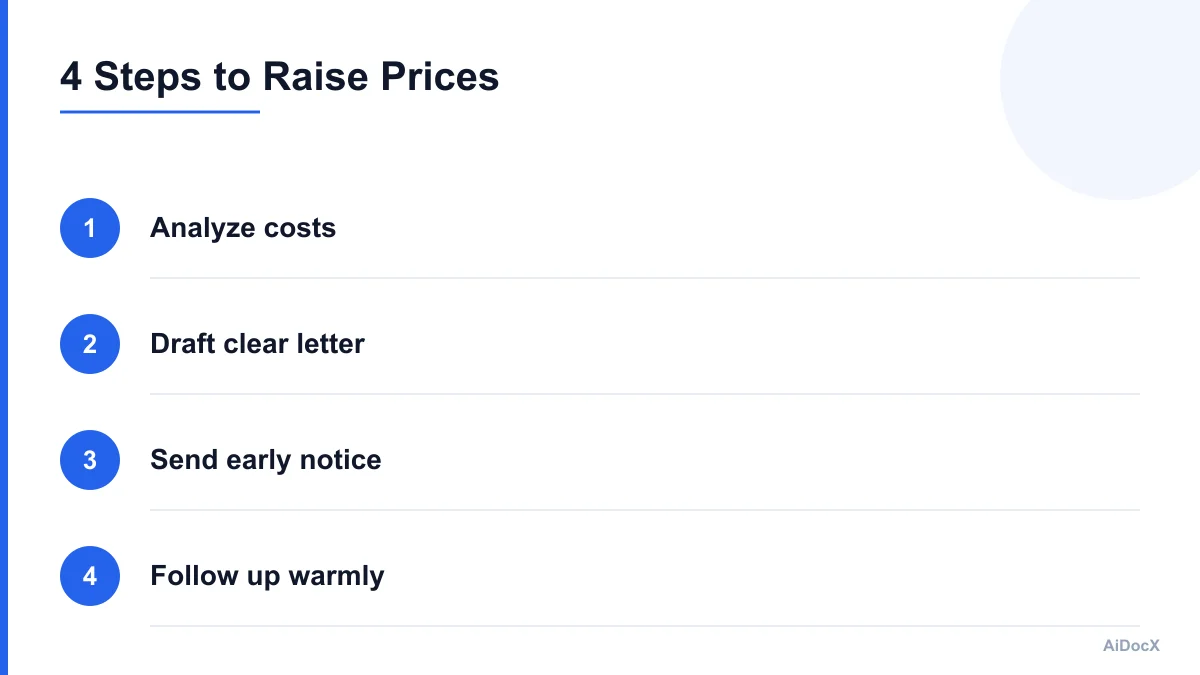
The ideal window for a price increase notification is 30 to 60 days before the effective date for existing clients, and at least 30 days for new quotes. This timeline serves three purposes: it gives clients time to adjust their budgets, it allows you to handle objections personally, and it demonstrates professionalism.
Consider the fiscal cycles of your clients. If your clients are small businesses, they likely plan their budgets in Q1 or Q4. Aligning your price increase with the start of their new fiscal year or quarter can make the transition smoother. Avoid announcing changes during periods of known industry instability or right after a major negative news event in your sector.
Additionally, segment your customer list. Not every client needs the same notice period or the same tone. Long-term, high-value clients might warrant a personal phone call followed by a formal letter. Newer clients or those on month-to-month contracts might only need a standard email notification. Tailoring your approach based on the relationship depth shows respect and increases the likelihood of retention.
3. Identifying the Right Message and Tone
Your tone should be confident, appreciative, and clear. Avoid apologetic language. You are not doing something wrong by raising prices; you are maintaining the quality your clients expect. Phrases like "We are sorry to inform you..." or "We hate to do this..." undermine your value and suggest that the price hike is a mistake.
Instead, use affirmative language. "To continue providing the high level of service you deserve..." or "As we invest in new tools to improve efficiency..." These phrases frame the increase as an investment in the client's experience.
Be specific about the reason. Vague reasons like "rising costs" can feel generic. Instead, highlight specific improvements or market realities. For example:
- "We have upgraded our security infrastructure to protect your data better."
- "We have expanded our support team to offer 24/7 assistance."
- "Industry-wide material costs have increased by 15%, and we are passing on only a fraction of that to maintain our quality standards."
However, be careful not to over-explain. You do not need to share your internal P&L statements. A brief, honest explanation is sufficient. The focus should remain on the value delivered, not just the costs incurred.
4. The Anatomy of a Winning Letter
A price increase letter is a document, not just an email. It should be professional, easy to read, and actionable. Here is the essential structure:
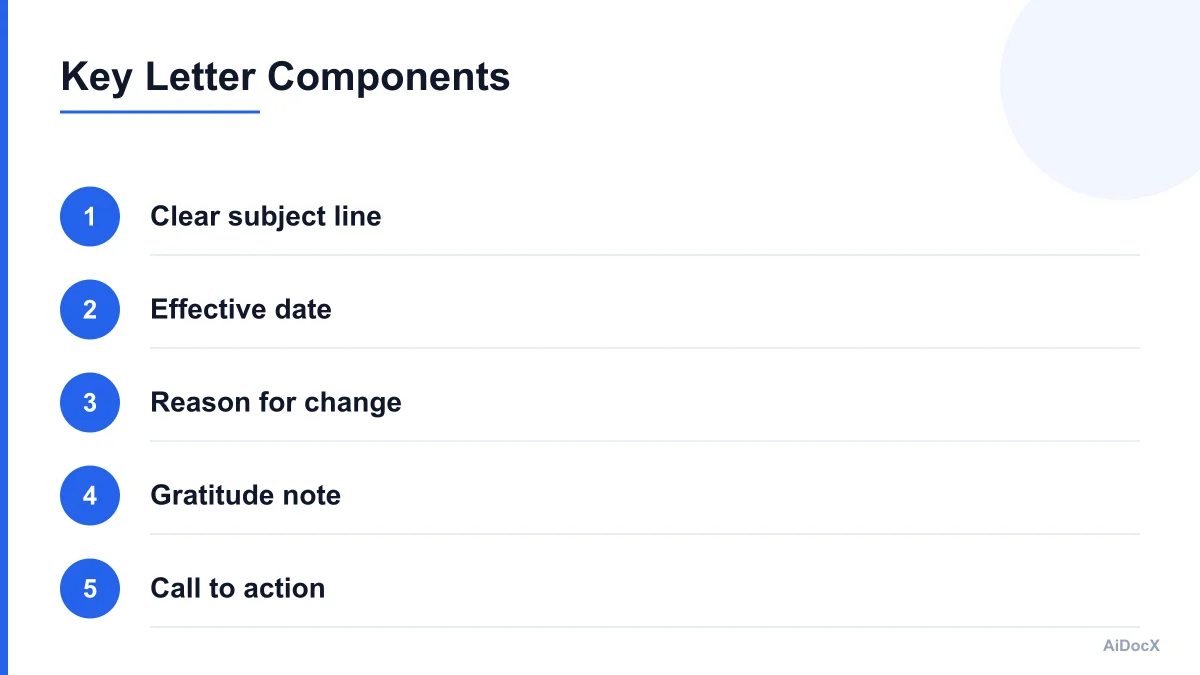
1. A Clear Subject Line Avoid ambiguity. Use phrases like "Important Update Regarding Your Account" or "2026 Pricing Update for [Company Name]." This ensures the email gets opened and treated with importance.
2. The Opening: Appreciation Start by thanking the client for their business. Acknowledge the relationship. "We have valued our partnership with [Client Name] over the past [Number] years..."
3. The Announcement: Direct and Clear State the change clearly. "Starting [Date], our prices will adjust by [Percentage/Amount]." Do not bury this in the middle of the paragraph. Make it stand out.
4. The "Why": Value Proposition Explain the reason briefly. Connect the price increase to value. "This adjustment allows us to continue investing in [Specific Benefit]..."
5. The Effective Date and Action Items Clearly state when the new price takes effect. If the client needs to take action (e.g., sign a new contract, update their PO system), list these steps clearly.
6. The Closing: Reassurance and Contact End on a positive note. Reiterate your commitment to their success. Provide a direct contact person for questions. "If you have any questions or would like to discuss this further, please contact [Name] directly."
5. Common Mistakes to Avoid
Even with a good template, execution errors can derail your strategy. Here are the most common pitfalls:
- Surprise Attacks: Announcing the increase on the invoice or the day it happens. This breeds resentment and often leads to immediate churn.
- Over-Apologizing: As mentioned, saying "sorry" repeatedly makes you look weak. It suggests the price is unjustified.
- One-Size-Fits-All: Sending the exact same generic email to your best clients and your most difficult clients. Personalization matters.
- Ignoring Objections: Not having a plan for how to handle pushback. Some clients will negotiate or leave. Have a script ready for these conversations.
- Failing to Follow Up: Sending the letter and disappearing. Follow up within a week to answer questions and confirm receipt.
6. How to Handle Objections and Retention
Not everyone will accept the new price. Some will push back, some will ask for a discount, and some may leave. This is normal. Your goal is to retain as many as possible while letting go of those who no longer align with your value proposition.
For Pushback: Listen actively. Understand if the issue is budget constraints or a perception of value. If it is budget, see if you can adjust the scope of work rather than the price. "We can reduce the monthly retainer to match your budget, but the per-hour rate will remain the same."
For Value Concerns: Reiterate the ROI. Show data, testimonials, or case studies that demonstrate the results they have achieved. "Since we implemented [Change], your efficiency has increased by 20%."
For Departing Clients: If a client decides to leave, do it gracefully. Ask for feedback. "We are sorry to see you go. Could you share what factors influenced your decision?" This data is invaluable for future improvements.
7. Streamlining the Process with AiDocX
Managing price increases for dozens or hundreds of clients can be administratively overwhelming. Drafting individual letters, tracking effective dates, and ensuring compliance can distract you from core business activities. This is where automation and AI-assisted tools become essential.
AiDocX helps you draft a clear, professional price increase letter tailored to your business and sends it to the full customer list at once. By using AiDocX, you can ensure consistency in your messaging, maintain a professional tone across all communications, and significantly reduce the time spent on administrative tasks. The platform allows you to customize templates based on client segments, ensuring that high-value clients receive a more personalized touch while standard clients get a streamlined notification. This efficiency allows you to focus on the human aspect of the conversation—answering questions and reinforcing relationships—rather than getting bogged down in paperwork.
Checklist for Your Price Increase
Before you send your price increase notifications, run through this checklist to ensure you are prepared.
- Review current market rates and inflation data to justify your increase.
- Determine the exact percentage or flat rate increase.
- Set the effective date (allow 30-60 days notice).
- Draft the letter using the structure provided above.
- Personalize the letter for key accounts if necessary.
- Prepare a FAQ document for common client questions.
- Train your sales/support team on how to handle objections.
- Schedule the emails/letters for delivery.
- Follow up with clients who do not respond within one week.
- Update your website and proposal templates with new pricing.
Conclusion
Raising prices in 2026 is not just a financial decision; it is a communication strategy. By being transparent, timely, and value-focused, you can navigate this change without losing your customers. Remember, your best clients expect you to run a healthy business. They want you to be successful because that ensures the quality of service they receive.
Use the template and strategies outlined here to communicate your changes with confidence. And remember, you don't have to do it alone. Tools like AiDocX can help you draft and distribute your price increase letters efficiently, ensuring you maintain professionalism and clarity across your entire customer base. Take the leap, communicate well, and keep growing.
Ready to automate your documents with AI?
Start free with AiDocX — AI contract drafting, meeting minutes, consultation notes, e-signatures, and more in one platform.
Get Started FreeMore from AiDocX Blog
AI Press Release Generator: Write One in Minutes (+ Template)
Learn what a press release is, the AP-style format, and how to use an AI press release generator to draft one in minutes with a fill-in template.
James September 21, 2026 10 min
Angel Investment Agreement (2026): Key Terms + Template Guide
Angel investor agreement explained: the four structures founders actually sign, key terms, securities basics, a closing checklist and a summary term sheet.
James September 21, 2026 12 min
Artist Commission Contract Template (2026): Free Template + Guide
Free artist commission contract template with license tiers, deposit, revision, refund and AI-training clauses, plus a guide to getting it e-signed.
James September 21, 2026 12 min