Generate a Compliant Privacy Policy with AI in 2026
Learn how to create a GDPR and PDP-compliant privacy policy using AI. Compare costs, avoid legal risks, and get a jurisdiction-aware document in minutes.
 James · Content Manager August 19, 2026 11 min read
Generate a Compliant Privacy Policy with AI in 2026
In 2026, data privacy is no longer an optional checkbox; it is a fundamental requirement for operating any digital business. Whether you are launching a SaaS platform, an e-commerce store, or a mobile app, you are legally obligated to inform users how you collect, process, and protect their personal data. However, for most startup founders and small business owners, hiring a specialized data privacy attorney is financially prohibitive and operationally slow. The gap between legal necessity and budget reality is widening, creating a urgent need for efficient, accurate, and accessible solutions.
The rise of AI-powered document generation has bridged this gap. By leveraging large language models trained on legal frameworks, you can now generate a robust, jurisdiction-aware privacy policy in minutes. This guide walks you through the process, explaining how AI interprets your data practices, which regulations it targets, and how to verify the output to ensure you remain compliant without breaking the bank.
Why Traditional Templates Fail in 2026
Many businesses still rely on static HTML templates found on free legal websites. While these templates were useful in the early days of the internet, they are increasingly dangerous in the current regulatory landscape. The primary issue is that privacy laws are not static; they evolve rapidly. The EU’s General Data Protection Regulation (GDPR) has seen numerous enforcement updates, while new laws like the Digital Privacy Act (DPA) in Australia and the Personal Data Protection Act (PDPA) in Singapore have introduced specific nuances that generic templates often miss.
Furthermore, generic templates rarely account for the specific context of your business. A template designed for a simple blog is ill-suited for an e-commerce site that processes payment data or an app that tracks user location. If your privacy policy claims you do not use cookies when your analytics platform clearly does, you are exposed to regulatory fines and loss of consumer trust.
The key failure points of static templates include:
- Lack of Jurisdiction Awareness: A standard template may not include the specific rights granted under local laws, such as the right to data portability under GDPR or specific consent mechanisms required under PDPA.
- Outdated Terminology: Legal definitions change. Terms like "data controller" and "data processor" have specific legal implications that must be used correctly based on your role.
- One-Size-Fits-All Approach: They do not adapt to your specific data flows. If you use a third-party marketing tool, the template must explicitly name that processor. Static templates cannot do this.
AI generation solves these issues by acting as a dynamic writer. It doesn't just fill in blanks; it constructs a narrative that reflects your actual business model and the legal landscape of your target markets.
The Cost of Getting It Wrong
To understand the value of efficient privacy policy generation, it is essential to look at the financial and reputational risks of non-compliance. The most common misconception is that small businesses are exempt from strict enforcement. In reality, regulatory bodies like the Information Commissioner’s Office (ICO) in the UK and various Data Protection Authorities (DPAs) across the globe actively monitor small and medium enterprises, particularly those handling sensitive data.
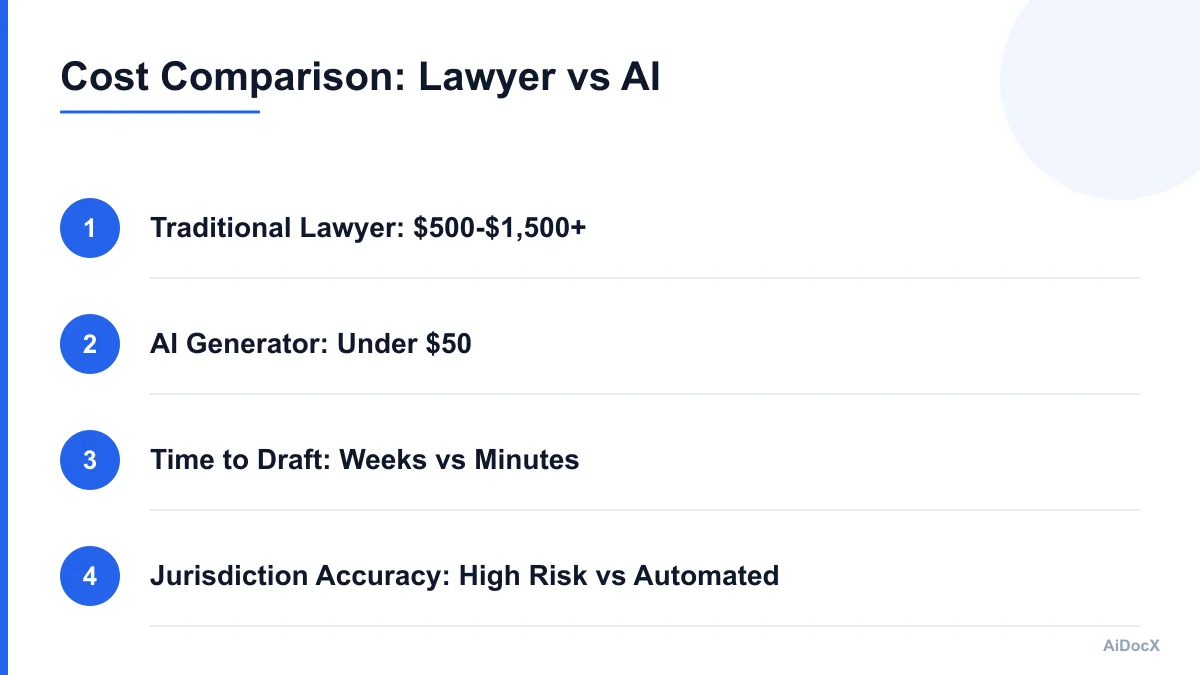
The financial penalty structure is severe. Under GDPR, fines can reach up to €20 million or 4% of global annual turnover, whichever is higher. While smaller violations may result in lower fines, the cost of legal defense alone can exceed the price of a compliant document. Beyond fines, there is the intangible cost of brand damage. In the 2026 consumer landscape, privacy-conscious users are quick to switch to competitors who demonstrate transparency.
Consider the following cost-benefit analysis:
- Legal Counsel: Hiring a lawyer to draft a custom privacy policy typically costs between $500 and $1,500 for a standard small business. For complex multi-jurisdictional apps, this can rise to $5,000+.
- Static Templates: Cost $0, but carry a high risk of inaccuracy. If a regulator flags your policy as generic or inaccurate, the fine may far exceed the cost of professional help.
- AI-Assisted Generation: Costs a fraction of legal fees. Tools like AiDocX’s AI document generator produce a jurisdiction-aware privacy policy in seconds from a brief description of data-collection practices, replacing the $500-$1,500 lawyer quote most small businesses face. This allows you to allocate budget to product development and marketing while maintaining legal hygiene.
The goal is not to avoid legal responsibility, but to manage it efficiently. An AI-generated policy serves as a strong foundation that can be reviewed by counsel if needed, but for most standard operations, it is sufficient to meet compliance thresholds.
Key Components of a Modern Privacy Policy
Regardless of the method you use to generate your policy, it must contain specific core elements to be considered compliant. Understanding these components helps you verify that your AI-generated document is thorough.
- Data Controller Identity: Clearly state who is responsible for the data. This includes your legal name, contact email, and registered address. Transparency here builds trust immediately.
- Types of Data Collected: Be specific. Do not just say "personal data." List categories such as "name, email address, IP address, and device ID." If you collect sensitive data (health, financial), this must be explicitly highlighted with enhanced protection measures.
- Purpose of Processing: Explain why you need the data. For example, "We collect your email address to send order confirmations and service updates." Vague statements like "to improve user experience" are often flagged by regulators as insufficient.
- Legal Basis for Processing: Under GDPR, you must cite the legal basis. Common bases include "Consent," "Contractual Necessity," or "Legitimate Interest." The AI should map your actions to the correct legal basis.
- Data Retention Periods: How long do you keep the data? If you store user profiles indefinitely, you must justify this. If you delete data after 30 days, state that. Ambiguity here is a common red flag.
- Third-Party Sharing: List all third-party processors. If you use Stripe for payments, Google Analytics for tracking, or AWS for hosting, they must be named or categorized. This is a critical area where generic templates often fail.
- User Rights: Detail how users can exercise their rights, such as access, rectification, erasure, and data portability. Provide a clear mechanism (e.g., a specific email address or a self-service portal) for exercising these rights.
- Security Measures: Briefly describe your technical and organizational measures. Mention encryption, access controls, and regular audits. You do not need to disclose security secrets, but you must demonstrate a commitment to safety.
How AI Ensures Jurisdictional Accuracy
The most significant advantage of using AI for privacy policies is its ability to handle jurisdictional complexity. A business selling in the US, EU, and Singapore faces three different legal frameworks. A human lawyer might charge premium rates to navigate this, but an AI model can apply logic to your user base to generate the appropriate clauses.
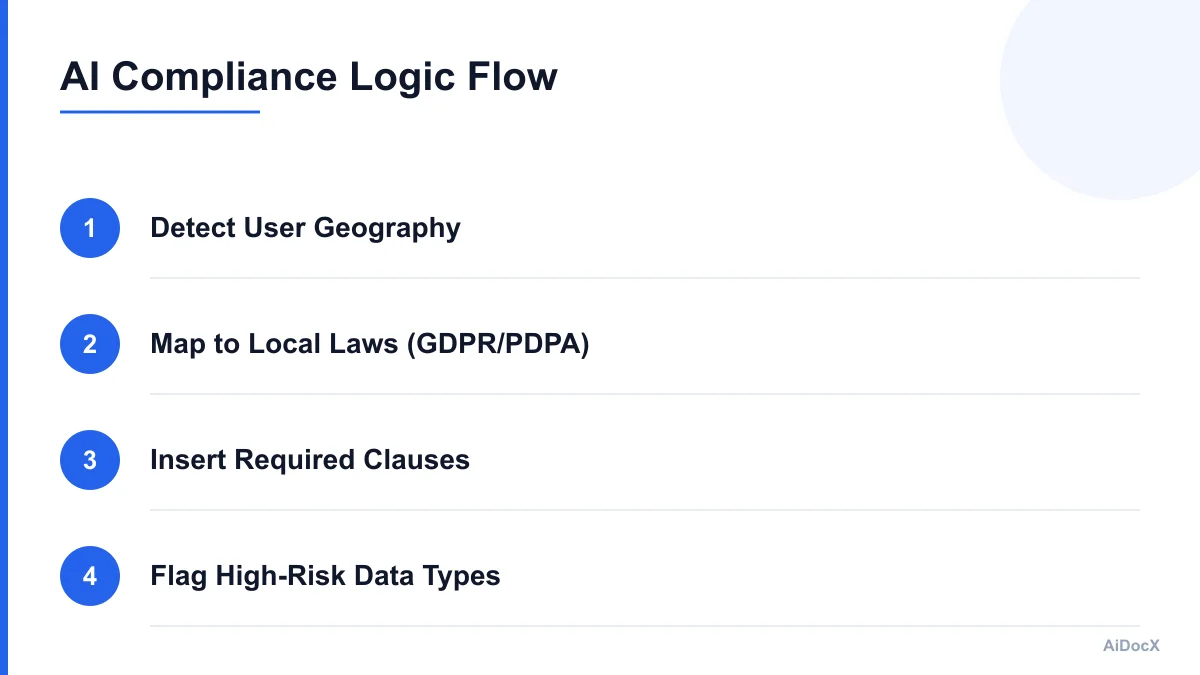
When you input your data practices into an AI generator, the system performs a series of logical checks:
- Geographic Mapping: The AI identifies where your users are located. If you target the EU, it applies GDPR. If you target Singapore, it applies PDPA. If you target California, it applies CCPA/CPRA.
- Clause Selection: Based on the jurisdiction, the AI selects the mandatory clauses. For instance, GDPR requires a "Right to Object to Direct Marketing," while PDPA emphasizes "Consent for Specific Purposes." The AI ensures both are present if you operate in both regions.
- Terminology Adaptation: The language shifts to match local legal standards. For example, the term "Personal Data" is standard in GDPR, while "Personal Information" might be more common in other contexts. The AI ensures consistency.
- Consent Mechanism Validation: The AI checks if your described data collection methods align with the consent requirements of the target jurisdiction. If you claim to collect location data without explicit consent in a GDPR region, the AI will flag this discrepancy or generate a clause that requires explicit opt-in.
This logic ensures that your policy is not just a generic document, but a tailored legal instrument that reflects the reality of your global operations. It reduces the risk of overlooking a specific regional requirement, which is a common pitfall for small businesses trying to DIY their compliance.
Step-by-Step: Generating Your Policy with AI
Generating a privacy policy with AI is a structured process. Here is how to do it effectively using a platform like AiDocX.
Step 1: Describe Your Business Model Start by providing a clear, concise description of your product. For example: "We are a B2B SaaS platform that helps marketers automate email campaigns. We collect user names, email addresses, and company domains. We use AWS for hosting and Mailchimp for email delivery."
Step 2: Define Data Flows Specify exactly what data is collected and how it is used. Be granular. Instead of "we track usage," say "we track page views and click events using cookies to analyze campaign performance." This level of detail allows the AI to generate accurate "Purpose of Processing" sections.
Step 3: Identify Third-Party Processors List every third-party service you use. This includes payment gateways, analytics tools, CRM software, and cloud providers. The AI will generate a "Third-Party Sharing" section that lists these entities and links to their privacy policies if available.
Step 4: Select Target Jurisdictions Indicate where your users are located. If you are unsure, select "Global" or "Multiple Regions." The AI will then generate a policy that includes the most stringent requirements, ensuring compliance across all borders.
Step 5: Review and Refine The AI will generate the draft. Read it carefully. Check for accuracy. Does it correctly state your data retention period? Does it name all your third-party processors? Make any necessary edits. This step is crucial because AI is a tool, not a replacement for human oversight.
Step 6: Publish and Monitor Once satisfied, publish the policy on your website. Set a reminder to review it annually or whenever you make significant changes to your data practices (e.g., adding a new feature that collects biometric data).
Common Mistakes to Avoid
Even with AI assistance, errors can occur. Here are the most common mistakes businesses make when generating privacy policies:
- Vague Data Descriptions: Saying "we collect personal data" is not enough. If the AI outputs this, it means your input was too vague. Refine your input to be specific.
- Missing Third-Party Links: Ensure that every third-party processor mentioned has a link to their privacy policy. This is a standard compliance requirement.
- Ignoring Cookie Consent: If you use cookies, your privacy policy must reference your Cookie Policy. Ensure these two documents are consistent.
- Outdated Contact Info: If you change your support email, update your privacy policy. An outdated contact address is a minor but noticeable error that undermines trust.
- Assuming "Set and Forget": Privacy policies are living documents. If you add a new feature that collects data, you must update the policy. AI can help you regenerate the relevant sections quickly.
Verifying Your AI-Generated Policy
How do you know if your AI-generated policy is good? Here is a checklist to verify its quality:
- Specificity: Does it name specific data types (e.g., "IP address") rather than general categories?
- Jurisdictional Clauses: Does it include rights specific to your target markets (e.g., GDPR right to erasure)?
- Third-Party Transparency: Are all third-party processors listed with links to their policies?
- Clear Contact Info: Is there a valid email address or form for data subject requests?
- Consistency: Does the policy align with your actual data practices? (e.g., if you don’t use cookies, the policy shouldn’t mention them).
- Readability: Is the language clear and understandable to a non-legal professional?
If you can check all these boxes, your policy is likely robust. For high-risk industries (healthcare, finance), consider having a lawyer review the final draft, but for most startups and e-commerce sites, the AI-generated policy is a sufficient and compliant solution.
Conclusion: Efficiency Meets Compliance
In 2026, the barrier to entry for compliant privacy practices has never been lower. You no longer need to choose between financial viability and legal safety. By leveraging AI-powered document generation, you can create a privacy policy that is accurate, jurisdiction-aware, and tailored to your specific business model in minutes.
This approach allows you to focus on what matters most: building your product and serving your customers. Compliance becomes a background task, handled efficiently and effectively. Whether you are a solo founder or a scaling startup, adopting AI for your legal documentation is a strategic move that saves time, reduces costs, and mitigates risk.
Start by documenting your data practices clearly. Use an AI tool to generate the initial draft. Review it for accuracy. Publish it. And remember, compliance is not a one-time event, but an ongoing commitment to respecting your users' privacy. With the right tools, that commitment is easier to maintain than ever before.
Ready to automate your documents with AI?
Start free with AiDocX — AI contract drafting, meeting minutes, consultation notes, e-signatures, and more in one platform.
Get Started FreeMore from AiDocX Blog
How to Read a Business Contract: A Founder's Checklist (2026)
A practical way to review parties, scope, money, IP, liability, and exit terms before signing a business contract.
 MinjiLee October 7, 2026 9 min
ESIGN vs eIDAS: What Founders Should Know About E-Signatures (2026)
What U.S. ESIGN and EU eIDAS actually say, where exceptions apply, and what founders should keep to document an electronic signing.
MinjiLee October 7, 2026 7 min
Does Document Automation Pay Off? An ROI Worksheet for Founders (2026)
Estimate document automation ROI with your own volume, time, labor, and software costs. Includes a clearly labeled example and break-even formula.
 Chloe October 7, 2026 8 min