Quote vs Estimate vs Invoice: Small Business Guide 2026
Confused by quote, estimate, and invoice? Learn the legal differences, when to use each, and how to streamline your billing process for better cash flow.
 James · Content Manager August 2, 2026 13 min read
Quote vs Estimate vs Invoice: Small Business Guide 2026
Navigating the paperwork of sales can feel like walking through a minefield. One wrong label, one misunderstood term, and you might find yourself bound to a price you can’t honor or unable to collect payment for work already done. For small business owners, clarity isn’t just about good design—it’s about legal protection and cash flow.
The three pillars of this process are the quote, the estimate, and the invoice. While often used interchangeably in casual conversation, they carry distinct legal weights and financial implications. Understanding when to use each document ensures you set clear expectations with clients, protect your margins, and maintain professional credibility. This guide breaks down the nuances of each document, helping you choose the right tool for every stage of your sales cycle.
The Core Differences: Legal and Financial Implications
To understand why these documents matter, we must look at their legal standing. In the world of commerce, words have weight. Mislabeling a document can inadvertently create a contract where none was intended, or worse, fail to create one where you need protection.
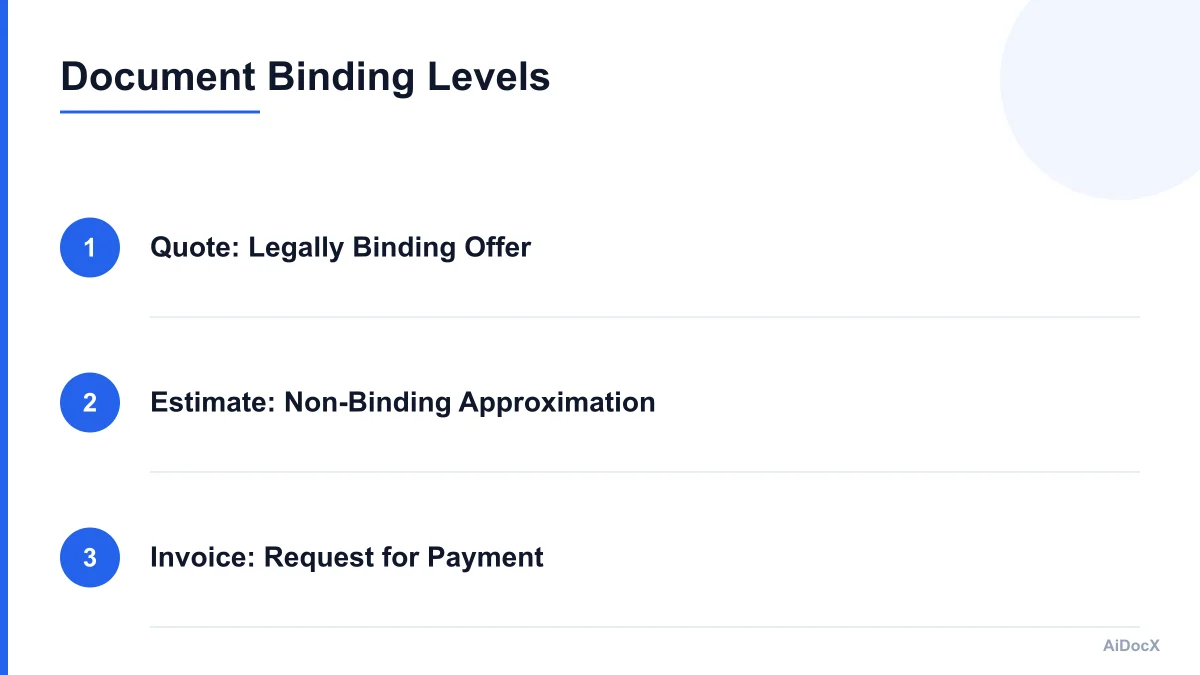
The Quote: A Firm Offer
A quote (also known as a price quote or firm quote) is a detailed document that specifies the exact price a business will charge for a specific product or service. Crucially, a quote is a legally binding offer. Once the client accepts the quote, a contract is formed. You are obligated to provide the goods or services at that exact price, provided the terms and conditions are met.
Quotes are ideal for projects with a defined scope and fixed costs. If you are a web developer building a five-page website with specific features, or a landscaper clearing a defined plot of land, a quote protects both parties. The client knows the final cost, and you have secured the work at a profitable rate.
The Estimate: A Reasonable Prediction
An estimate is an approximation of the cost of work. It is not a legally binding promise of a final price. Instead, it is a professional opinion on what the job should cost based on current information. Estimates are used when the scope of work is unclear, variable, or dependent on factors outside your control (such as material price fluctuations or unforeseen structural issues).
If a client hires you based on an estimate, you must charge a "reasonable" price. If the final cost significantly exceeds the estimate without communication, you risk losing the right to collect the difference. Estimates are essential for custom fabrication, emergency repairs, or creative services where the final output cannot be precisely predicted upfront.
The Invoice: A Demand for Payment
An invoice is not a sales document in the same sense as a quote or estimate; it is a bill for goods or services already provided. It serves as a formal request for payment and acts as a record of the transaction for accounting and tax purposes. An invoice details what was delivered, the quantity, the unit price, and the total amount due.
While quotes and estimates are forward-looking, invoices are backward-looking. They close the loop on a transaction. Without a proper invoice, tracking accounts receivable becomes chaotic, and chasing late payments is significantly harder.
When to Use Each Document: A Decision Framework
Choosing the right document depends on two factors: the certainty of your scope and the stage of the client relationship. Here is a practical framework to guide your decision-making.
Scenario 1: The Fixed-Price Project (Use a Quote)
Best for: Product sales, standardized services, projects with clear deliverables.
If you can define exactly what the client is getting and how long it will take, use a quote. This provides maximum security for both parties.
- Example: A graphic designer offering a logo package for $500.
- Why: The scope is defined (one logo, three revisions). The price is fixed.
- Risk if wrong: If you send an estimate, the client might expect the final price to stay at $500 even if you encounter unexpected complexity. If you send a quote, you are locked in, but you have clarity.
Scenario 2: The Variable Scope Project (Use an Estimate)
Best for: Repair work, custom manufacturing, consulting with undefined timelines.
If the project involves unknowns, an estimate protects you from margin erosion. It sets an expectation rather than a promise.
- Example: A plumber diagnosing and fixing a leaky pipe. The initial visit might cost $100, but the repair could require parts and additional hours.
- Why: You cannot know the final cost until you see the pipes. An estimate covers the diagnostic fee and provides a range for the repair.
- Risk if wrong: If you send a quote for the repair before diagnosis, and the job turns out to be three times harder, you are legally bound to the original price, potentially losing money on the job.
Scenario 3: Post-Completion (Use an Invoice)
Best for: All completed transactions.
Once the work is done, or at agreed-upon milestones, you must issue an invoice. This applies regardless of whether you started with a quote or an estimate.
- Example: The plumber has fixed the leak. You send an invoice for $350 (diagnostic + parts + labor).
- Why: This formalizes the debt. It triggers the payment clock and provides a legal paper trail for collection if necessary.
How to Structure a Professional Quote
A quote is more than a price tag; it is a sales tool that builds trust. A well-structured quote minimizes back-and-forth questions and sets the stage for a smooth contract.
Essential Elements of a Quote
- Header Information: Your business name, logo, contact details, and a unique quote number. This makes the document professional and searchable.
- Client Details: Name, address, and contact information of the client.
- Date and Validity: The date the quote was issued and an expiration date. Quotes should not be open-ended. A standard validity period is 30 days, which protects you if material costs rise or your schedule changes.
- Detailed Description of Goods/Services: Be specific. Instead of "Web Design," write "Design of homepage, about page, and contact page, including mobile responsiveness."
- Pricing Breakdown: List unit prices, quantities, and subtotals. This transparency helps clients understand what they are paying for.
- Terms and Conditions: Include payment terms (e.g., Net 30, 50% deposit required), delivery timelines, and any exclusions (what is not included in the price).
- Acceptance Section: A place for the client to sign and date, indicating their acceptance of the offer.
Best Practices for Quoting
- Be Specific: Ambiguity leads to scope creep. If it’s not in the quote, it’s not in the price.
- Highlight Value: Use the description section to explain why your service is worth the price.
- Keep it Simple: Avoid legal jargon where possible. Clear language prevents misunderstandings.
How to Structure an Estimate
An estimate requires a different tone. It must communicate flexibility while maintaining professionalism. The goal is to provide a realistic range, not a fixed number.
Essential Elements of an Estimate
- Clear Labeling: The word "ESTIMATE" should be prominent. Do not use "Quote" or "Invoice" on an estimate document.
- Scope of Work: Describe the work to be done, but acknowledge variables. Use phrases like "subject to inspection" or "based on current conditions."
- Price Range or Hourly Rate: Instead of a fixed total, provide a minimum and maximum cost, or an hourly rate with an estimated number of hours.
- Example: "Plumbing repairs: $200 - $400" or "Consulting: $150/hour (estimated 10 hours)."
- Assumptions and Exclusions: Clearly state what factors could change the price. For example, "Price excludes permits" or "Cost assumes no structural damage is found."
- Validity Period: Like quotes, estimates should have an expiration date. Conditions change, and so do material costs.
- Disclaimer: Include a statement that the final price may vary based on actual conditions and that a detailed quote will be provided once the scope is confirmed.
Best Practices for Estimating
- Under-promise, Over-deliver: It is better to come in under budget than over. If you estimate $1,000, consider if $1,200 is a safer upper bound.
- Communicate Changes: If the work exceeds the estimate, contact the client immediately. Do not wait until the end of the job to present the final bill.
- Get Confirmation: Ask the client to confirm they understand the estimate is a range, not a fixed price.
How to Structure an Invoice
An invoice is a legal document. It must be accurate, clear, and easy to pay. Poorly formatted invoices lead to delayed payments and administrative headaches.
Essential Elements of an Invoice
- Label: The word "INVOICE" must be clearly visible.
- Invoice Number: A unique, sequential number for tracking.
- Issue Date and Due Date: Clearly state when the invoice was issued and when payment is due (e.g., "Due on Receipt," "Net 15," "Net 30").
- Client and Vendor Details: Both parties’ names, addresses, and contact info.
- Line Items: A detailed list of products or services, including:
- Description
- Quantity/Hours
- Unit Price
- Total per line
- Subtotal, Taxes, and Grand Total: Show the math. Include any applicable sales tax.
- Payment Instructions: How should the client pay? Bank transfer details, credit card link, or check mailing address.
- Late Fees: If applicable, state the penalty for late payment.
Best Practices for Invoicing
- Send Immediately: The sooner you send the invoice, the sooner you get paid. Do not wait for the end of the month if the work is done on the 5th.
- Be Detailed: If a client disputes a charge, a detailed invoice makes it harder for them to justify non-payment.
- Follow Up: If payment is late, send a polite reminder. Automation can help here.
Integrating Your Workflow: From Quote to Invoice
The biggest mistake small businesses make is treating these documents as silos. A quote should seamlessly transform into an invoice upon completion. This integration reduces errors and saves time.
The Danger of Manual Re-entry
If you create a quote in one tool, an estimate in another, and type the details manually into an invoice template, you introduce risk. Typos in prices, missed line items, and inconsistent formatting are common. Worse, you lose the link between the original agreement and the final bill. If a client disputes an invoice, you have to dig through emails to find the original quote to prove your pricing.
The Solution: Linked Document Generation
Modern document management tools allow you to generate quotes, estimates, and invoices from a single source of truth. By using an AI-powered platform like AiDocX, you can create a quote or estimate, and when the project is complete, convert it into an invoice with one click.
This linkage ensures that:
- Data Consistency: The line items, prices, and client details remain identical across all documents.
- Audit Trail: You can trace an invoice back to the original quote or estimate, providing a clear history of the engagement.
- Efficiency: You spend less time re-typing data and more time delivering services.
AiDocX generates quotes, estimates, and invoices from the same AI writer and keeps them linked so nothing gets lost between stages. This approach not only speeds up your billing cycle but also enhances professional credibility. Clients appreciate seeing consistent branding and accurate details across all communications.
Common Mistakes to Avoid in Your Billing Process
Even experienced business owners make errors in their billing documentation. Here are the most common pitfalls and how to avoid them.
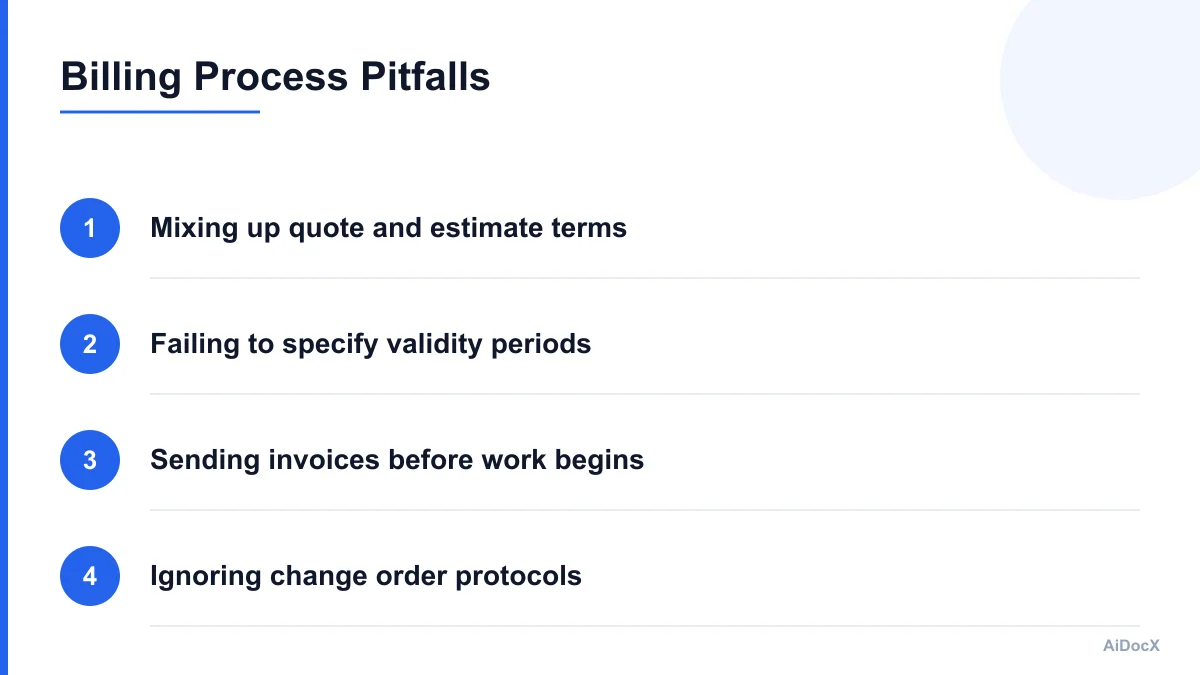
1. Mixing Up Quotes and Estimates
This is the most frequent legal error. If you send a quote when you meant to send an estimate, you have lost your flexibility. Conversely, if you send an estimate when you meant to send a quote, you may struggle to collect the full price if the job becomes more complex.
- Fix: Use a standardized template for each document type. Label them clearly. Train your team on the distinction.
2. Vague Descriptions
"Consulting services" or "Labor" are not enough. If a client disputes the value, vague descriptions offer no defense.
- Fix: Be specific. "Consulting services for Q3 marketing strategy" or "Labor: 4 hours of site preparation."
3. Ignoring Change Orders
Scope creep is the enemy of profitability. If the client asks for additional work that was not in the original quote or estimate, you must document it.
- Fix: Use a change order document. This is an amendment to the original contract that specifies the additional work and cost. Never proceed with extra work without written approval.
4. Missing Payment Terms
If you don’t specify when payment is due, you may be forced to wait longer than you intend. In many jurisdictions, if no payment term is specified, the default may be Net 30 or even Net 60.
- Fix: Always include clear payment terms (e.g., "Due on Receipt" or "Net 15") on your invoice and quote.
5. Not Getting Signatures
A quote without acceptance is just a piece of paper. An estimate without acknowledgment is just a guess.
- Fix: Require a signature or email confirmation for quotes and estimates. For invoices, a signature is not required, but proof of delivery is.
Quick Checklist: Document Readiness
Before sending any billing document, use this checklist to ensure accuracy and professionalism.
- Document Type Correct: Is it clearly labeled as Quote, Estimate, or Invoice?
- Client Details Accurate: Are the name, address, and contact info correct?
- Scope Defined: Is the description of goods or services specific and unambiguous?
- Pricing Clear: Are unit prices, quantities, and totals correct?
- Validity/Due Dates: Is the expiration date (for quotes/estimates) or due date (for invoices) included?
- Terms Included: Are payment terms, late fees, and exclusions stated?
- Contact Info: Is your contact information easy to find for questions?
- Branding: Does the document reflect your professional brand?
Final Thoughts: Clarity Drives Cash Flow
The difference between a quote, an estimate, and an invoice is not just semantic; it is strategic. Using the right document at the right stage protects your legal interests, manages client expectations, and ensures you get paid.
Quotes bind you to a price for defined work. Estimates provide a range for variable work. Invoices request payment for work done. By understanding these distinctions and integrating your workflow with tools that link these documents, you reduce administrative friction and build stronger client relationships.
Start reviewing your current billing process. Are you using the right documents? Are they linked? Taking these steps today will save you time, money, and stress tomorrow.
FAQ: Common Questions
Can I send an invoice instead of a quote? Technically, yes, but it is risky. An invoice assumes the price is agreed upon. If the client disputes the price, you have no prior agreement to reference. It is best practice to provide a quote or estimate first.
How long should a quote be valid? There is no legal standard, but 30 days is common. This protects you from market fluctuations. Specify the validity period in the document.
What if the final cost exceeds the estimate? Contact the client immediately. Explain the reasons for the increase (e.g., unforeseen issues, material cost hikes). If the increase is significant, you may need to issue a revised estimate or a change order before proceeding.
Do I need a contract in addition to a quote? For small, simple jobs, a quote with terms and conditions can serve as a contract. For larger, complex projects, a separate, detailed service agreement is recommended.
Ready to automate your documents with AI?
Start free with AiDocX — AI contract drafting, meeting minutes, consultation notes, e-signatures, and more in one platform.
Get Started FreeMore from AiDocX Blog
AI Press Release Generator: Write One in Minutes (+ Template)
Learn what a press release is, the AP-style format, and how to use an AI press release generator to draft one in minutes with a fill-in template.
James September 21, 2026 10 min
Angel Investment Agreement (2026): Key Terms + Template Guide
Angel investor agreement explained: the four structures founders actually sign, key terms, securities basics, a closing checklist and a summary term sheet.
James September 21, 2026 12 min
Artist Commission Contract Template (2026): Free Template + Guide
Free artist commission contract template with license tiers, deposit, revision, refund and AI-training clauses, plus a guide to getting it e-signed.
James September 21, 2026 12 min