How to Follow Up on Sales Quotes Without Being Annoying in 2026
Stop guessing when to follow up. Learn the psychology, timing, and templates that turn silent quotes into closed deals in 2026 without being pushy.
 James · Content Manager August 2, 2026 9 min read
How to Follow Up on Sales Quotes Without Being Annoying in 2026
You sent the quote. It was perfect. Clear pricing, tailored scope, professional formatting. Then... silence.
For small business owners and salespeople, this silence is the most expensive part of the sales cycle. It’s where deals go to die. Not because the prospect doesn’t want your solution, but because they got distracted, overwhelmed, or simply forgot.
Following up is not a nuisance; it is a necessity. However, most follow-ups are lazy. They are generic "just checking in" emails that add no value and irritate the recipient. To close more deals in 2026, you need a strategic approach that respects the prospect’s time while gently guiding them toward a decision.
This playbook provides the psychology, timing, and templates you need to turn quiet quotes into signed contracts.
The Psychology of the "Silent" Prospect
Before you write another email, you must understand why your prospects go silent. It is rarely personal. It is rarely a rejection of your product. It is almost always a failure of prioritization on their end.
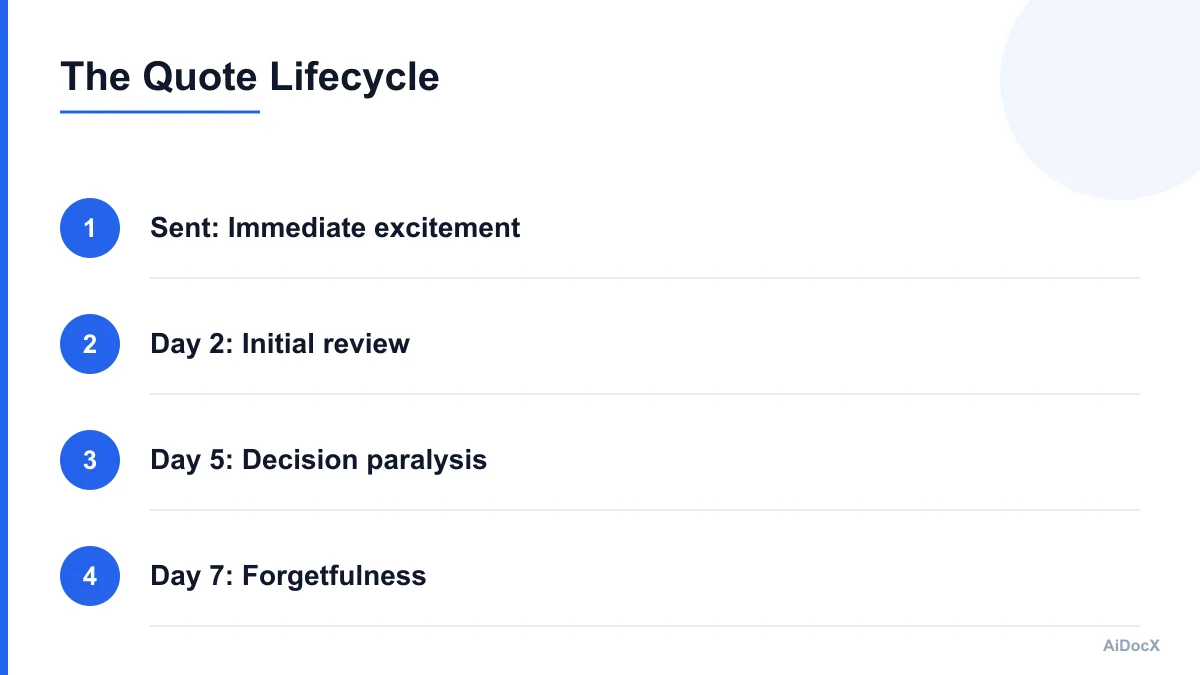
When a prospect receives a quote, they experience a brief spike of dopamine. The problem is solved. The need is acknowledged. But then, life happens. An urgent internal meeting arises. A competitor calls. The invoice gets buried under ten other emails.
The Peak-End Rule
Psychologically, people remember the peak intensity of an experience and how it ended. If your quote was sent with high energy, but your follow-up is low-energy and passive ("Just checking in"), the overall perception of your professionalism drops. You want the follow-up to maintain the momentum of the initial interaction.
Decision Fatigue
Small business owners and procurement officers are bombarded with decisions daily. A quote requires them to:
- Review the details.
- Consult with stakeholders.
- Compare against competitors.
- Approve the budget.
- Sign the document.
This is a high-friction process. If you make it easier, they are more likely to move forward. If you add friction (by being vague or annoying), they will delay.
The "Ghosting" Myth
Do not take silence personally. A silent prospect is not necessarily a lost cause. They are often in "analysis paralysis." They want to buy, but they need a nudge, a reminder, or a new piece of information to break the deadlock. Your job is to provide that nudge without adding pressure.
Timing is Everything: When to Follow Up
One of the biggest mistakes small businesses make is following up too soon or too late. The "Goldilocks" zone for follow-ups has shifted in 2026 due to increased email volume and shorter attention spans.
The First Follow-Up: 24-48 Hours After Sending
Do not wait a week. If you sent the quote on Tuesday, follow up on Wednesday or Thursday morning.
Why? The quote is still top-of-mind. The prospect may have just opened it and thought, "I need to check this with my partner." A gentle nudge helps them take that next step.
The Mistake: Sending a follow-up immediately (within an hour). This looks desperate and insecure.
The Second Follow-Up: 3-5 Days Later
If there is no response, wait a few days. This gives the prospect time to actually read the quote and consult with their team.
The Mistake: Sending a second email the next day. This crosses the line from persistent to annoying.
The Third Follow-Up: 7-10 Days Later
At this point, the prospect has likely forgotten about the quote entirely. You need to re-engage them with a new angle or value proposition.
The Mistake: Using the same subject line and body as the previous emails. You must change the context.
The Final Follow-Up: 14-21 Days Later
This is your "break-up" email. It removes the pressure and gives the prospect an out. Paradoxically, this often triggers the highest response rate because it relieves the guilt of ignoring you.
The Mistake: Never following up after the break-up email. If they don’t reply, let them go. You have done your due diligence.
The 3-Step Follow-Up Framework
To ensure your follow-ups are effective, use this three-step framework for every email you send:
1. Add Value, Don’t Just Ask
Never send an email that only asks for something. Always provide something. This could be:
- A case study relevant to their industry.
- A link to a blog post solving a problem they mentioned.
- A new piece of information (e.g., "I just updated the pricing structure...").
2. Create Low-Friction Urgency
Urgency should be based on facts, not fake scarcity.
- Bad: "Hurry, prices are going up tomorrow!" (Unless true).
- Good: "I have capacity to start this project next week, but I need to confirm by Friday to secure that slot."
3. Ask a Specific Question
Vague questions get vague answers. Specific questions get specific answers.
- Bad: "Let me know if you have any questions."
- Good: "Do you have any questions about the implementation timeline?" or "Should I hold this rate for another week?"
Templates That Convert: Copy-Paste and Adapt
Here are four templates tailored for different stages of the follow-up process. Customize them to fit your voice and industry.
Template 1: The Day-2 Check-In
Subject: Quick question about [Project Name] quote
Hi [Name],
I hope you’re having a great week.
I’m writing to check if you had a chance to review the quote I sent on [Day]. I wanted to make sure you didn’t have any questions about the [Specific Item, e.g., delivery timeline or pricing].
If you need any adjustments to better fit your budget, just let me know. I’m happy to tweak it.
Best, [Your Name]
Template 2: The Day-5 Value Add
Subject: Case study: How [Competitor/Similar Company] solved [Problem]
Hi [Name],
I was thinking about your challenge with [Specific Pain Point] and came across this case study from [Similar Company]. They saw a [X]% increase in efficiency after implementing [Your Solution].
I thought it might be helpful as you review the quote.
Are you still looking to move forward with this project?
Best, [Your Name]
Template 3: The Day-10 Urgency Nudge
Subject: Availability for [Project Name]
Hi [Name],
I’m currently finalizing my schedule for next month. I’d love to include [Project Name] in my calendar, but I need to confirm the scope by [Day of Week].
If you’re ready to proceed, I can send over the agreement today. If you need more time, just let me know, and I’ll hold the spot for another [X] days.
Best, [Your Name]
Template 4: The Break-Up Email
Subject: Closing the file on [Project Name]?
Hi [Name],
I haven’t heard back from you, so I assume [Project Name] isn’t a priority right now.
I’m going to close this file on my end to free up my resources for other clients. If you decide to revisit this in the future, just reply to this email, and we can pick up where we left off.
No hard feelings!
Best, [Your Name]
Leveraging Technology: When Did They Open It?
One of the biggest sources of anxiety in sales is not knowing if your prospect has seen your quote. Did they delete it? Did they open it and ignore it? Did they forward it to their boss?
Guessing leads to bad timing. You might follow up too early, appearing impatient, or too late, appearing disinterested.
This is where tools like AiDocX become invaluable. By using a platform that shows exactly when a prospect opens a quote, you can time your follow-up with precision.
For example, if you see that a prospect opened your quote three times in one day but didn’t reply, you know they are actively considering it but are stuck on a detail. Your follow-up should address that specific hesitation. If they opened it once and never again, they may have forgotten. Your follow-up should be a gentle reminder.
This data removes the guesswork. It allows you to follow up at the right moment, increasing your response rates and reducing the annoyance factor. You’re not just sending emails; you’re having a conversation based on their actual behavior.
Common Mistakes to Avoid
Even with the best templates, small business owners often fall into traps that kill deals. Avoid these common pitfalls.
1. Being Too Personal
Keep the follow-up professional. Do not ask about their weekend, their kids, or their sports team unless you have an established relationship. In 2026, privacy concerns are higher, and overly personal emails can feel intrusive.
2. Over-Explaining
Do not re-write the quote in every follow-up email. The prospect has it. They can look at it. Your job is to facilitate the decision, not to re-sell the product every time.
3. Using Negative Language
Avoid phrases like "I’m worried you forgot," "Why haven’t you replied," or "I’m chasing you." These create guilt and defensiveness. Instead, use positive, forward-looking language.
4. Sending Too Many Channels at Once
Do not email, LinkedIn message, and call on the same day. Spread your touchpoints. Email is primary. LinkedIn is secondary. Phone is for high-value prospects or final attempts.
A/B Testing Your Follow-Ups
To continuously improve your close rate, you should A/B test your follow-up emails.
Test Subject Lines
Subject lines determine open rates. Test:
- Question-based: "Any questions on the quote?"
- Value-based: "Idea for [Project Name]"
- Urgency-based: "Final availability for [Month]"
Test Call-to-Actions (CTAs)
Test different ways of asking for the close.
- Direct: "Shall I send the agreement?"
- Soft: "Let me know if you’re ready to move forward."
- Alternative: "Is there a better person I should speak with?"
Track and Iterate
Use your CRM or email tracking tool to see which subject lines and CTAs get the highest response rates. Double down on what works.
The Follow-Up Checklist
Use this checklist to ensure every follow-up is optimized.
- Did I wait the appropriate amount of time since the last contact?
- Did I add value in this email (not just ask for something)?
- Is the subject line clear and compelling?
- Did I ask a specific, easy-to-answer question?
- Is the tone professional and helpful?
- Did I check if the prospect opened the quote before sending?
- Is there a clear next step for the prospect?
Closing the Loop: From Quote to Contract
Following up on sales quotes is not about being annoying; it’s about being helpful. It’s about recognizing that buying is a process, and your job is to guide the prospect through that process with clarity and confidence.
By understanding the psychology of the silent prospect, timing your follow-ups correctly, and using value-added templates, you can significantly increase your close rate. And by leveraging technology like AiDocX, you can remove the guesswork and follow up with precision.
Remember, every "no" or silence is a learning opportunity. Analyze your follow-ups, refine your approach, and keep moving forward. The next deal is just one well-timed email away.
Start implementing these strategies today. Your pipeline will thank you.
Ready to automate your documents with AI?
Start free with AiDocX — AI contract drafting, meeting minutes, consultation notes, e-signatures, and more in one platform.
Get Started FreeMore from AiDocX Blog
AI Press Release Generator: Write One in Minutes (+ Template)
Learn what a press release is, the AP-style format, and how to use an AI press release generator to draft one in minutes with a fill-in template.
James September 21, 2026 10 min
Angel Investment Agreement (2026): Key Terms + Template Guide
Angel investor agreement explained: the four structures founders actually sign, key terms, securities basics, a closing checklist and a summary term sheet.
James September 21, 2026 12 min
Artist Commission Contract Template (2026): Free Template + Guide
Free artist commission contract template with license tiers, deposit, revision, refund and AI-training clauses, plus a guide to getting it e-signed.
James September 21, 2026 12 min