Supply & Manufacturing Agreement Template 2026: Protect Your First Run
Secure your first production run with a solid supply agreement. Learn key clauses for quality, payments, and timelines to protect your small brand in 2026.
 James · Content Manager August 9, 2026 10 min read
Supply and Manufacturing Agreement Template 2026: What a Small Brand Should Lock In Before Its First Production Run
Launching a physical product is a leap of faith. You have the design, the prototype, and the initial marketing hype. But before you send that first check to a manufacturer, you need a shield. That shield is a well-drafted supply and manufacturing agreement. Without it, you are relying on the goodwill of a vendor who may be juggling dozens of other clients. In 2026, with global supply chains still adapting to new regulatory standards and logistical realities, a robust contract is not just legal paperwork; it is your operational blueprint.
This guide breaks down exactly what small brands must negotiate and include in their first manufacturing agreement. We will move beyond generic legal jargon to focus on the specific clauses that protect your quality, your timeline, and your bank account. If you are preparing for your first production run, this is your checklist for avoiding costly surprises.
1. The Critical Difference Between a Quote and a Contract
Many small brand founders make the fatal mistake of treating a Proforma Invoice or a detailed email quote as a binding contract. While a quote outlines the price, it rarely outlines the obligations. A quote says, "I will make 1,000 units for $5 each." A contract says, "I will make 1,000 units to Specification A, by Date B, with Defect Rate C, under Penalty D."
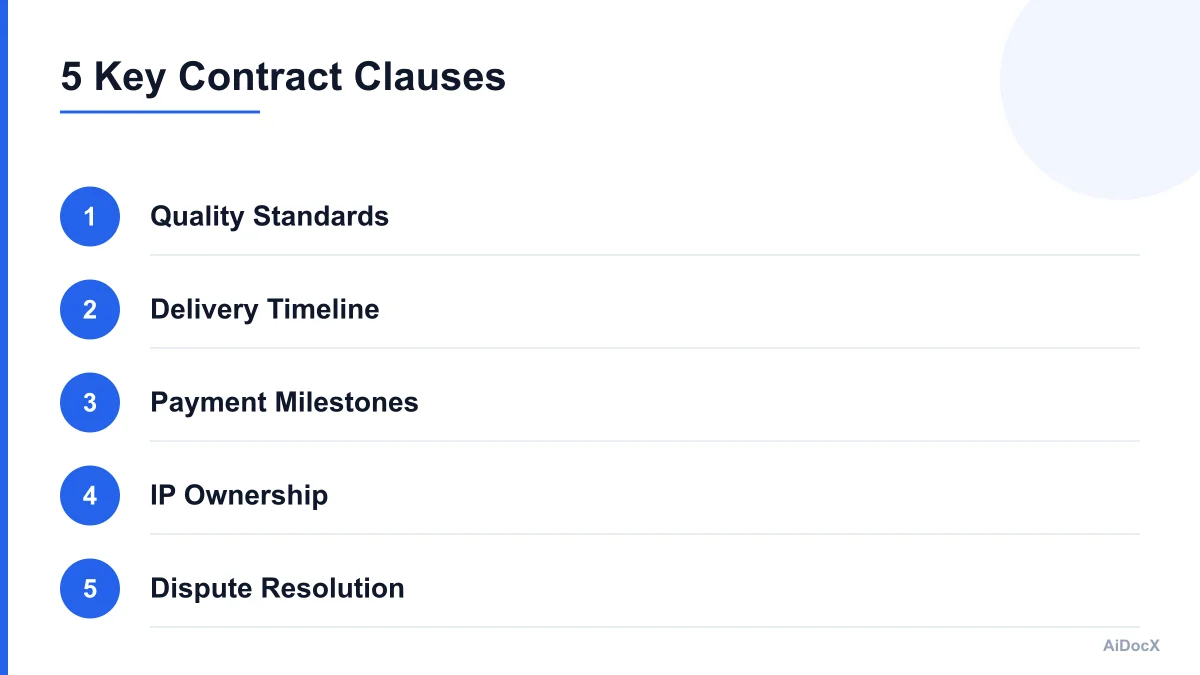
Without a formal agreement, you have no leverage if the manufacturer delivers late, sends the wrong material, or goes silent mid-production. In 2026, as remote collaboration becomes the norm, having a signed digital contract is essential for clarity. It serves as the single source of truth for both parties.
Key Distinctions to Note:
- Quote: A price estimate based on current material costs and labor rates. It can change.
- Contract: A fixed agreement on scope, quality, and penalties. It is legally binding.
- Purchase Order (PO): A specific instruction to produce a batch, governed by the terms of the master contract.
Always ensure your manufacturer signs a Master Supply Agreement (MSA) or a specific Manufacturing Agreement before you issue the first Purchase Order. This sets the ground rules for all future orders, saving time and legal fees down the line.
2. Defining Product Specifications and Quality Standards
The most common source of dispute in manufacturing is ambiguity. "High-quality finish" means something different to a factory manager in Shenzhen than it does to a designer in Brooklyn. You must define quality with objective, measurable criteria. This section of your agreement should reference detailed Technical Packs (Tech Packs) as exhibits or appendices.
What to Include in Quality Clauses:
- Material Specifications: Exact grades of materials (e.g., 304 stainless steel, 100% organic cotton). Include acceptable tolerances for thickness, color (Pantone codes), and weight.
- Workmanship Standards: Define what constitutes a defect. Is a loose thread acceptable? How many visible scratches are allowed? Reference industry standards like ISO or ASTM where applicable.
- Sampling Process: Require pre-production samples (PPS) and golden samples. The golden sample is the physical benchmark against which all mass production units are measured.
- Inspection Rights: Explicitly state your right to conduct third-party inspections (e.g., via SGS, QIMA, or local agents) at critical stages: during production (DUPRO) and before shipment (FPS).
Pro Tip: If a manufacturer refuses to sign off on detailed specifications, it is a red flag. They may be planning to "value engineer" your product mid-run by substituting cheaper materials without your consent.
3. Intellectual Property and Confidentiality Protections
When you share your design files, molds, and brand assets with a manufacturer, you are handing them the keys to your business. You must protect your Intellectual Property (IP) aggressively. In 2026, with AI-driven design tools and easy access to manufacturing databases, IP theft is a growing concern.
Essential IP Clauses:
- Work for Hire: State that all designs, molds, tooling, and custom packaging created for your brand are your exclusive property. The manufacturer cannot sell your design to a competitor or produce "overruns" (extra units) to sell on the gray market.
- Non-Compete/Non-Solicit: While broad non-competes are hard to enforce globally, you can restrict the manufacturer from producing identical products for direct competitors within a specific timeframe or region.
- Confidentiality (NDA): Ensure the agreement includes strict confidentiality terms regarding your business data, sales figures, and future product roadmaps.
- Tooling Ownership: If you are paying for custom molds or dies, explicitly state that you own them. If the relationship ends, you have the right to retrieve them or have them destroyed to prevent unauthorized use.
4. Payment Terms That Protect Your Cash Flow
Cash flow is the lifeblood of a small brand. You do not want to pay 100% upfront and then discover the goods are defective, nor do you want to pay only a small deposit and risk the manufacturer prioritizing larger clients. A balanced payment structure protects both parties.
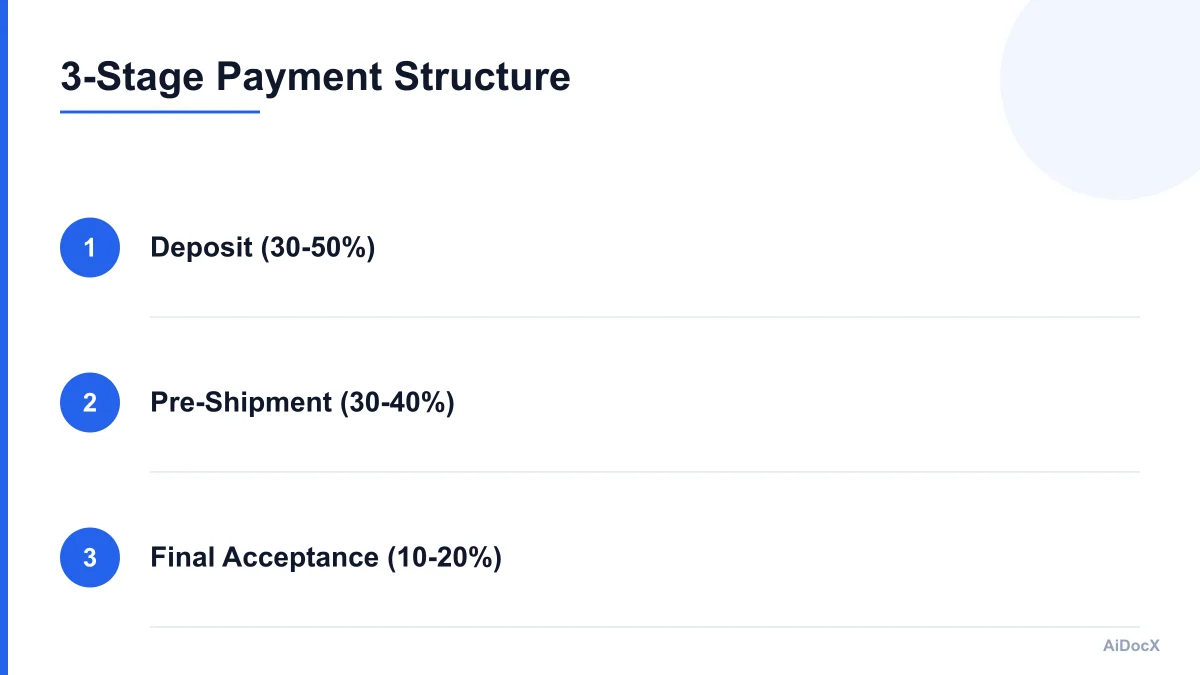
Recommended Payment Milestones:
- Deposit (30-50%): Paid upon signing the contract and receiving confirmed samples. This covers material procurement and initial setup.
- Pre-Shipment Payment (30-40%): Paid after successful inspection of the finished goods. Never pay this balance before verifying quality.
- Retainer/Final Acceptance (10-20%): Ideally, hold back a portion until the goods are received and verified at your warehouse. If this is difficult due to international logistics, ensure the pre-shipment inspection is thorough and conducted by a reputable third party.
Avoid These Payment Pitfalls:
- 100% Upfront: You lose all leverage. If the manufacturer delays, you have no leverage to force them to act.
- Payment Before Inspection: Never pay the final balance before a quality check. Once the money is gone, you are at their mercy.
- Vague Invoicing: Ensure invoices are tied to specific milestones in the contract (e.g., "Invoice #1: 50% Deposit against PO #001").
Note: AiDocX drafts a supply and manufacturing agreement with quality standards, delivery timelines, and payment milestones, then keeps a signed copy on file before money moves. This ensures your financial terms are locked in and legally enforceable before any funds are transferred.
5. Delivery Timelines, Late Fees, and Force Majeure
"ASAP" is not a delivery date. In manufacturing, time is money. Delays can cause you to miss holiday seasons, retail windows, or marketing campaigns, leading to significant lost revenue. Your agreement must include specific dates and consequences for missing them.
Key Delivery Clauses:
- Specific Dates: Define the "Production Completion Date" (when goods are ready at the factory) and the "Shipment Date" (when goods leave the factory).
- Liquidated Damages: Include a clause that imposes a penalty for late delivery. For example, a 1% discount per week of delay, capped at 10% of the order value. This incentivizes the manufacturer to prioritize your order.
- Expedited Shipping: Clarify who pays for expedited freight if the manufacturer is late. Usually, the manufacturer should cover the cost of upgrading from sea to air freight if the delay is their fault.
- Force Majeure: This clause protects both parties from unforeseen events like natural disasters, wars, or pandemics. However, ensure it does not become a loophole. Require the manufacturer to notify you immediately if a force majeure event occurs and provide proof.
Common Mistake: Assuming that "production time" includes shipping time. Always separate these. Production time is the time to make the goods. Shipping time is the time to transport them. A 30-day production time does not mean you get the goods in 30 days; it means they are ready in 30 days.
6. Warranty, Returns, and Defective Goods
Even with the best quality control, defects happen. You need a clear process for handling non-conforming goods. Without a warranty clause, you might be stuck with boxes of unusable products and no recourse.
Warranty and Defect Handling:
- Defect Rate Tolerance: Define an acceptable defect rate (e.g., AQL 2.5). If the defect rate exceeds this, the manufacturer must replace or repair the goods at their own cost.
- Replacement/Refund: Specify that the manufacturer must either replace defective items within a set timeframe (e.g., 30 days) or refund the cost of the defective units.
- Return Shipping Costs: Clarify who pays for returning defective goods. Often, it is more cost-effective to dispose of defective items locally in the manufacturing country than to ship them back. Your contract should allow for local disposal with proof (photos/video) provided to you.
- Long-Tail Warranty: For durable goods, consider a warranty period (e.g., 12 months) where the manufacturer replaces defective units sold to customers.
7. Termination and Dispute Resolution
It is unpleasant to think about ending the relationship, but you need an exit strategy. If the manufacturer consistently fails to meet quality or delivery standards, you need the ability to terminate the contract without massive penalties.
Termination and Dispute Clauses:
- Termination for Cause: Allow immediate termination if the manufacturer breaches key terms (e.g., IP violation, chronic late delivery, quality failures).
- Termination for Convenience: Some contracts allow either party to terminate with notice (e.g., 30-60 days) and payment for work-in-progress. This gives you flexibility if you pivot your business strategy.
- Governing Law and Jurisdiction: Decide where disputes will be resolved. Ideally, choose a neutral jurisdiction or the location of the smaller party. Litigation in a foreign country is expensive and complex. Consider including an arbitration clause for faster, less costly resolution.
- Language of Contract: Specify the official language of the contract. If there is a discrepancy between the English and Chinese versions, state which version prevails (usually English for international brands).
8. The Pre-Production Checklist: Before You Sign
Before you send that first deposit, run through this checklist to ensure your agreement is robust and your production run is set up for success.
- Tech Pack Finalized: All materials, colors, dimensions, and packaging details are locked and attached to the contract.
- Samples Approved: You have received and approved pre-production samples (PPS) and signed off on them in writing.
- IP Protection: The contract clearly states you own all molds, designs, and IP.
- Quality Standards Defined: AQL (Acceptable Quality Limit) levels are specified, and third-party inspection rights are included.
- Payment Terms Clear: Milestones are defined, with a balance held back until inspection.
- Delivery Dates Specific: Production and shipment dates are explicit, with late fees attached.
- Dispute Resolution Plan: You know where and how disputes will be handled if things go wrong.
- Insurance Coverage: Confirm the manufacturer has product liability insurance and that you are named as an additional insured if possible.
Selling finished goods through distributors instead of buying them from a factory? See our distribution and reseller agreement template.
Conclusion: Your First Run Sets the Tone
Your first production run is more than a transaction; it is the foundation of your brand’s reputation. A well-drafted supply and manufacturing agreement protects you from the most common pitfalls: poor quality, late delivery, and IP theft. It also establishes a professional relationship with your manufacturer, showing them that you are organized, serious, and clear about your expectations.
In 2026, the gap between successful small brands and those that struggle often comes down to operational discipline. By locking in these critical terms before you spend a dollar, you safeguard your investment and your peace of mind.
Ready to draft your agreement? Don’t leave your first production run to chance. Use a structured approach to protect your brand. AiDocX drafts a supply and manufacturing agreement with quality standards, delivery timelines, and payment milestones, then keeps a signed copy on file before money moves. Start your first run with confidence.
Ready to automate your documents with AI?
Start free with AiDocX — AI contract drafting, meeting minutes, consultation notes, e-signatures, and more in one platform.
Get Started FreeMore from AiDocX Blog
Buy Sell Agreement Template (2026): Triggers, Valuation and Funding for Co-Owners
A free buy sell agreement template for co-owners, with triggering events, valuation methods, insurance funding and cross-purchase vs. redemption structures.
James September 26, 2026 12 min
Consignment Agreement Template (2026): Commission, Title, Risk of Loss and Unsold Goods
Free consignment agreement template for makers, artists and boutiques: commission split, title, insurance and how to protect consigned inventory.
James September 26, 2026 9 min
Distribution Agreement Template (2026): Territory, Exclusivity, Minimums and Reseller Terms
Free distribution agreement template (works as a reseller agreement template too): territory, exclusivity, minimums, pricing, IP and termination.
James September 26, 2026 13 min