
Virtual Data Rooms: Complete Guide for Startups and M&A in 2026
Everything you need to know about virtual data rooms (VDRs) for fundraising, M&A, due diligence, and audits. Learn how to organize a VDR, essential security features, pricing comparisons, and affordable alternatives to enterprise solutions.
 Sophie · Content Planner February 17, 2026 8 min read
A Series B startup lost a $40 million acquisition deal because their due diligence documents were scattered across Google Drive, email, and Dropbox. The acquiring company's legal team flagged the disorganization as an operational risk indicator and walked away. The documents were fine. The delivery was not.
Whether you are raising a seed round, navigating an acquisition, or undergoing a regulatory audit, how you organize and share sensitive documents matters as much as the documents themselves. Virtual data rooms exist to solve this problem.
What Is a Virtual Data Room?
A virtual data room (VDR) is a secure online repository for storing and sharing confidential documents during financial transactions, legal proceedings, and regulatory processes. Think of it as a highly controlled digital filing cabinet where every document is tracked, every viewer is authenticated, and every interaction is logged.
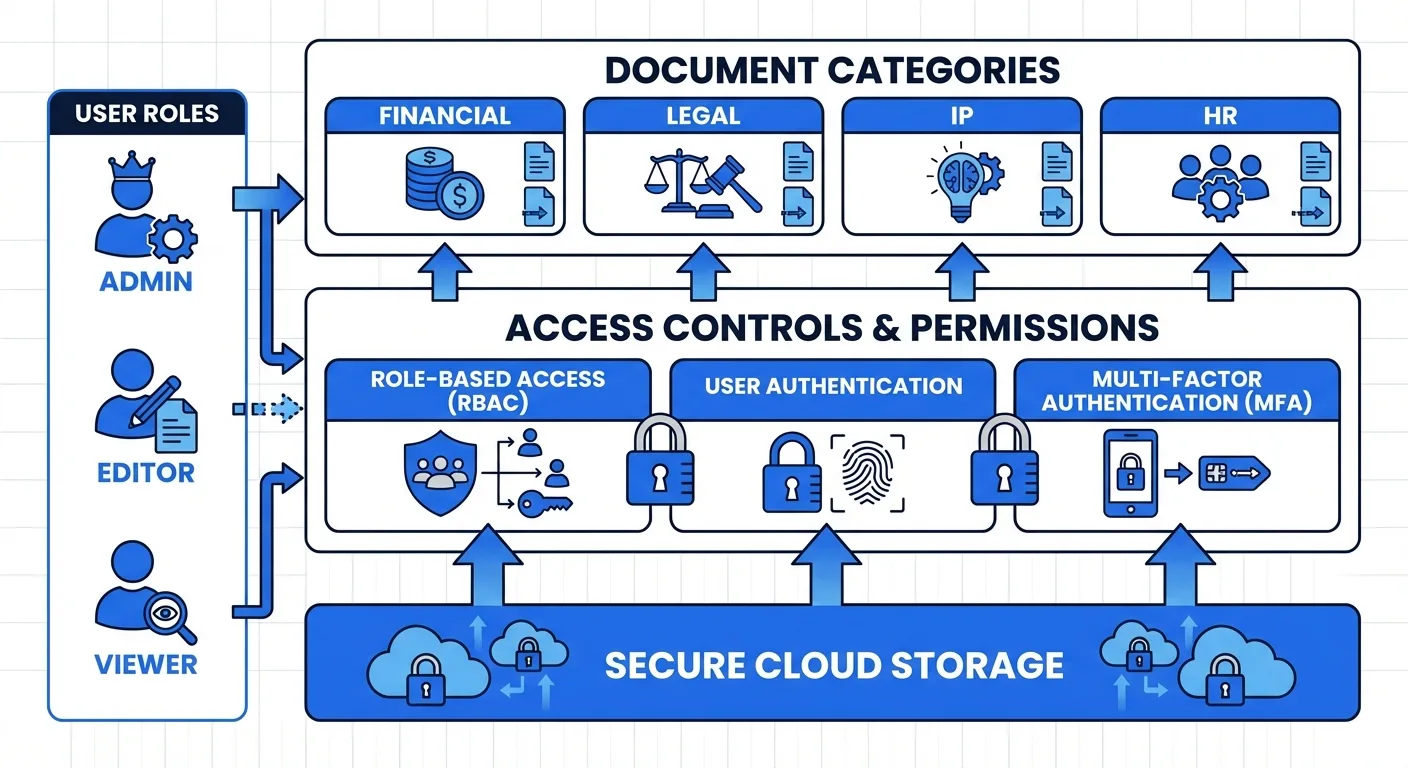
The distinction between a VDR and a file-sharing service like Dropbox or Google Drive is critical. Consumer tools are designed for collaboration and convenience. VDRs are designed for security, control, and compliance -- granular permissions, detailed audit trails, watermarking, NDA gating, and the ability to revoke access even after documents have been viewed.
When Do You Need a Virtual Data Room?
Not every document-sharing scenario requires a VDR. Here are the situations where one becomes essential.
Fundraising and Investment Rounds
From seed stage onward, investors will request access to financial statements, cap table, material contracts, IP assignments, and governance documents. A VDR lets you share these professionally while tracking exactly who views what and for how long -- helping you gauge genuine interest and prioritize follow-ups. This is the same document analytics capability that platforms like AiDocX provide for IR decks and other shared documents.
Mergers and Acquisitions
M&A due diligence is the original use case for virtual data rooms, and it remains the most demanding. An acquiring company's legal, financial, and operational teams need to review hundreds or thousands of documents across every aspect of the target business. The VDR must handle:
- Volume: Thousands of documents organized across dozens of categories
- Multiple parties: Legal teams, financial advisors, management, and sometimes regulatory bodies all need different levels of access
- Granular permissions: Some documents should be visible to all parties; others are restricted to specific teams or individuals
- Audit trails: A complete record of who accessed what, when, and for how long -- essential for regulatory compliance and dispute resolution
IPO, Audits, and Other Transactions
VDRs are equally essential for IPO preparation (sharing documentation with underwriters, auditors, and regulators), regulatory audits (demonstrating organizational competence with clear audit trails), commercial real estate transactions, and legal proceedings requiring controlled document exchange. In each case, the common thread is the need for security, organization, and a verifiable record of who accessed what.
Essential VDR Features: What to Look For
The VDR market ranges from basic file-sharing with access controls to enterprise platforms with hundreds of features. Here are the capabilities that matter most, ranked by importance.
Access Controls and Permissions
The foundation of any VDR is its permission system. At minimum, you need:
- Role-based access: Define roles (e.g., "Investor," "Legal Counsel," "Management") and assign document access by role
- Document-level permissions: Control who can view, download, or print specific documents
- Folder-level inheritance: Set permissions at the folder level that automatically apply to all documents within
- Time-based access: Set expiration dates for access rights
- Access revocation: Remove access to documents instantly, even after they have been downloaded (via DRM for advanced platforms)
NDA Gating
Before any potential investor or acquirer sees confidential documents, they should sign a non-disclosure agreement. NDA gating automates this: new users are presented with an NDA that must be signed electronically before any documents become visible.
AiDocX's Spaces feature includes NDA gating as a built-in capability. When you create a Space (our term for a VDR), you attach an NDA that every participant must sign before accessing content. Signed NDAs are stored automatically, creating a clean record of who agreed to confidentiality terms and when.
Activity Tracking and Analytics
Knowing who viewed which documents, for how long, and how many times provides critical intelligence during negotiations. Comprehensive logs should capture document views with timestamps, download and print events, login patterns, and page-level analytics.
This tracking is comparable to what DocSend offers for individual document sharing at $10+ per month. The difference with a VDR is that tracking applies across an entire organized collection, providing a holistic view of how parties engage with your materials.
Search, Security, and Collaboration
Beyond permissions and tracking, look for full-text search (within document content, not just file names), bulk upload with preserved folder structure, and index numbering for easy reference in communications.
Security should include AES-256 encryption at rest, TLS 1.3 in transit, dynamic watermarking, mandatory two-factor authentication, and SOC 2 compliance. Data residency options matter for GDPR and other sovereignty requirements.
Modern VDRs also offer collaboration features: structured Q&A workflows for due diligence questions, document annotations visible to specific parties, and automated notifications when new materials are added.
How to Organize a Virtual Data Room
Poor organization is the most common VDR mistake, and it has real consequences. A well-organized VDR accelerates due diligence, reduces questions, and signals operational maturity. Here is a standard structure that works across most transaction types.
Standard Folder Structure for Fundraising and M&A
1. Corporate Documents
   1.1 Certificate of Incorporation
   1.2 Bylaws / Operating Agreement
   1.3 Board Minutes and Resolutions
   1.4 Shareholder Agreements

2. Financial Information
   2.1 Audited Financial Statements (3 years)
   2.2 Financial Projections and Models
   2.3 Cap Table
   2.4 Tax Returns (3 years)

3. Material Contracts
   3.1 Customer Agreements (Top 10-20)
   3.2 Vendor and Supplier Agreements
   3.3 Lease and Loan Agreements

4. Intellectual Property
   4.1 Patent and Trademark Registrations
   4.2 IP Assignment Agreements
   4.3 Technology Licenses

5. Employment and HR
   5.1 Executive Employment Agreements
   5.2 Employee Stock Option Plan
   5.3 Key Employee List

6. Legal and Compliance
   6.1 Pending or Threatened Litigation
   6.2 Privacy Policy and Data Processing
   6.3 Insurance Policies

7. Product and Technology
   7.1 Product Roadmap
   7.2 Technical Architecture Overview
   7.3 Security Audit Reports

8. Sales and Marketing
   8.1 Customer Metrics (churn, LTV, CAC)
   8.2 Sales Pipeline Summary
Organization Best Practices
Number everything. Use a consistent numbering system (1.1, 1.2, etc.) so parties can reference specific documents unambiguously. "Please see document 3.4.2" is far more efficient than "the second lease agreement in the contracts folder."
Include an index document. Place a master index at the top level listing every document with its number, title, and date. This dramatically reduces "where can I find..." questions.
Use consistent naming conventions. Adopt a format like [Number]_[DocumentType]_[Entity]_[Date].pdf. Avoid spaces in file names.
Populate progressively. You do not need every document on day one. Start with the most commonly requested materials and add documents as they are requested. Initial investor interest does not require the same depth as final due diligence.
The VDR Pricing Landscape in 2026
VDR pricing has historically been one of the most opaque areas in enterprise software. Understanding the landscape helps you avoid overpaying for capabilities you do not need.
Enterprise VDR Providers
Platforms like Intralinks, Datasite (formerly Merrill), and Firmex target large M&A transactions. Pricing starts at $500+ per month, often running into thousands for active deal rooms. Per-page pricing can result in bills of $15,000-$25,000+ for a single transaction. These platforms are feature-rich but designed for investment banks and large law firms with matching budgets.
Mid-Market and Modern Alternatives
Mid-market providers like Ansarada and SecureDocs offer pricing in the $150-$500 per month range with most essential features, though they may lack AI-powered analysis or integrated signatures.
A newer category -- including AiDocX -- approaches the VDR problem differently. Rather than standalone VDR pricing, these platforms integrate secure document sharing with electronic signatures, AI analysis, document tracking, and IR deck management. AiDocX's Spaces feature provides VDR functionality -- NDA gating, granular permissions, activity tracking -- as part of a platform starting free, with a Basic plan at $6 per month. That single plan includes capabilities that would otherwise require DocSend ($10+/mo for tracking), DocuSign ($10+/mo for signatures), and a separate VDR subscription.
For startups where a $2-5 million fundraising round makes $15,000 in VDR costs a meaningful percentage of capital raised, this bundled approach changes the equation entirely.
Security Considerations for Your VDR
Security is the entire reason VDRs exist as a separate category from file-sharing tools. Key considerations include:
Encryption. AES-256 at rest and TLS 1.3 in transit are non-negotiable minimums. Ask providers whether they encrypt metadata as well as files -- document names can leak sensitive information.
Access security. Multi-factor authentication should be mandatory. Prefer authenticator apps over SMS-based MFA, which is vulnerable to SIM-swapping attacks. IP-based access restrictions add another layer of protection.
Audit trail integrity. The audit trail must be tamper-proof. Best-practice implementations store audit logs separately from documents with independent integrity verification.
Data residency. GDPR, CCPA, and other regulations may require data storage in specific jurisdictions. Clarify data residency options before committing to a provider.
Vendor security posture. SOC 2 Type II certification is the baseline standard. Ask about penetration testing frequency and incident response procedures.
Common VDR Mistakes to Avoid
Over-sharing early. Start with a curated set of high-level materials and expand access as the transaction progresses. Protect sensitive documents until disclosure is appropriate for the transaction stage.
Neglecting the Q&A process. Due diligence generates questions. Use a structured Q&A workflow within the VDR rather than email, which creates fragmentation and risks questions falling through the cracks.
Ignoring document analytics. If your VDR provides activity tracking and you are not reviewing it, you are leaving valuable intelligence on the table. Knowing which documents get the most attention reveals where concerns and interest lie.
Poor permission hygiene. Set permissions deliberately and review them as team members change and transaction phases progress.
Failing to archive. After a transaction closes, archive the VDR contents and audit trail. This record may be needed for regulatory inquiries or future transactions.
Setting Up Your First VDR: A Practical Checklist
- Define the scope -- transaction type, parties, and required documents
- Choose your platform -- match to your needs and budget (enterprise M&A may justify Intralinks; a Series A fundraise works well with AiDocX at a fraction of the cost)
- Build your folder structure using the template above as a starting point
- Prepare and configure your NDA as a gate for VDR access
- Upload and organize documents with consistent naming conventions
- Configure permissions and define roles before inviting external parties
- Test the experience with an internal team member before going live
- Monitor and iterate -- review analytics regularly, add documents as requested, update permissions as the transaction progresses
The Bottom Line
A virtual data room is not a luxury -- it is infrastructure. For any company engaging in transactions involving confidential document exchange, a VDR provides the security, organization, and intelligence the process demands.
The good news is that VDR capabilities are no longer locked behind enterprise pricing. Whether you are sharing an IR deck with angel investors or managing due diligence for a major acquisition, the principles are the same: organize methodically, control access carefully, and use engagement data to make smarter decisions. Your documents represent your company's value, history, and future -- they deserve a home that reflects it.
Ready to automate your documents with AI?
Start free with AiDocX — AI contract drafting, meeting minutes, consultation notes, e-signatures, and more in one platform.
Get Started FreeMore from AiDocX Blog
Consulting Proposal Template (2026): 9 Sections + Example
Copy a consulting proposal template with nine sections, pricing options, and a filled example. Includes tips to make the proposal easy to approve.
 AiDocX Team October 24, 2026 11 min
Internship Agreement Template (2026): Paid & Unpaid Interns
Copy an internship agreement template for paid or unpaid interns. Covers U.S. and UK pay rules, duties, IP, confidentiality, and a filled example.
AiDocX Team October 24, 2026 12 min
Meeting Minutes Template (2026): 4 Formats + Filled Example
Copy a meeting minutes template in four formats: team, decision log, board, and client call. See a filled example and a 15-minute workflow.
AiDocX Team October 24, 2026 11 min