5 Contract Clauses That Could Cost Your Business Thousands in 2026 (and How to Spot Them)
Most business owners sign contracts without reading the fine print. Here are 5 clauses that commonly lead to unexpected costs, legal disputes, and lost leverage — plus how to protect yourself.
 MinjiLee · Strategic Lead February 23, 2026 9 min read
5 Contract Clauses That Could Cost Your Business Thousands in 2026
A freelance developer signed what looked like a standard client contract. The scope was clear, the rate was fair, and the project seemed straightforward. Six months later, the auto-renewal clause buried in section 14 quietly locked them into another full year at the original rate — a rate that was now $50 per hour below market. By the time they noticed, the cancellation window had passed. Total cost of that overlooked paragraph: roughly $40,000 in lost income over twelve months.
This is not an unusual story. It happens every day to freelancers, startup founders, agency owners, and small business operators who are moving too fast to read every line of every contract they sign. And in most cases, the clause that causes the damage is not hidden in some devious way. It is sitting right there in plain text, written in language that looks routine but carries serious financial consequences.
Why This Matters More in 2026 Than Ever Before
The volume of contracts flowing through modern businesses has exploded. A typical small business now manages dozens of active agreements at any given time: SaaS subscriptions, freelancer and contractor agreements, vendor and supplier contracts, office leases, partnership deals, NDAs, and terms of service for every platform they use.
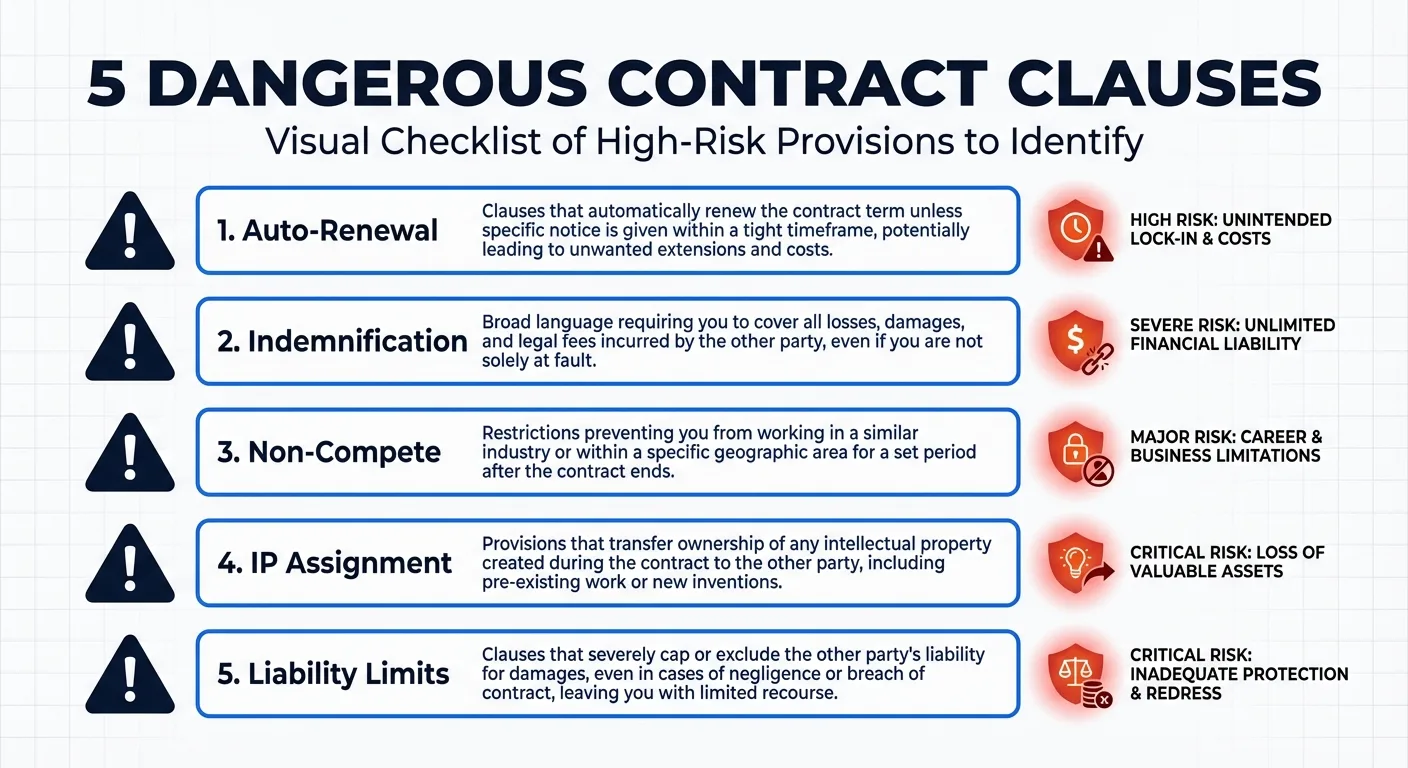
Most of these contracts are template-based. And here is the critical thing to understand about templates: they are almost always written by the party offering them. The SaaS provider wrote their terms of service. The client wrote their freelancer agreement. The vendor wrote their supply contract. These templates are not neutral. They are drafted to protect the drafter, and they do it through clauses that shift risk, limit accountability, and preserve optionality — for one side only.
If you are the one receiving the contract rather than drafting it, you are starting at a disadvantage. Knowing which clauses to watch for — and having a solid contract risk management strategy — is the first step toward leveling the playing field.
Clause 1: Auto-Renewal with Silent Extension
What It Looks Like
"This Agreement shall automatically renew for successive one-year terms unless either party provides written notice of non-renewal at least sixty (60) days prior to the expiration of the then-current term."
This language is incredibly common. You will find it in SaaS contracts, vendor agreements, office leases, and service retainers. On the surface, it seems reasonable — it ensures continuity of service without requiring a new contract every year.
Why It Is Dangerous
The danger is not in the renewal itself. It is in the notice window. A 60-day notice requirement on an annual contract means you need to make your renewal decision ten months into the term. Miss that window by even a single day, and you are committed for another full year. Some contracts go further, requiring 90 days or even 120 days of advance notice, which means you need to decide whether to continue the relationship before you have even completed three-quarters of the current term.
For businesses, this creates a compounding problem. If you have fifteen different contracts with auto-renewal clauses and different notice deadlines scattered across the calendar, the odds of missing at least one cancellation window are extremely high. And vendors know this. Many count on inertia and missed deadlines as a core part of their retention strategy.
How to Protect Yourself
First, negotiate the notice period down. Thirty days is reasonable for most agreements. Sixty days is the maximum you should accept without pushback. Anything beyond that is tilted heavily in the other party's favor.
Second, insist on adding language that requires the other party to send you a written reminder at least 30 days before the cancellation window closes. This is increasingly standard in consumer contracts and there is no reason it should not appear in business agreements.
Third, build a contract calendar. Whether it is a spreadsheet, a project management tool, or a dedicated contract management system, you need a single place that tracks every renewal date and cancellation deadline across your business.
Clause 2: Broad Indemnification
What It Looks Like
"Contractor agrees to indemnify, defend, and hold harmless Company, its officers, directors, employees, agents, and affiliates from and against any and all claims, damages, losses, costs, and expenses (including reasonable attorney fees) arising out of or related to Contractor's performance under this Agreement."
Why It Is Dangerous
Indemnification clauses assign responsibility for legal costs and damages. In theory, they exist to ensure that the party who causes a problem pays for it. In practice, broadly written indemnification clauses can make you financially responsible for situations that are far beyond your control.
Consider a scenario: you are a marketing consultant hired to run a social media campaign. The client provides you with product images to use in the campaign. One of those images turns out to infringe on a photographer's copyright. Under a broad indemnification clause tied to "performance under this Agreement," the client could argue that you are responsible for the resulting copyright claim — even though they provided the infringing material.
The phrase "arising out of or related to" is the most dangerous language in any indemnification clause. Courts have interpreted it extremely broadly. It can cover situations where your involvement was peripheral, where the other party contributed to the problem, or where the harm was entirely unforeseeable at the time of contracting.
How to Protect Yourself
Narrow the scope. Replace "arising out of or related to" with "directly caused by the negligent acts or omissions of." This limits your indemnification obligation to situations where you actually did something wrong.
Add a cap. Your indemnification obligation should not exceed the total fees paid under the contract. Unlimited indemnification means unlimited financial exposure, and no business relationship justifies that.
Make it mutual. If you are indemnifying the other party, they should be indemnifying you under the same terms. One-sided indemnification is a red flag that the contract was drafted entirely in the other party's interest.
Clause 3: IP Assignment Beyond Scope
What It Looks Like
"Contractor hereby assigns to Company all right, title, and interest in and to all work product, inventions, developments, and intellectual property created during the term of this Agreement, whether or not related to the services performed hereunder."
Why It Is Dangerous
Read that clause again carefully. The key phrase is "whether or not related to the services performed." This means that if you build a personal side project on your own time, using your own equipment, that has absolutely nothing to do with the client's business — the client could claim ownership of it simply because you created it during the contract term.
This type of clause is disturbingly common in freelancer agreements, agency contracts, and employment agreements in the tech industry. It is modeled after employment IP assignment clauses that were designed for full-time employees working exclusively for one company. When applied to independent contractors who serve multiple clients simultaneously, the results are absurd and potentially devastating.
A graphic designer working under such a clause could lose the rights to a typeface they designed on weekends. A software developer could lose ownership of an open-source tool they built in their spare time. The clause does not care about fairness. It cares about breadth.
How to Protect Yourself
Limit assignment to work product directly created in the performance of services under the contract. The clause should read "created in the course of performing the Services" rather than "created during the term."
Explicitly exclude pre-existing IP. If you are bringing tools, frameworks, templates, or methodologies that you developed before the contract, those should be listed in an exhibit and explicitly carved out from any assignment.
Exclude personal projects. Add language that exempts intellectual property created on your own time, using your own resources, that does not relate to the client's business or the services you are providing. Several U.S. states (including California, Delaware, and Illinois) already limit employer IP assignment clauses by statute. Even if your state does not, you can negotiate the same protections into your contract.
Clause 4: Unilateral Termination for Convenience
What It Looks Like
"Company may terminate this Agreement at any time, for any reason or no reason, upon fifteen (15) days' written notice to Contractor."
Meanwhile, the contractor's termination rights read:
"Contractor may terminate this Agreement only for material breach by Company, and only after providing Company with thirty (30) days' written notice and an opportunity to cure."
Why It Is Dangerous
This is one of the most lopsided clause structures you will encounter, and it is remarkably common. One party gets an unrestricted exit ramp with minimal notice. The other party is locked in unless the first party commits a material breach, and even then has to wait through a cure period before the termination takes effect.
The practical impact is severe. If you are a service provider operating under this structure, the client can terminate your contract on a whim with two weeks' notice. You, on the other hand, cannot walk away even if the client is consistently late on payments, unresponsive to communications, or making your work impossible — as long as their behavior does not technically constitute "material breach" as defined by the contract.
This creates an enormous power imbalance. The party with unilateral termination rights has leverage in every negotiation that follows the signing of the contract. They can demand scope changes, rate reductions, or accelerated timelines, knowing that you cannot easily leave but they can.
How to Protect Yourself
Make termination rights mutual. If one party can terminate for convenience, both parties should have the same right with the same notice period.
Extend the notice period. Fifteen days is rarely enough time to find replacement work or a replacement vendor. Thirty days is a more reasonable minimum, and for larger engagements, 60 or 90 days is appropriate.
Add a termination fee or wind-down payment. If the client terminates for convenience, they should compensate you for the disruption. This is standard in many industries and typically covers 30 to 90 days of fees or the remainder of any minimum commitment period.
Clause 5: Limitation of Liability Gaps
What It Looks Like
"In no event shall Company's total aggregate liability under this Agreement exceed the fees paid by Customer in the three (3) months preceding the claim. In no event shall Company be liable for any indirect, incidental, special, consequential, or punitive damages."
Why It Is Dangerous
Limitation of liability clauses are standard and generally reasonable. Both parties benefit from knowing their maximum exposure. The danger arises when the caps are set so low that they provide no meaningful remedy, or when the exclusions are so broad that they effectively eliminate accountability.
A three-month fee cap on a $500 per month SaaS subscription means the vendor's maximum liability is $1,500 — even if their platform failure causes you $200,000 in lost business. The exclusion of "consequential damages" wipes out almost every real-world harm you might suffer, because in practice, most business losses from a vendor failure are consequential by nature (lost revenue, lost customers, reputational damage).
The other gap to watch for is asymmetry. Some contracts cap the vendor's liability at a fraction of fees paid while leaving the customer's liability uncapped, particularly around indemnification obligations or intellectual property infringement claims.
How to Protect Yourself
Push for a twelve-month fee cap rather than three months. This is a widely accepted standard in the SaaS industry and gives you a meaningful remedy without creating unreasonable risk for the vendor.
Carve out exceptions. Certain obligations should not be subject to the liability cap: confidentiality breaches, data security incidents, willful misconduct, and indemnification obligations. These are situations where a low cap creates a perverse incentive to be careless.
Ensure symmetry. Whatever liability limitations apply to one party should apply equally to the other. If the vendor caps their liability at twelve months of fees, your liability should be capped the same way.
How to Protect Yourself: A Practical Checklist
Knowing which clauses to watch for is valuable. Having a systematic process for catching them is essential. Here is a practical framework that works whether you are reviewing two contracts a month or two hundred.
Step 1: Read the full contract. This is obvious advice that most people ignore. Reading a ten-page contract takes 20 to 30 minutes. That time investment has an enormous return when it prevents a $40,000 mistake. If you genuinely cannot read every contract, at minimum read the sections on termination, indemnification, liability, IP assignment, and renewal terms.
Step 2: Use a clause-by-clause checklist. Before you sign anything, run through these questions:
- What are the renewal terms and cancellation deadlines?
- Is the indemnification mutual and reasonably scoped?
- Does the IP assignment extend beyond the scope of work?
- Are termination rights balanced between both parties?
- Is the liability cap fair relative to the contract value?
- Are there any non-compete or exclusivity restrictions?
- What governing law and dispute resolution mechanism applies?
- Are there liquidated damages or penalty clauses?
Step 3: Run a quick AI review as a first pass. AI contract review tools have become practical and affordable enough that there is no reason to skip this step in 2026. Platforms like AiDocX, LawGeex, and LegalZoom offer AI-powered clause analysis that can flag risky language in minutes. These tools are not a substitute for legal counsel, but they are excellent at catching the specific clause patterns described in this article — auto-renewal traps, overbroad indemnification, IP overreach — that are easy to miss during a manual read-through. Think of it as a spell-checker for legal risk: it catches the obvious problems so you can focus your attention (and your legal budget) on the nuanced ones.
Step 4: Get a lawyer for high-value agreements. For contracts above a certain threshold — and only you can define what that threshold is for your business — professional legal review is worth every dollar. A good business attorney will catch issues that no AI tool or checklist can, particularly around regulatory compliance, tax implications, and jurisdiction-specific enforceability. The combination of AI for initial screening and human expertise for critical review gives you thorough coverage without breaking your legal budget.
The Bottom Line
The five clauses outlined in this article are not exotic legal traps. They are standard provisions that appear in contracts signed by businesses every single day. Their danger lies not in their obscurity but in their normalcy. Because they look routine, they get overlooked. Because they get overlooked, they cost businesses thousands — sometimes tens of thousands — of dollars every year.
The best contract is one where both parties feel protected. If the agreement in front of you protects only one side, that is not a negotiation oversight. It is a feature of the draft, and it is working exactly as intended — just not in your favor.
Take the time to read. Use the tools available to you. And remember that every clause you negotiate today is a dispute you prevent tomorrow.
AiDocX offers free AI contract analysis on the Starter plan — upload a contract and get a risk assessment in under two minutes. No credit card required.
Ready to automate your documents with AI?
Start free with AiDocX — AI contract drafting, meeting minutes, consultation notes, e-signatures, and more in one platform.
Get Started FreeMore from AiDocX Blog
AI Addiction Counseling Notes: Templates & Automation Guide for 2026
Complete guide for addiction counselors on writing MI session records, relapse prevention plans, and CBT notes — with AI automation tips and HIPAA 42 CFR Part 2 compliance.
 SophieKim March 13, 2026 13 min
AI Counseling Notes Guide (2026): Free Templates + Auto-Generate in Minutes
Complete guide to writing counseling notes in 2026. Includes copy-paste templates for psychology, legal, sales, and general counseling, plus how to auto-generate structured records with AI.
SophieKim March 13, 2026 12 min
AI Domestic Violence Counseling Notes (2026): Templates + Safety Guide for DV Advocates
Complete guide to domestic violence counseling documentation in 2026. Includes intake records, danger assessment checklists, safety plan templates, and how to automate records with AI while protecting victim privacy.
SophieKim March 13, 2026 13 min