AI Voice Cloning Consent Form Template: Project, Usage and Exit Terms
Use a limited-use AI voice consent form with a named provider, approved channels, payment terms, output approval and an agreed exit plan.
An AI voice cloning consent form should explain which voice recordings may be used, what the named system may do with them, and where the resulting synthetic speech may appear. Permission to record a performance should not be treated as an unexplained license to generate new speech indefinitely.
The practical question is specific: may this client create this voice model and publish these outputs for this project, under these conditions? Write those conditions before recordings are uploaded or a provider account is opened.
SAG-AFTRA describes a digital replica as a digitally created replica of a person’s voice or likeness and emphasizes clear, conspicuous informed consent. Its terminology is useful for separating a conventional recording from a replica that can produce new material. SAG-AFTRA: terms to know
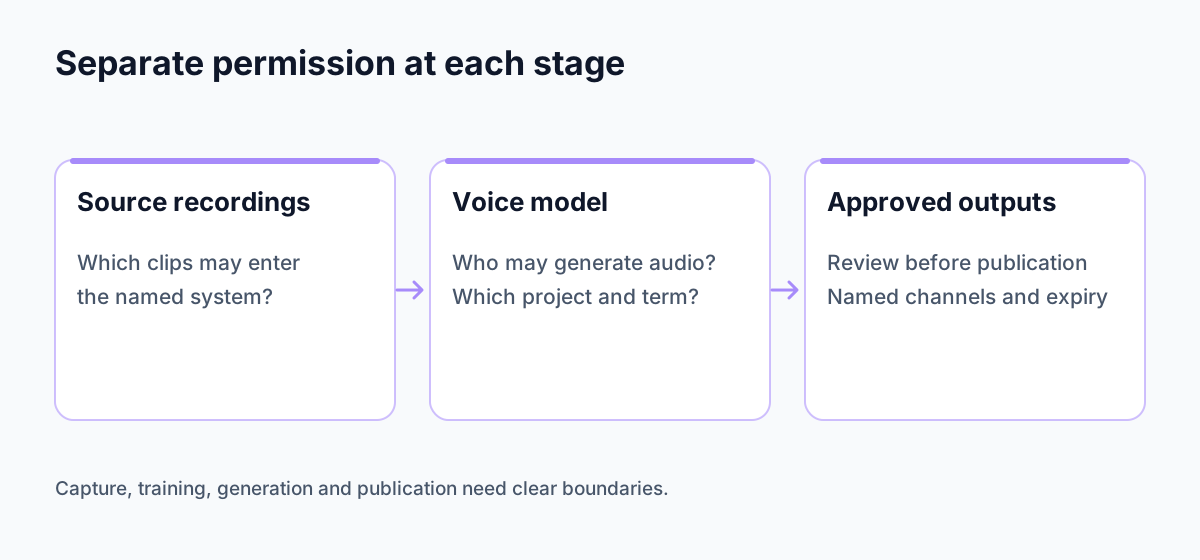
Separate permission at each stage
| Stage | What the parties should identify |
|---|---|
| Source recordings | The specific clips, scripts and allowed processing |
| Voice model | The provider, account, permitted operators, project and access period |
| Outputs | Approval process, publication channels, territory, languages and expiry |
| Exit | Future-generation controls, existing-output treatment and data handling |
A recording fee, a model-creation fee and an agreed usage fee can pay for different things. List them separately if they are part of the deal. That makes an extension or new use a visible decision rather than an assumption buried in the original session price.
What this template covers
The example is a limited-use rider for an adult speaker authorizing use of their own voice for one named project. It keeps general-purpose model training, resale and unlisted uses outside the permission granted here.
If a union agreement covers the production, use its applicable terms and required procedures. For example, SAG-AFTRA’s 2025 Interactive Media Agreement includes AI digital-replica consent and disclosure protections for covered work; this generic rider is not that agreement or a replacement for it. Applicable privacy, publicity and employment requirements also need project-specific review. SAG-AFTRA’s 2025 Interactive Media Agreement overview
AI voice cloning consent form template
Complete the schedule before signing. Describe the actual provider workflow rather than using “AI processing” as a catch-all. If a field has not been agreed, keep the draft in review.
LIMITED AI VOICE CONSENT RIDER

Date: [DATE]
Speaker: [LEGAL NAME / CONTACT]
Client: [LEGAL NAME / CONTACT]
Project: [PROJECT TITLE, PURPOSE AND REFERENCE]
Related recording or services agreement: [REFERENCE]

1. Source material
The approved source recordings are listed in Schedule A.
The Speaker authorizes the following processing of those recordings
solely for the named Project: [EXACT PROCESSING / MODEL-CREATION STEPS].

No other recordings are included in this permission.

2. Named system and access
Provider and product: [PROVIDER / PRODUCT / VERSION IF RELEVANT]
Project account or model identifier: [IDENTIFIER]
Permitted operators: [NAMES / ROLES]
Permitted creation and access period: [START DATE] to [END DATE]

Access credentials and the resulting model may not be shared beyond
the approved operators except as expressly agreed in Schedule A.

3. Limited purpose
The permitted purpose is: [SPECIFIC USE CASE].
The permission granted here excludes general-purpose training,
use in unrelated projects, resale, sublicensing and any other use
not expressly listed in this rider.

Any additional use requires a new written agreement with the Speaker.

4. Output approval and publication
The Client will provide proposed outputs and their context to
[APPROVER / CONTACT] for approval before publication.
Approval method and record: [METHOD / RECORD LOCATION]
Approved channels: [CHANNELS]
Territory and languages: [TERRITORY / LANGUAGES]
Publication period: [START / EXPIRY OR OTHER AGREED LIMIT]
Permitted edits after approval: [LIMITS]
Disclosure or labeling requirements for the Project: [REQUIREMENTS]

A material change to the approved wording or context must be submitted
for approval again under this rider.

5. Payment
Recording/session fee: [AMOUNT / TERMS OR EXISTING AGREEMENT]
Model-creation fee, if agreed: [AMOUNT / TERMS]
Usage payments, if agreed: [AMOUNT / BASIS / REPORTING / DUE DATES]
Extension or renewal process: [PROCESS]

6. Handling recordings and model artifacts
The Client will obtain the Provider’s documented retention and deletion
terms and identify the Project’s obligations in Schedule B.

Schedule B must address source files, project-specific models or other
artifacts, access controls, backups and any permitted legal retention.
It must distinguish actions the Client can perform from actions
requiring the Provider’s cooperation.

7. Expiry, termination and withdrawal procedure
Notice contact: [CONTACT]
Procedure and agreed deadline for stopping new generation: [TERMS]
Treatment of already approved/published outputs: [TERMS / EXPIRY]
Removal and data-handling steps: [TERMS / RESPONSIBLE PARTY]
Confirmation or reporting to the Speaker: [METHOD / TIMING]

These terms do not limit rights that applicable law or a governing
union agreement makes non-waivable.

8. Other permissions and related terms
The Speaker’s voice permission does not grant rights in third-party
scripts, music, footage or recordings. The Client will identify and
obtain the other permissions needed for the Project.

Governing law, dispute terms and changes to the related agreement:
[AGREED TERMS / REFERENCE]

Schedule A: Clips, processing, system, operators and permitted uses
Schedule B: Retention, exit actions, responsibilities and limitations

SPEAKER
Name: [NAME]
Signature: [SIGNATURE]                 Date: [DATE]

CLIENT / AUTHORIZED REPRESENTATIVE
Name / title: [NAME / TITLE]
Signature: [SIGNATURE]                 Date: [DATE]
Make the permitted use concrete
“Marketing” leaves too much unresolved. Compare two project descriptions:
| Broad description | A more specific discussion draft |
|---|---|
| Use my AI voice for marketing | Generate the listed product-training narration for the client’s internal learning portal during the agreed term |
| Use it on our channels | Publish the approved clips on the named website pages and channels listed in the schedule |
| Use it in any language | Generate outputs only in the agreed languages, with the specified review process |
| Use the recording to improve AI | Name the exact project-only processing that is allowed and address any other training in a separate agreement |
These are drafting examples, not a recommendation to accept the proposed uses. The speaker and client still need to agree on purpose, price, approval and limits.
A new product, paid advertisement, different provider or broader distribution can change the deal. The schedule should explain which changes require a new permission rather than silently treating all future uses as included.
Ask the provider before promising an exit plan
An exit clause should describe actions the parties can carry out. Ask the provider what happens to source recordings, project models, access permissions and retained artifacts. Identify which actions are available in the account and which require a support request or another process.
Avoid promising complete deletion or “untraining” without a supported mechanism and an agreed way to confirm the result. Also decide what happens to approved audio that has already been published; stopping new generation and removing existing outputs are different tasks.
A short request to the provider can start with:
Please describe the retention and exit controls for [PROJECT/MODEL].

- Which source files and project artifacts are retained, and for how long?
- How can we disable access and prevent new generation?
- Which deletion actions can our account perform directly?
- Which actions need your support, and what confirmation is available?
- What backup or legal-retention limits must we disclose to the speaker?
- Are source material or outputs used outside this named project?

Please identify the relevant terms and controls for our specific plan.
Keep the provider’s response with the rider. A promise in the client’s document should not depend on a vendor capability nobody has checked.
Review the rider before uploading recordings
- Identify the speaker, client and named project.
- List the approved recordings and exact processing steps.
- Confirm the provider, account and permitted operators.
- Define approval before publication and the permitted channels.
- Agree on the term, payments and extension process.
- Complete a feasible exit and data-handling plan.
- Check applicable union terms and other project requirements.
For an ordinary recording engagement, start with the voice over contract template. Keep the synthetic-voice permissions separate enough that both parties can find and review them.
Frequently asked questions
Can an ordinary recording release cover voice cloning?
Read the actual permission granted. Do not treat access to a recording as proof that the speaker agreed to model creation, new speech or publication in a different context. This rider is designed to make those decisions explicit.
Does this form authorize general-purpose model training?
No. The example excludes it from the permission granted here. Project-only processing must still be described in the schedule. Broader model-training rights need a separate, specifically reviewed agreement.
Does withdrawing consent automatically remove every existing output?
Do not assume that. The rider requires an agreed procedure for new generation, existing outputs and data handling. Applicable law or a governing agreement may provide additional rights or obligations.
Can the client change providers later?
The example names the system and requires new written agreement for unlisted uses. Review a proposed provider or workflow change before transferring recordings or model access.
Keep the agreed permissions with the project documents
Prepared by AiDocX Team with AI assistance; the cited primary materials were checked on November 17, 2026. This is an original discussion template, not an official SAG-AFTRA form or a statement that one form satisfies every jurisdiction’s requirements.
Ready to automate your documents with AI?
Start free with AiDocX — AI contract drafting, meeting minutes, consultation notes, e-signatures, and more in one platform.
Get Started FreeMore from AiDocX Blog
Deposit Invoice Template: Show the Upfront Payment and Final Balance
Use a deposit invoice template with a worked 40% example, a final balance invoice, payment receipt wording, and checks that prevent duplicate requests.
 AiDocX Team November 19, 2026 8 min
Project Acceptance Form Template: Client Sign-Off With Open Items
Copy a client project acceptance form, record deliverables and exceptions, and send a sign-off email with a clear review deadline.
AiDocX Team November 19, 2026 8 min
Service Contract Extension Addendum Template: Dates, Fees and Scope
Copy a service contract extension template with a three-month example, fee schedule, approval checklist, and clear treatment of unchanged terms.
AiDocX Team November 19, 2026 8 min