
Service Contract Extension Addendum Template: Dates, Fees and Scope
Copy a service contract extension template with a three-month example, fee schedule, approval checklist, and clear treatment of unchanged terms.
 AiDocX Team · AiDocX Editorial November 19, 2026 8 min read
A service contract extension records an agreed change to the period of an existing engagement. Identify the original agreement and previous amendments, state the current end date, give the extension's exact start and end dates, and describe the services and fees during that period. Record approvals using the process required by the agreement and applicable rules.
A short extension is useful when a client wants another three months of the same support, consulting, or agency service. The document below is a discussion draft for a private service engagement. It does not determine whether your particular change meets local legal formalities.
Decide whether an extension fits the job
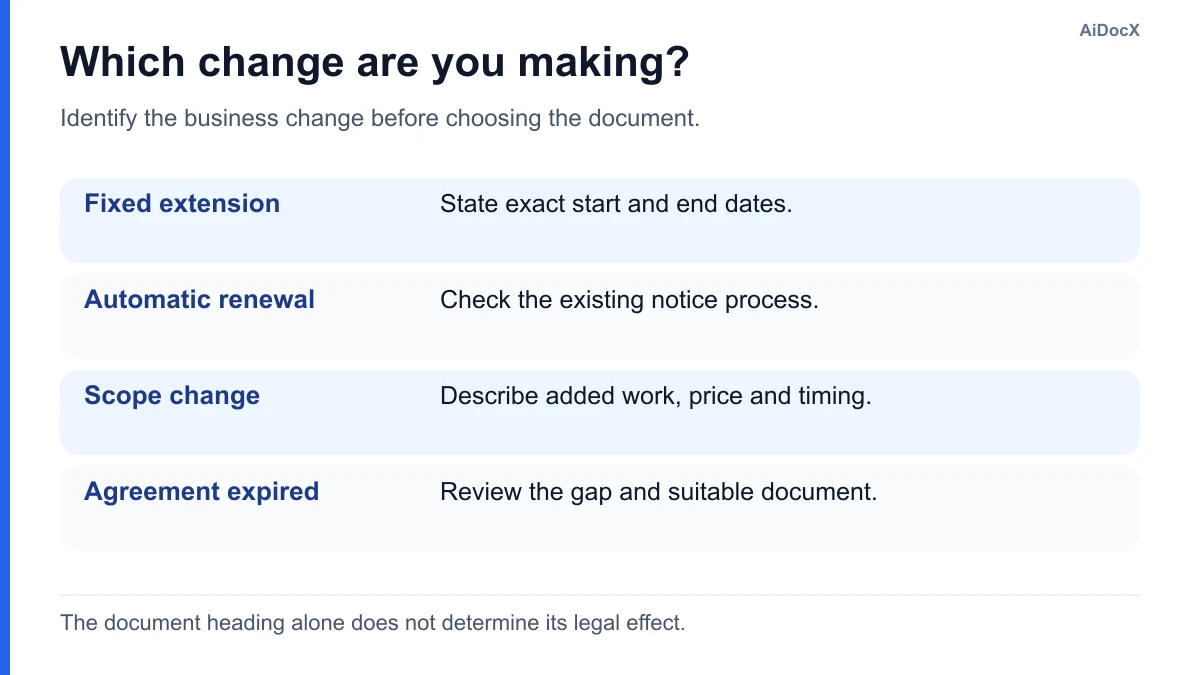
Start with the business change, then choose the document. “Addendum,” “amendment,” and “extension agreement” are used differently across contracts and jurisdictions; the heading does not settle the document's legal effect.
| Situation | What to clarify before drafting |
|---|---|
| Same service continues for a fixed additional period | Extension dates, fees, and which terms continue |
| Extra deliverables are requested | A scope change and its delivery and pricing impact |
| Original term includes automatic renewal | The renewal mechanism, notices, and whether a separate change is needed |
| Original agreement has already expired | The gap period and whether a new agreement or reviewed arrangement is appropriate |
| A new company will provide or receive the service | Party changes and any required consent, not just a later end date |
For added deliverables, the agency change order form helps describe the change. For an extension, keep the specific continuation period and its commercial terms visible from the first page.
Copy this service contract extension template
Replace every bracket, check the original agreement, and remove instructions before signing. Have the completed terms reviewed where the value, risk, or local requirements warrant it.
SERVICE CONTRACT EXTENSION — DISCUSSION DRAFT

Document reference: [EXTENSION NUMBER / VERSION]
Date of this document: [DATE]

Client: [EXACT LEGAL NAME AND ADDRESS]
Service provider: [EXACT LEGAL NAME AND ADDRESS]

1. AGREEMENT BEING EXTENDED
This document relates to [AGREEMENT TITLE], dated [ORIGINAL DATE],
between the parties above, together with the following existing
amendments or schedules: [COMPLETE LIST / NONE].
Current contractual end date: [DATE].
Relevant term / amendment clause: [REFERENCE].

2. FIXED EXTENSION PERIOD
The parties agree that the engagement continues from [START DATE]
through [END DATE], subject to the termination provisions identified
below. The agreed current end date is replaced by [NEW END DATE].

3. SERVICES AND DELIVERABLES
Services during the extension: [EXACT LIST / DATED SCOPE REFERENCE].
Service levels, included hours, and exclusions: [DETAILS].
Changes to existing scope: [SPECIFY / NONE].

4. FEES AND PAYMENT
Currency and tax basis: [DETAILS TO CONFIRM].
Fees during the extension: [AMOUNT, BASIS, BILLING PERIOD].
Invoice schedule and due dates: [DETAILS].
Expenses or approved additional work: [PROCESS / LIMIT].
Existing unpaid invoices: [IDENTIFY / STATE HOW HANDLED].

5. CONTINUING TERMS AND SPECIFIC CHANGES
Except for the changes expressly stated here, the parties intend
the existing agreement and listed amendments to continue on their
existing terms.
Termination / notice terms during the extension: [REFERENCE / CHANGE].
Other expressly changed clauses: [CLAUSE NUMBER AND EXACT CHANGE].
If texts conflict, the intended order of precedence is:
[SPECIFY NARROWLY AND CHECK AGAINST EXISTING DOCUMENTS].
Further renewal after the new end date: [EXACT AGREED ARRANGEMENT].

6. APPROVALS AND EXECUTION
Required internal / contractual approvals: [DETAILS].
Client authorized representative: [NAME AND ROLE]
Signature: [SIGNATURE]   Actual signing date: [DATE]
Provider authorized representative: [NAME AND ROLE]
Signature: [SIGNATURE]   Actual signing date: [DATE]

Attachments: [NUMBERED, DATED LIST]
The wording describes the intended business arrangement. It is not a promise that adding this block to any contract makes the extension enforceable. Check authority, execution requirements, and any formalities that apply to the specific agreement.
Fill it in: a three-month support extension
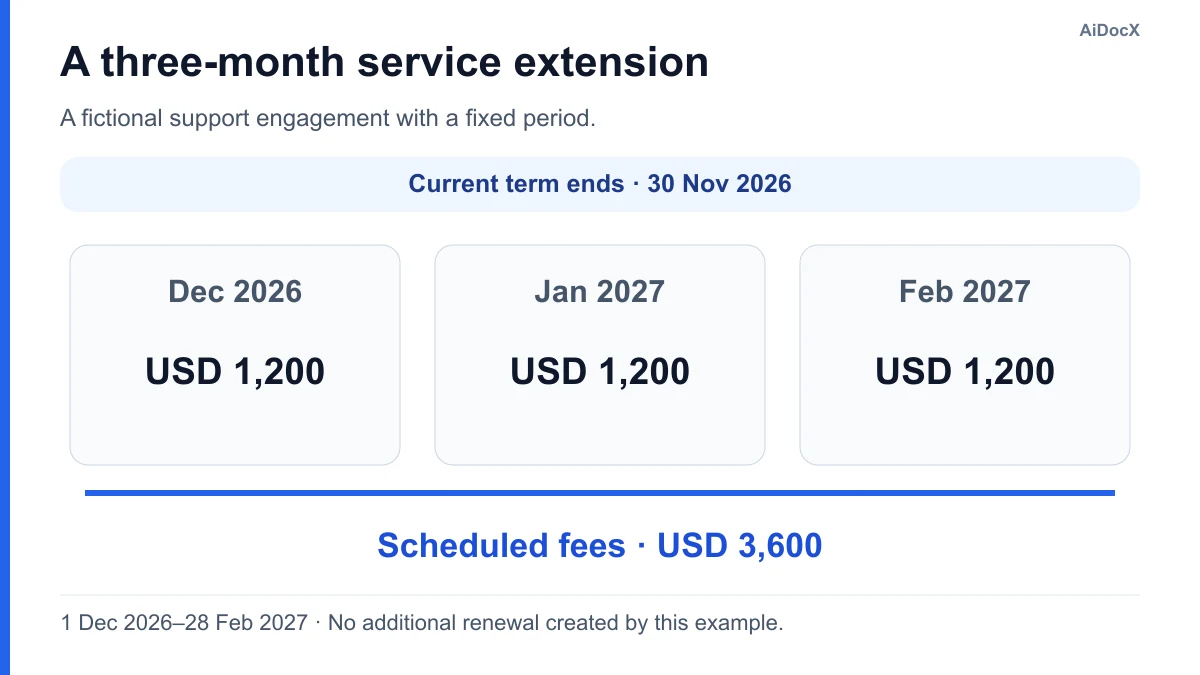
Consider a fictional website support agreement ending on November 30, 2026. The client wants the same defined support through February 28, 2027. The parties discuss the extension before the original term ends.
| Item | Example entry |
|---|---|
| Original agreement | Website Support Agreement, March 1, 2026 |
| Previous amendment | Amendment 1, July 15, 2026 |
| Current end date | November 30, 2026 |
| Extension start | December 1, 2026 |
| New end date | February 28, 2027 |
| Monthly scope | Up to 10 support hours for the listed website |
| Excluded work | Redesign, new integrations, and extra sites |
| Monthly fee | USD 1,200, excluding applicable taxes |
| Scheduled fees | Three monthly fees, totaling USD 3,600 |
| Next-term decision | No additional renewal created by this extension |
The example's fee schedule can say:
December 2026 service fee: USD 1,200
January 2027 service fee:  USD 1,200
February 2027 service fee: USD 1,200
Total scheduled fees:     USD 3,600

Invoice dates and payment deadlines follow the completed schedule.
Applicable taxes, approved extra work, and any early-termination
adjustment are handled under the expressly agreed terms.
The USD 3,600 is the sum of three scheduled fees. It is not automatically a prepaid or non-cancellable commitment. State what the existing termination clause means for billing if the engagement can end early.
Similarly, “10 support hours” needs an operational definition. Say whether unused hours expire or carry over, how time is reported, and how extra work is approved. Extending dates does not answer those questions.
Check the dates before circulating the document
There are several dates with different jobs:
- Original agreement date: identifies the document being changed.
- Document preparation date: identifies this draft or version.
- Signing dates: record when each representative actually signs.
- Extension effective period: states when the continued services apply.
- New end date and notice dates: drive the next decision and reminders.
A November preparation date does not mean both parties signed in November. Keep actual signing dates accurate. If the parties want an effective date different from the signing date, describe it openly and obtain advice about its effect where needed.
Avoid an undefined phrase such as “extend for another quarter.” A calendar quarter, three months from signing, and three months from the old end date can produce different periods. Put the start and end dates in the same sentence and compare them with the existing notice requirements.
Keep the fee, scope, and earlier amendments aligned
A short extension can still create conflicting instructions. Before sending it, compare the original agreement, every signed amendment, and the proposed continuation period.
If a July amendment introduced a new hourly rate, a November extension should not accidentally restore the March rate. Reference the current schedule and state any new rate expressly. If scope is changing, identify the exact attachment and version used during the extension.
Check how the longer service period affects support commitments, confidentiality, access, insurance requirements, and any deliverables due at exit. Do not write that every obligation expires on the new end date: the existing agreement may describe obligations intended to survive the service period.
Name any invoices still outstanding. An extension discussion should not leave either party assuming that an old balance has been forgiven or automatically replaced by new fees. Resolve any proposed adjustment explicitly.
For staged payments, the deposit and balance invoice guide shows a way to keep requests and receipts distinct. If an extended project finishes with a client review, use the project acceptance record for that separate decision.
Send the proposal before the current term ends
Use an email that gives the other party the specific decision and enough time for any required approvals.
Subject: Proposed service extension — [AGREEMENT / PROJECT]

Hi [NAME],

Our current service period ends on [CURRENT END DATE]. Attached is
a draft extension covering [START DATE] through [NEW END DATE].

Proposed services: [SCOPE REFERENCE]
Fees during the extension: [AMOUNT / BASIS]
Other proposed changes: [LIST / NONE]

Please review the draft and confirm the authorized signatory and
required approvals. We propose completing the agreed approval
process by [TARGET DATE].

The attachment is a proposal for review. Please send any requested
changes before it is circulated as the final version.

Thank you,
[NAME]
Save one final version, collect the required approvals, and give both sides a copy of the executed document. Then update the service calendar, billing schedule, and next-term reminder. Store the extension beside the original agreement and earlier amendments so the full chain can be read together.
Questions about extending a service agreement
Can I use an extension letter instead of a separate addendum?
A letter can be a useful format if it contains the agreed changes and meets the agreement's approval process and applicable requirements. The label alone is not enough. Use a clear reference to the original agreement and an appropriate execution method.
What if the agreement has already expired?
Identify the actual timeline, including work or payments during the gap, and get advice on the suitable document. Do not conceal the gap or put a false signing date on a new document. A fresh agreement may be appropriate depending on the circumstances.
Should the extension repeat every original clause?
A focused extension usually identifies the existing documents and spells out the specific changes. Where the agreement has many conflicting amendments or the parties are changing most of the relationship, a reviewed consolidated agreement may be easier to administer.
Prepare the extension for review
Explore the AiDocX contract generator to prepare a draft using the agreed dates, service scope, and fees. Compare the completed text with the current signed documents before circulating it.
Editorial method: AI-assisted drafting with a fictional service engagement. This template is general information and does not replace advice on the applicable contract law or execution requirements.
Ready to automate your documents with AI?
Start free with AiDocX — AI contract drafting, meeting minutes, consultation notes, e-signatures, and more in one platform.
Get Started FreeMore from AiDocX Blog
Deposit Invoice Template: Show the Upfront Payment and Final Balance
Use a deposit invoice template with a worked 40% example, a final balance invoice, payment receipt wording, and checks that prevent duplicate requests.
AiDocX Team November 19, 2026 8 min
Project Acceptance Form Template: Client Sign-Off With Open Items
Copy a client project acceptance form, record deliverables and exceptions, and send a sign-off email with a clear review deadline.
AiDocX Team November 19, 2026 8 min
Music Permission Request Letter Template: Email + Follow-Up
Copy a music permission request email for a video or client ad, with a follow-up template, rights-holder checklist and a worked example of the requested scope.