Music Permission Request Letter Template: Email + Follow-Up
Copy a music permission request email for a video or client ad, with a follow-up template, rights-holder checklist and a worked example of the requested scope.
A music permission request letter asks the appropriate rights holder for permission to use an identified song or recording in a specific project. A useful request names the track, the excerpt, where the finished video will appear, whether it will run as advertising, and the proposed license period.
Below are an original email template, a follow-up and a worked example you can adapt. Sending the request does not authorize the use. Your next step is to obtain permission that actually covers the project.
This guide uses U.S. music-rights terminology. Check any existing license and the rules that apply to your project; these examples do not determine whether a copyright exception applies.
Music permission request email template
Use this for a video, short film or client advertisement. Replace the bracketed fields, remove unused alternatives, and send it to a verified licensing contact. If you are requesting permission without a fee, say so expressly and leave room for the owner to decline or request payment.
Subject: Music permission request — [SONG TITLE] for [PROJECT]

Hello [NAME / LICENSING TEAM],

I am [NAME, ROLE] at [ORGANIZATION]. We would like to request
permission to use the following music in [PROJECT TITLE]:

Song / composition: [TITLE AND KNOWN SONGWRITERS]
Recording: [ARTIST, VERSION / MIX AND RELEASE]
Reference link: [LINK IDENTIFYING THE EXACT RECORDING]
Excerpt: [START–END TIMECODES IN THE RECORDING]
Total music used: [DURATION, INCLUDING ANY REPEATED USE]

Project: [BRIEF DESCRIPTION, CLIENT / BRAND AND SUBJECT]
Placement: [BACKGROUND / OPENING / END CREDITS / OTHER]
Edits: [TRIM, FADE, LOOP OR OTHER PROPOSED CHANGE]
Video versions: [MAIN FILM, CUTDOWNS, TRAILER, ETC.]

Proposed distribution:
- Platforms / accounts: [NAMED CHANNELS, WEBSITE AND ACCOUNT OWNER]
- Use: [ORGANIC POST, MONETIZED VIDEO, PAID ADVERTISING, ETC.]
- Territory: [REQUESTED TERRITORY / ONLINE AVAILABILITY]
- License period: [START DATE AND END DATE / REQUESTED TERM]
- Treatment after expiry: [REMOVE, REPLACE MUSIC OR REQUEST ARCHIVE USE]

Proposed fee: [ASK FOR LICENSING TERMS / OFFERED BUDGET / NO-FEE REQUEST]
Planned release: [DATE]
Requested response date: [DATE]

Please confirm whether you are authorized to license the
composition, the recording, or both for this use, and whether
other owners or representatives must approve it separately.

If you can consider the request, please share the proposed
license, fee, required credit and any conditions. Please also
identify any process we should follow for Content ID claims
on the specified channels.

This is a permission request. We will not treat a fee offer,
acknowledgment or lack of response as approval.

Thank you,
[NAME / TITLE]
[ORGANIZATION]
[EMAIL / PHONE]
A response date is your production request, not an obligation on the recipient. Keep an alternative track available while you wait.
Who should receive the letter?
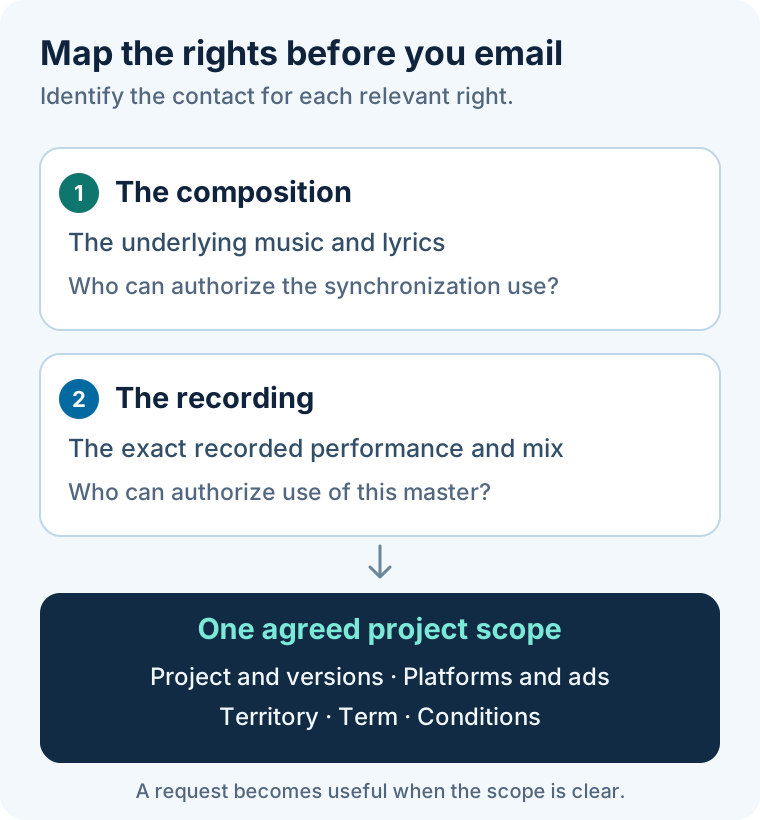
Start by separating the song from the specific recording. The U.S. Copyright Office explains that the musical composition and sound recording are separate works; permission for one does not substitute for permission for the other. Copyright Office: musical compositions and sound recordings
| What you want to use | Contact to investigate | What to ask |
|---|---|---|
| The underlying music and lyrics in your video | The publisher, administrator or songwriter authorized to license the relevant composition rights | Can you authorize the requested synchronization use, and which interests do you control? |
| An existing recorded performance of that song | The label, recording owner or authorized licensing representative | Can you authorize use of this exact master recording in the specified project? |
| A track from a music library | The supplier named in your license or its licensing team | Does the existing license cover this client, channel, advertising use, territory and period? |
One person or company may control both the composition and the recording. Ask them to confirm that scope rather than assuming an artist's reply covers everything. A contact might represent only part of the relevant rights.
For video use, the composition permission is commonly called a synchronization license, and permission for the existing recording is commonly called a master use license. An audio-only mechanical license does not cover audiovisual synchronization. Copyright Office: synchronization rights, page 12
If you cannot find the contact, use the track's release credits and official publisher or label website as starting points. Verify who currently has authority. The Copyright Office's permission guide explains how ownership information and contact research fit into the request process.
Make the requested use specific enough to answer
“Can I use your song on social media?” leaves several production decisions unresolved. Give the recipient a short brief they can evaluate without guessing.
| Field | A useful entry | A detail to resolve |
|---|---|---|
| Exact recording | Artist, release and original or alternate mix | A live performance and a studio master are different recordings |
| Excerpt | 00:42–01:02, played once under narration | Repeated uses can change the total music duration |
| Project and licensee | Named film, producer and client brand | State who needs permission to publish the finished work |
| Versions | One main film and two identified cutdowns | A trailer or a new campaign may need its own permission |
| Distribution | Named YouTube channel and client website | State separately whether paid promotion is requested |
| Territory | Requested countries and intended online availability | Advertising targeting and worldwide page access may differ |
| Term | Proposed start and end dates | Ask what happens to existing posts after the term |
| Commercial context | Sponsorship, client work and monetization plans | “We will not monetize” does not describe every commercial use |
These are drafting prompts, not universal license terms. Ask for what the project needs and compare the offer with that request.
If you plan to display lyrics, create a remix, or release an audio-only version, describe that separately. Do not assume permission to use background music in one video includes those uses.
Worked example: a main film and a paid cutdown
The following project is fictional. It shows how to turn a vague request into a brief; it is not an example of an approved license.
A small studio wants the same recording in a two-minute client film and a short advertisement. Its initial note says, “We need 20 seconds for our launch video.”
A more useful scope is:
Project: Example Studio launch film for Example Client
Licensee: Example Studio, with publication by Example Client
Recording: [EXACT TRACK, ARTIST AND VERSION]
Excerpt: 00:42–01:02 in the main film, played once
Cutdown: 00:42–00:48 in one 15-second advertisement, played once

Main film:
- Example Client's named YouTube channel and website
- Organic publication, with worldwide online availability requested
- Requested publication period: 1 February–30 April 2027

Advertisement:
- Example Client's named Instagram account
- Paid campaign targeting the United States during the same period
- Online availability and platform delivery limits to be agreed

After expiry:
- Remove the posts unless a separate archive permission is agreed

Please provide licensing terms for both uses and identify any rights
or approvals your offer does not cover.
The six-second excerpt is an explicit part of the request. Its short duration is not itself permission. YouTube's copyright myths guidance explains that using only a few seconds can still create copyright issues.
If the resulting offer covers only the main film, resolve the advertisement before using the track there. Keep the offer attached to the brief so the difference remains visible.
Follow-up email when you have no reply
Reply in the original thread so the recipient can see the track and scope. Choose the timing around your production schedule; there is no fixed response deadline.
Subject: Follow-up — [SONG TITLE] permission request for [PROJECT]

Hello [NAME / TEAM],

I am following up on the permission request below, sent on [DATE].

We are seeking permission for [ONE-SENTENCE SUMMARY OF THE USE].
Our planned release is [DATE], and we need to choose the music
by [DECISION DATE].

Could you confirm whether this is the right licensing contact,
and whether you can consider the request? If another party
controls any of the required rights, a referral would be helpful.

[NO CHANGE TO THE REQUESTED SCOPE / CLEAR DESCRIPTION OF CHANGES]

We have not treated the unanswered request as permission.
If clearance cannot be completed in time, we will use another track.

Thank you,
[NAME / CONTACT]
Do not turn a follow-up into an announcement that you will publish unless someone objects. If you need permission and have not obtained it, choose a different track or postpone that use.
What to check when someone says yes
Compare the actual permission with the request before handing the music to the editor for the final release.
- Authority and rights: Does the sender control the rights being granted? Are other approvals still outstanding?
- Identified material: Does the permission name the right composition and the exact recording?
- Scope: Are the client, versions, platforms, advertising use, territory and term covered?
- Conditions: Are payment, credit, approval or other steps required before use?
- Expiry and platform handling: What happens to old posts, and whom should you contact about a claim?
A friendly acknowledgment or an offer of pricing may leave these questions open. Resolve them in the permission or license rather than adding your own assumptions to the production notes.
When you are ready to document the agreed grant, use the music sync licensing agreement template as a separate drafting reference. If the project instead involves commissioning a new recording, the music producer agreement guide covers a different stage of the work.
Keep the final permission, any required payment evidence, the approved brief and the final video version together. For a later cutdown or campaign, compare the new use with that record before reusing the music.
Frequently asked questions
Can I ask for permission to use music for free?
Yes. State that you are requesting a no-fee license and describe the same scope you would include in a paid request. The owner may agree, propose a fee or decline. “Free” should not leave the permitted project, advertising use or term undefined.
Is credit enough if the video is not monetized?
Credit and a decision not to monetize do not automatically provide permission. YouTube addresses both points in its official copyright myths guide. Check the applicable license or exception instead of treating a credit line as the grant.
Does no reply mean I can use the song?
Do not treat an unanswered request as approval. If your intended use requires permission, you still need to obtain it. Keep the release decision separate from the fact that you sent an email.
Will a permission letter prevent every Content ID claim?
Do not promise that outcome to a client. Ask the licensing contact how claims on the approved channels should be handled, and retain the permission records. A platform claim and the scope of the actual license are separate questions.
Should I send this to the artist, publisher or label?
Use the contact authorized to license the rights you need. The artist may be the correct person, or may refer you elsewhere. Identify the composition and recording contacts separately and ask what each can approve.
Editorial method: AI-assisted drafting with checks against the linked Copyright Office and YouTube materials on November 18, 2026. The templates and worked example are original drafting aids; no legal review is claimed.
Ready to automate your documents with AI?
Start free with AiDocX — AI contract drafting, meeting minutes, consultation notes, e-signatures, and more in one platform.
Get Started FreeMore from AiDocX Blog
Deposit Invoice Template: Show the Upfront Payment and Final Balance
Use a deposit invoice template with a worked 40% example, a final balance invoice, payment receipt wording, and checks that prevent duplicate requests.
 AiDocX Team November 19, 2026 8 min
Project Acceptance Form Template: Client Sign-Off With Open Items
Copy a client project acceptance form, record deliverables and exceptions, and send a sign-off email with a clear review deadline.
AiDocX Team November 19, 2026 8 min
Service Contract Extension Addendum Template: Dates, Fees and Scope
Copy a service contract extension template with a three-month example, fee schedule, approval checklist, and clear treatment of unchanged terms.
AiDocX Team November 19, 2026 8 min