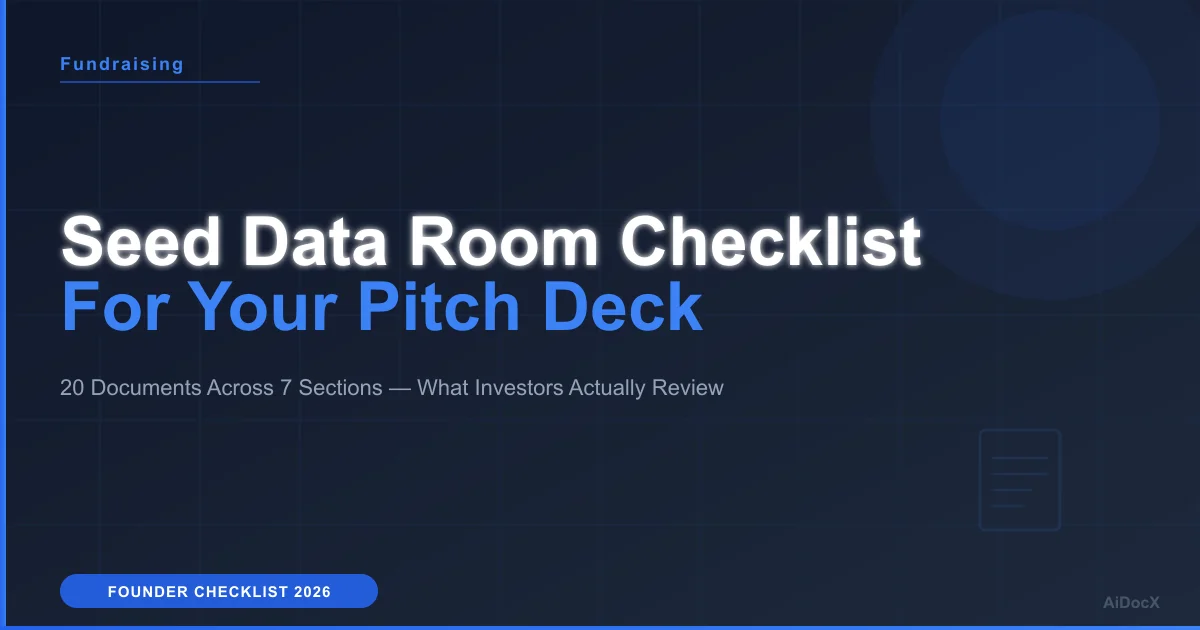
Seed-Stage Pitch Deck & Data Room Checklist (2026)
The complete seed-stage data room checklist — what investors expect, what to include, and what NOT to include. Covers pitch deck, cap table, financial model, KPIs, and legal docs.
 James · Startup Advisor April 23, 2026 12 min read
TL;DR: A seed-stage data room needs 7 core sections: pitch deck, team, financials, metrics/KPIs, product, legal, and customer proof. Keep it lean — 15–25 documents, not 100. Use a tracked platform so you know which investor reviewed which doc.
Contracts and investor decks shouldn't take days — AiDocx lets you go from draft to signed in minutes.
Seed investors make commitment decisions in 30–45 days on average. Your data room's job is not to answer every possible question — it is to answer the questions that matter, fast, and let you see which investors are actually doing the work. This guide is the checklist experienced founders use in 2026.
What Is a Seed-Stage Data Room?
A data room is a secure shared workspace containing the documents investors need for due diligence. At seed stage, it is deliberately minimal — most investors will only skim the deck and ask 2–3 follow-up questions. The documents exist to make those 2–3 questions answerable without another meeting.
At Series A and later, data rooms balloon into hundreds of documents. At seed, aim for 15–25 documents covering the seven sections below.
Why a Structured Data Room Beats Ad-Hoc Sharing
Sending decks and financials as email attachments creates four problems:
- No tracking — you don't know who read what
- Version drift — your "latest" financials get forwarded as "final" to new investors
- Security gaps — sensitive docs like cap tables live in inbox forwards indefinitely
- No discipline — you write each document as it's asked for, inconsistently
A structured data room with per-document view tracking replaces all four with one workflow.
The 7-Section Seed Data Room Checklist
Section 1 — Pitch Deck (Always First)
What to include:
- Primary 12–15 slide deck (the one you present live)
- Short "overview" version (6–8 slides, for cold shares)
- Appendix deck (detailed charts, customer logos, team bios)
What not to include:
- Multiple "old" versions
- Video embeds (link out instead)
- Oversized PDFs (compress under 10 MB)
For deck construction, see our AI pitch deck guide for seed startups and how investors read pitch decks.
Section 2 — Team & Company
What to include:
- One-page team summary (founders, key hires, advisors)
- Cap table (simple, current)
- Org chart (only if you have 10+ employees)
- Founder bios (one paragraph each with LinkedIn links)
What not to include:
- Full resumes (unless asked)
- Compensation details
- Hiring plans (live in the model, not separate)
Section 3 — Financials & Model
What to include:
- Historical P&L (last 12 months, monthly)
- 24-month forward model (revenue, cost, headcount assumptions)
- Unit economics one-pager (CAC, LTV, payback)
- Current cash position + runway
What not to include:
- 5-year projections (nobody believes them at seed)
- Raw bookkeeping exports
- Personal founder finances
For fundraising document structure, the one-pagers matter more than the raw spreadsheet.
Section 4 — Metrics & KPIs
What to include:
- North-star metric trend (90-day graph)
- Cohort retention (if consumer/SaaS)
- ARR/MRR bridge (new, expansion, churn)
- Top 5 customers by revenue
What not to include:
- Every metric you track
- Vanity metrics (total signups, total pageviews)
- Data older than 12 months
Section 5 — Product
What to include:
- Live demo link (Loom recording or sandbox account)
- Product screenshots in deck appendix
- Short product roadmap (6-month, directional)
- Tech stack one-pager (only if asked)
What not to include:
- Feature list (investors don't care)
- Long technical documentation
- Code samples
Section 6 — Legal & Structure
What to include:
- Incorporation documents (certificate of incorporation)
- Cap table management link (Carta, Pulley)
- Existing investor list with check sizes
- Current SAFE notes or convertible notes outstanding
What not to include:
- Employment contracts (unless asked)
- Customer contracts in full (summary table only)
- IP filings (link to assignments summary)
Section 7 — Customer Proof
What to include:
- 2–3 customer case studies (one page each)
- Testimonial quotes with permission
- Logo bar of paying customers
- NPS or satisfaction snapshot (if you have real data)
What not to include:
- Every testimonial you have
- Unverified anecdotes
- Logos of non-paying users
The Complete Document List
A lean seed data room typically has these 20 documents:
- Pitch deck (main, 12–15 slides)
- Pitch deck (short, 6–8 slides)
- Appendix deck
- Team one-pager
- Cap table
- Current financials (P&L)
- 24-month forward model
- Unit economics one-pager
- Runway summary
- KPI dashboard snapshot
- Cohort retention chart
- ARR/MRR bridge
- Top customers table
- Product demo video
- Product roadmap (6-month)
- Incorporation cert
- Existing investors list
- Outstanding SAFEs summary
- Customer case study 1
- Customer case study 2
That's it. If you need to add more, you're probably over-preparing.
How to Host the Data Room
Option 1 — Purpose-built data room (recommended)
Use a platform with:
- Per-investor tracking links
- Document expiration
- Download lock or watermark
- NDA gate (optional)
- E-signature for the SAFE
AiDocx, DocSend, and Ironclad all provide this. AiDocx is the only one that also lets you draft the SAFE and send it for signature in the same workspace. See our virtual data room fundraising guide and secure pitch deck sharing guide for setup details.
Option 2 — Google Drive (not recommended)
Google Drive lacks investor-grade tracking and security controls. Founders use it for speed, then regret it when the same link circulates among VCs without attribution.
Option 3 — Shared Notion (not recommended)
Same issues as Google Drive, plus Notion pages sometimes leak to the open web via indexing misconfigurations.
Comparison: Seed Data Room Platforms
| Feature | AiDocx | DocSend | Ironclad | Google Drive |
|---|---|---|---|---|
| Per-investor tracking | Yes | Yes | Partial | No |
| E-signature for SAFE | Yes | No | Yes | No |
| AI pitch deck drafting | Yes | No | No | No |
| NDA gate | Yes | Yes | Yes | No |
| Free tier | Yes | No | No | Yes |
| Startup-friendly pricing | Yes | No | No | Free |
How to Use Tracking to Drive the Round
Every view event is a signal:
- Investor opened the deck within 2 hours of send → hot; follow up same day
- Investor spent 4+ minutes on traction slide → they care about retention proof; send the cohort chart next
- Investor opened, skimmed 30 seconds, never returned → cold; deprioritize
- Investor forwarded the link internally → pass is imminent one way or the other; ask where they are
For the full tracking playbook, see our how to track pitch deck views guide.
Common Mistakes
Mistake 1 — 100-document data room at seed
Overpreparation signals inexperience. Keep it tight.
Mistake 2 — Updating documents without notifying investors
If the model changes materially, email investors who viewed the old version.
Mistake 3 — No NDA on the cap table
Cap tables leak. NDA-gate the cap table and outstanding SAFEs.
Mistake 4 — Sending the same data room link to every investor
Use per-investor links. This lets you track and revoke per-relationship.
Mistake 5 — Leaving the data room open after the round closes
Once you close, expire the link. Old data rooms drift into competitor hands over time.
Frequently Asked Questions
Do I need a data room at pre-seed?
Usually no. At pre-seed, the pitch deck + a warm intro is enough. Start the data room at seed when you're asking for $500K+ checks.
Should I NDA-gate my pitch deck?
Usually not. Most seed investors won't sign NDAs for a deck review. Reserve the NDA for financials, cap table, and customer-specific docs.
How often should I update the data room?
Monthly during active fundraising, quarterly otherwise. Update the KPI snapshot and runway first.
Can AI help build the data room?
Yes. AI drafts the pitch deck, the customer case studies, and the investor update template. Keep the model in a real spreadsheet, though — AI-generated financial models are unreliable.
What about a competitive analysis doc?
Include one competitive slide in the appendix deck, not a separate doc. Avoid multi-page competitive teardowns; they age badly.
Should I include customer contracts?
Only a summary table (counterparty, ARR, contract end date). Full contracts belong in diligence at Series A, not seed.
What if an investor asks for something not in the data room?
Treat it as a signal of seriousness. Send the requested doc within 24 hours and add it to the data room for the next investor who asks.
The Bottom Line
Your seed data room is a communication tool, not a compliance exercise. Fifteen well-chosen documents, tracked per investor, beat fifty documents in a Google Drive folder. Use the tracking to time your follow-ups and prune your investor list as the round progresses.
Anywhere you create, share, track, and sign — AiDocx does it faster.
Build your seed data room free →
Related Guides
Ready to automate your documents with AI?
Start free with AiDocX — AI contract drafting, meeting minutes, consultation notes, e-signatures, and more in one platform.
Get Started FreeMore from AiDocX Blog
Consulting Proposal Template (2026): 9 Sections + Example
Copy a consulting proposal template with nine sections, pricing options, and a filled example. Includes tips to make the proposal easy to approve.
 AiDocX Team October 24, 2026 11 min
Internship Agreement Template (2026): Paid & Unpaid Interns
Copy an internship agreement template for paid or unpaid interns. Covers U.S. and UK pay rules, duties, IP, confidentiality, and a filled example.
AiDocX Team October 24, 2026 12 min
Meeting Minutes Template (2026): 4 Formats + Filled Example
Copy a meeting minutes template in four formats: team, decision log, board, and client call. See a filled example and a 15-minute workflow.
AiDocX Team October 24, 2026 11 min