The Enterprise B2B Sales Playbook: From POC to Proposal Tracking (2026 Guide)
Three strategies that actually work for B2B startups selling into enterprise accounts — win the door with a POC, go all-in on your first customer, and sell with radical honesty. Plus the blind spot almost everyone misses: proposal tracking.
 MinjiLee · Strategic Lead March 12, 2026 11 min read
The Enterprise B2B Sales Playbook: From POC to Proposal Tracking
TL;DR: To break through the enterprise wall, B2B startups need to prove market fit with a POC and go all-in on their first customer to build a reference story. But if you have no idea what happens after you hit "send" on a proposal — the final gate in the sales process — all that earlier effort can evaporate into thin air.
Last month, a founder told me something like this:
"We spent six months building a relationship with the procurement lead at a major enterprise. The POC went great. We finally sent over the proposal, and... three weeks of silence. Did they even open it?"
Sound familiar?
B2B sales is hard for reasons that have nothing to do with your product being "not good enough." Enterprise sales is hard because of complex decision structures, long cycles, and the black boxes that swallow deals at every stage of the process. And the black box that opens right after you send a proposal quietly kills far more deals than most founders realize.
You shouldn't need days to get one contract signed. With AiDocX, you can go from draft to signature in the time it takes to finish a cup of coffee. But before that, you need to know what's actually happening on the other end when that proposal lands on someone's screen.
In this post, we'll walk through the strategies that genuinely work for B2B startups selling into enterprise accounts — using a POC as your foot in the door, winning your first customer, and selling with real transparency — before covering the blind spot almost everyone misses: proposal tracking.
Why Is Enterprise B2B Sales So Hard?
When a B2B startup knocks on an enterprise's door, it runs into three major walls.
First, the trust wall. If an enterprise procurement lead brings in an unproven startup solution, they're the one who takes the fall if it goes wrong. No matter how good your product is, if you haven't been validated yet, the default reaction is "looks promising, but let's wait and see."
Second, decision-maker complexity. According to Gartner, an average B2B purchase decision involves 6 to 10 stakeholders. Even if you win over the one champion you've been cultivating, that person still has to convince five more people internally.
Third, the long sales cycle. Startups need deals to close fast, but enterprises move through a long journey — evaluation, internal reporting, legal review, budget approval, then contract. It's not unusual for this to stretch past six months to a year.
There are proven, field-tested strategies for clearing all three walls.
Strategy 1: Use a POC to Lower the Barrier
The fastest way for a B2B SaaS or solutions company to earn enterprise trust is a POC (Proof of Concept) — letting the prospect actually use your product, in a limited scope, before signing a contract.
Why POCs Work
A POC isn't just a "free trial." For the enterprise, it's a low-risk way to validate real-world value. For the startup, it's a chance to prove the product inside an actual enterprise environment.
Through a POC, you get:
- Real usage data and concrete areas to improve
- An internal champion — someone inside the organization rooting for your product
- A far stronger negotiating position when the contract conversation starts
How to Land a POC Opportunity
Cold-calling your way into an enterprise account is a losing game. There are smarter paths in.
Tap corporate innovation and open-innovation programs: Most Fortune 500 companies and large enterprises run formal corporate venture, open-innovation, or startup-partnership programs specifically to evaluate outside solutions. These programs are an official, much easier channel into a POC than trying to cold-email your way past a gatekeeper.
Use grant and pilot-funding programs: Programs like SBIR/STTR grants, government innovation vouchers, regulatory sandboxes, and public-sector procurement innovation initiatives can open an official route to running a POC with a large enterprise or public agency — often with funding attached.
Find your internal champion first: Target the actual end users of your product before you target procurement. When someone inside the company proposes "let's try this solution" on their own, it carries far more weight than any outside pitch ever could.
Strategy 2: Go All-In on Your First Customer — Reference Over Revenue
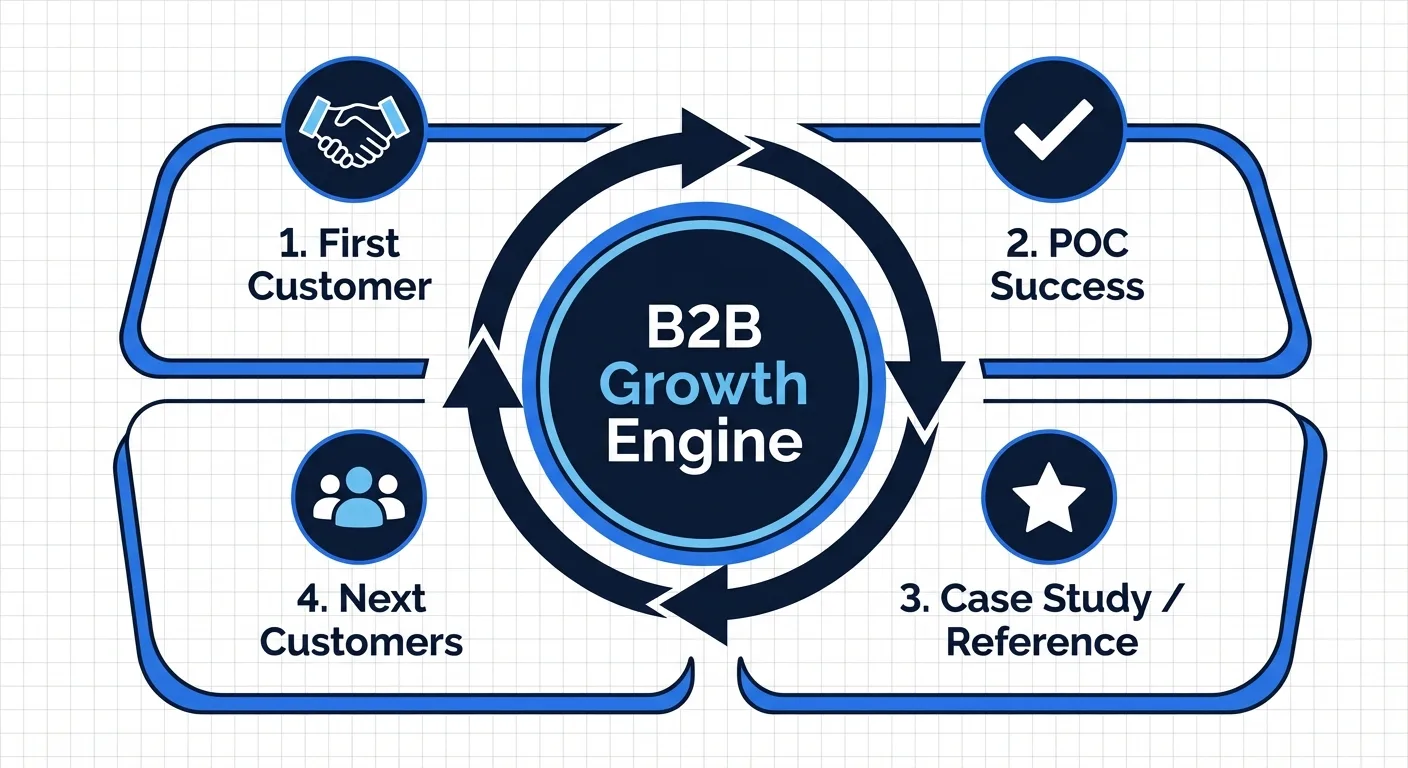
In B2B sales, your first customer means something entirely different from every customer that follows. It's not just the start of revenue — it's the start of your reference story.
Keep Going Until They Say "This Changed Everything"
Once the first contract is signed, a lot of startups make the same mistake: they think collecting the payment and shipping the feature is the finish line.
It's not. You need to stay locked in on that first customer until they say, out loud, "this solution changed how we work." Custom feature work, onboarding the team, weekly feedback calls, help measuring impact — whatever it takes.
Why? Because your first customer's success story is what brings in your second and third customers. One reference in the same industry — "Company A adopted this and improved efficiency by 30%" — is worth more than dozens of cold calls combined.
Don't Be Afraid to Customize
Plenty of early-stage startups lose their first customer by stubbornly insisting on a rigid, one-size-fits-all product. You obviously can't say yes to every request. But customization aimed at solving your first customer's core pain point is really a process of strengthening the product itself.
Building what your first customer needs often turns into a feature every future customer needs too. Your first customer isn't just a client — they're your beta tester and co-developer.
Strategy 3: Radical Honesty Is Your Strongest Weapon
Peter Kazanjy's lesson from Dropbox's early B2B sales days is simple but powerful: not hiding your weaknesses is what builds trust.
"Be Our First Innovator"
There's a question enterprise procurement teams ask constantly: "Who are your reference customers? Have you sold to a Fortune 500 company before?"
Early-stage startups tend to shrink in the face of that question. But answering it honestly is far more effective than dodging it.
"We don't have a customer your size yet — which means we can give you our full attention. Sign now, and you become our first innovator: you get to shape the product roadmap, and you get white-glove, custom support that a bigger customer never would."
This approach works because most sales pitches are wall-to-wall exaggeration and polish. Honesty stands out precisely because it's rare.
Give Value First
Don't beg for a meeting. Instead, send something genuinely useful that solves the prospect's pain point — before you ever ask for their time.
For example, if you sell a proposal-automation product, sharing "an analysis of the average time and cost your industry spends drafting proposals" up front is far more effective than a cold pitch. If that report delivered real value, asking for a meeting afterward becomes an easy conversation.
Know the Product Like an Expert
A great B2B sales rep isn't just a salesperson — they're a thought leader. You need to understand the customer's industry, workflows, and current pain points as deeply as you understand your own product.
That's the difference between saying "this feature is great" and saying "here's exactly how this solves the bottleneck in your purchasing process." The second sentence is what closes deals.
But What Happens After You Hit Send?
You nailed the POC. You built a reference customer through relentless effort. You earned trust through honest, transparent selling. Finally, you send the proposal.
And then... you wait.
This is the most anxious, most uncertain moment in the entire B2B sales process. Did they open it? What part caught their attention? Did they forward it to another department? Or did it just land in a spam folder somewhere?
Most B2B sales teams have no idea what the answer is.
This is the fatal blind spot.
Why Proposal Tracking Is a Game-Changer for B2B Sales
According to RAIN Group research, roughly 80% of B2B proposals never get a meaningful response. Most are never opened, or they're opened and ignored, or they never even make it to the actual decision-maker.
But do you know which of those buckets your proposal falls into?
The Limits of Following Up Blind
Send a proposal with zero tracking, and your follow-up strategy becomes pure guesswork.
- "Should I reach out again in three days?"
- "It's Monday now, I should probably follow up"
- "If I reach out too often I'll seem pushy, better to wait a bit longer"
Every one of these calls is a guess made with zero data behind it. The result: you follow up too early (pinging "did you get a chance to review this?" before they've even opened it) or too late (reaching out only after their interest has already cooled).
What Proposal Tracking Actually Tells You
With a proposal tracking tool in place, here's what becomes possible:
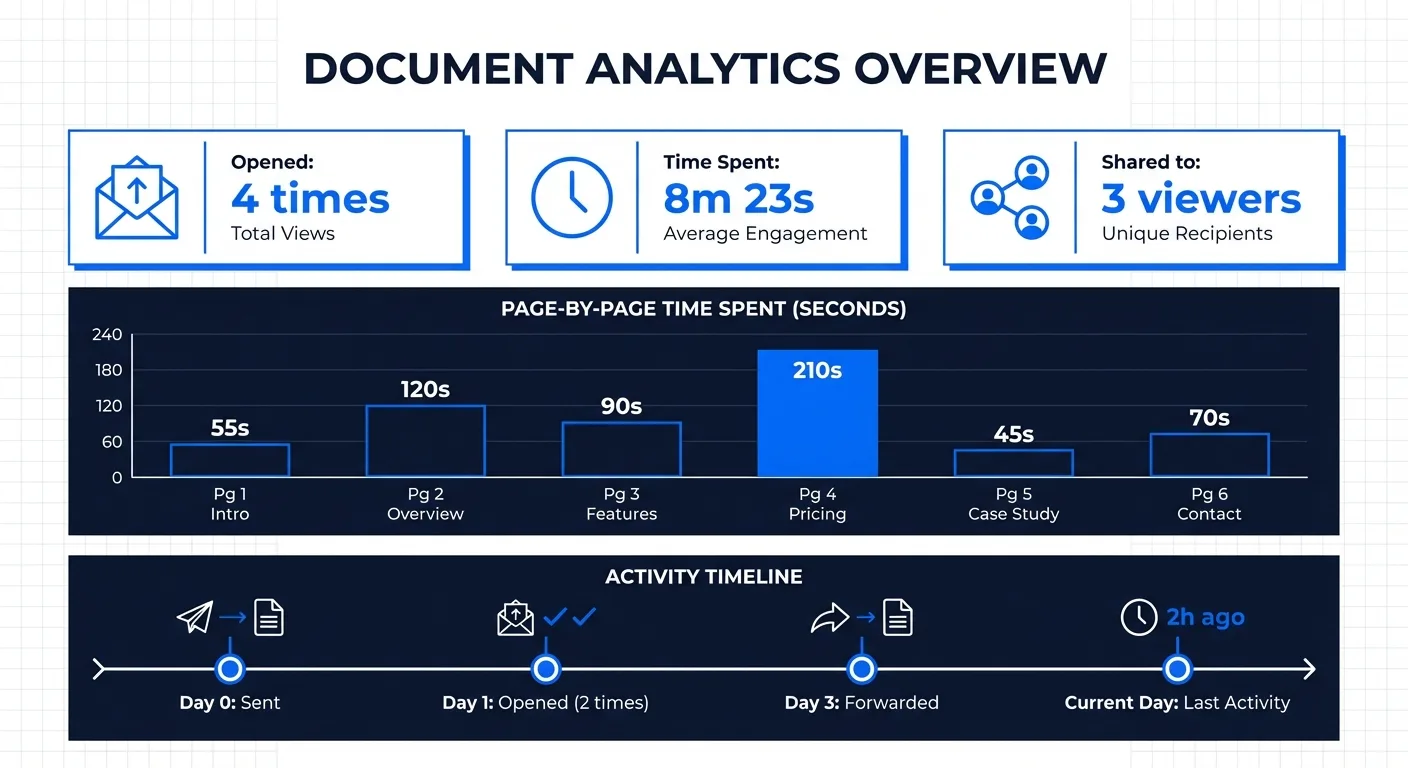
Real-time open notifications: You get notified the instant the recipient opens your proposal. When you know the proposal is on their screen right now, your follow-up lands at the exact right moment.
Page-by-page time analysis: Did they spend three minutes on the pricing page and thirty seconds on the case study? That data tells you exactly what they care about and where the friction is. A follow-up like "any questions about the pricing structure?" suddenly lands with almost eerie precision.
Sharing and forwarding tracking: Did your contact forward the proposal to two colleagues? That's a strong signal that internal review is underway on their end. That's exactly the moment to reach out with "let me know if you need any additional materials to help with the internal decision."
What Gong.io's Data Shows
Research from Gong.io found that following up within one hour of a prospect engaging with your content produces a 7x higher response rate than following up 24 hours later. The moment right after someone opens your proposal is the moment their interest is at its peak. Catching that window requires a real-time open notification — there's no way around it.
The 3 Pillars of B2B Sales + Proposal Tracking, Combined
Putting it all together:
| Stage | Core Strategy | Execution Point |
|---|---|---|
| Open the door | Build trust with a POC | Leverage corporate innovation & grant programs |
| Deepen the relationship | Go all-in on your first customer | Customize until they say "this changed everything" |
| Build trust | Radical honesty and transparency | Admit the gaps + give value first |
| Close the deal | Proposal tracking | Open notifications → follow up at the perfect moment |
Even if you nail the first three stages — which take the most effort by far — you can still lose the deal if you miss the timing at the final stage. Conversely, following up at exactly the right moment with proposal tracking turns all that earlier effort into a far bigger payoff.
Get Started with Proposal Tracking on AiDocX
AiDocX brings proposal drafting, sending, tracking, and e-signature together in one platform.
Proposal tracking features:
- Real-time open notifications (email + browser push)
- Page-by-page time-on-page analysis
- Visitor identification and forward/share tracking
- Full visit count and open history
You can get started on the free plan. Send your next proposal with a tracking link and see what happens. Once the data starts talking, the way you sell changes for good.
Frequently Asked Questions
Who covers the cost of a POC?
In most cases, POC costs are negotiable. From a startup's perspective, offering it for free tends to pay off through the reference value it creates — but if the POC requires heavy IT integration or large-scale data processing on your side, charging a partial fee is often the realistic move. Grant or pilot-funding programs (corporate innovation programs, SBIR/STTR-style grants, etc.) can sometimes cover these costs directly.
How much customization should I give my first customer?
There's one test: "Will other customers need this too?" Keep one-off customizations — like integrating with a specific company's internal systems — to a minimum, and prioritize building out requests that have broad, universal value. Features that started as a request from your first customer very often end up becoming core to the product.
What proposal tracking tool should I use?
DocSend, PandaDoc, and AiDocX are the well-known options. The tool matters less than building the habit of tracking in the first place. If you're currently sending proposals as email attachments with zero visibility, starting with literally any tracking tool beats flying blind. AiDocX includes tracking on its free plan.
Won't proposal tracking feel invasive to the recipient?
Link-based tracking isn't fundamentally different from the open-tracking used in ordinary marketing emails. Most B2B buyers already know this happens, and it's a common, accepted part of the sales process. That said, there's no need to make it obvious that you "know exactly when they opened it" — use the tracking data to sharpen your timing and your message, not to call it out.
What if the POC fails?
A failed POC isn't a failed product. Get specific feedback on where it fell short, then either improve and try again, or recognize that this particular account just isn't the right fit and redirect your energy toward a better-matched target. What matters is feeding that feedback back into the product.
Closing Thoughts
Enterprise B2B sales is a marathon. You need a POC to open the door, relentless focus on your first customer to build a reference story, and honest, transparent selling to earn trust along the way. None of these three are optional — they're the fundamentals.
But if you have no visibility into how the proposal — the output of all that effort — actually gets handled on the other end, you risk wasting half the work you put in to get there.
Proposal tracking isn't a technology problem — it's a mindset shift. It's the decision to make data-driven calls even in the last mile of the sales process. To follow up on information, not instinct.
Send your next proposal with a tracking link. The first time you see data like "opened at 10:32 AM, spent 4 minutes on the pricing page," the way you think about sales changes for good.
Ready to automate your documents with AI?
Start free with AiDocX — AI contract drafting, meeting minutes, consultation notes, e-signatures, and more in one platform.
Get Started FreeMore from AiDocX Blog
Buy Sell Agreement Template (2026): Triggers, Valuation and Funding for Co-Owners
A free buy sell agreement template for co-owners, with triggering events, valuation methods, insurance funding and cross-purchase vs. redemption structures.
 James September 26, 2026 12 min
Consignment Agreement Template (2026): Commission, Title, Risk of Loss and Unsold Goods
Free consignment agreement template for makers, artists and boutiques: commission split, title, insurance and how to protect consigned inventory.
James September 26, 2026 9 min
Distribution Agreement Template (2026): Territory, Exclusivity, Minimums and Reseller Terms
Free distribution agreement template (works as a reseller agreement template too): territory, exclusivity, minimums, pricing, IP and termination.
James September 26, 2026 13 min