Employee Stock Option Plans (ESOP) for Startups: Vesting, Pools, and Templates (2026)
A founder's guide to employee stock option plans — how options and vesting work, how big your option pool should be, the documents you need, and the mistakes that cost startups equity. With a free template workflow.
 MinjiLee · Strategic Lead June 28, 2026 11 min read
Employee Stock Option Plans (ESOP) for Startups: Vesting, Pools, and Templates
Equity is the currency early startups use to hire people they otherwise couldn't afford. A senior engineer who would cost $250,000 at a large company joins a seed-stage startup for less cash and a slice of the upside — paid in stock options. Done right, an employee stock option plan aligns the whole team around building something valuable. Done carelessly, it dilutes founders, frustrates employees who don't understand what they hold, and creates legal cleanup that scares off investors during due diligence.
This guide explains how option plans actually work, how to size your pool, the documents you need, and the mistakes that quietly cost startups equity — written for founders, not lawyers.
What an Employee Stock Option Plan Actually Is
An Employee Stock Option Plan (ESOP, sometimes called an option pool or equity incentive plan) is a formal program that lets a company grant stock options to employees, advisors, and sometimes contractors.
A stock option is not stock. It is the right to buy a set number of shares at a fixed price — the strike price (or exercise price) — at some point in the future. If the company grows and its shares become worth far more than the strike price, the holder can exercise the option, pay the strike price, and capture the difference. If the company never grows, the option simply expires worthless and the holder has lost nothing but opportunity.
That structure is the whole point. It costs the employee nothing today, costs the company no cash, and only pays out if everyone succeeds together.
The Mechanics: Vesting, Cliffs, and Exercise
Options don't all become usable at once. They vest over time, so the equity rewards people who stay and contribute.
The Standard Vesting Schedule
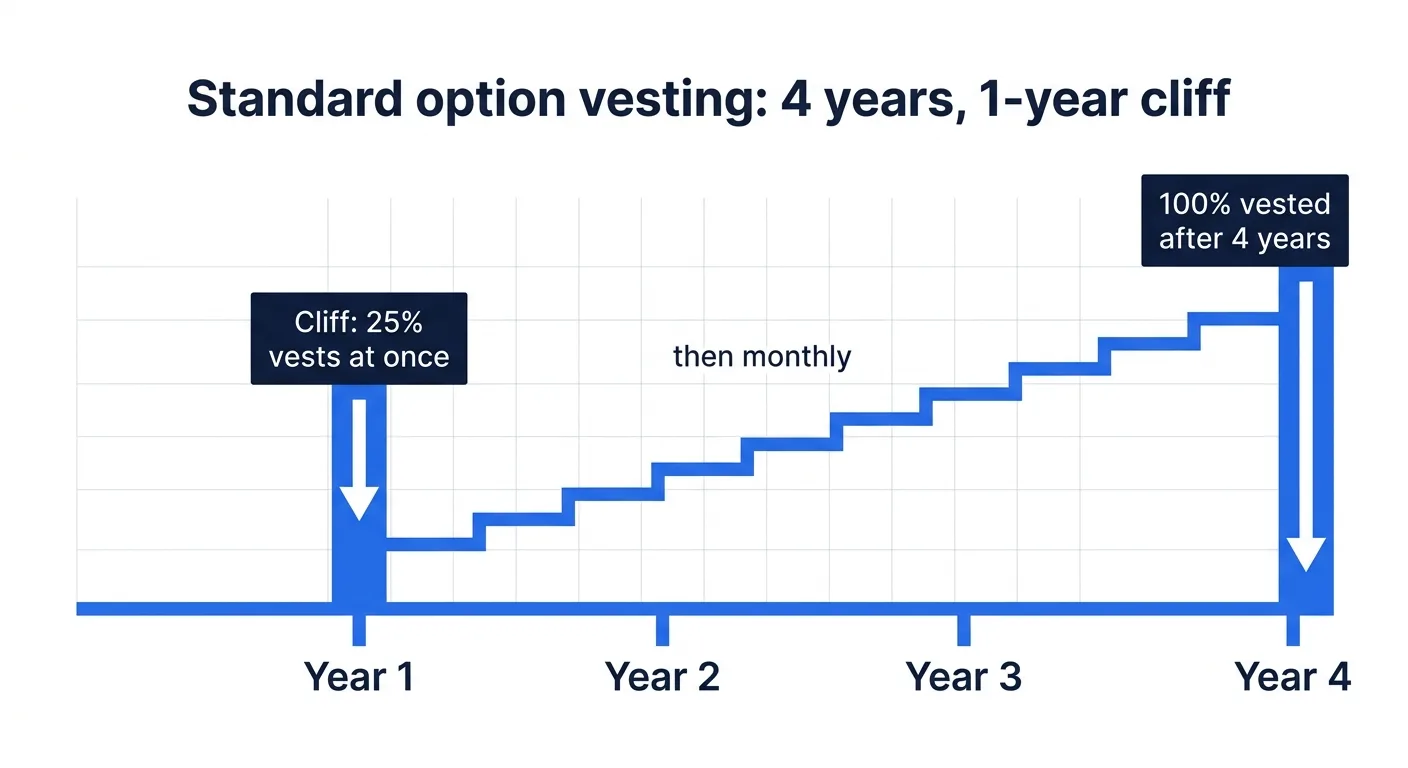
The market-standard schedule is four years with a one-year cliff:
- Four-year vesting: the full grant vests gradually over 48 months.
- One-year cliff: nothing vests until the employee completes 12 months. On their first anniversary, 25% vests at once (the "cliff"). After that, the rest typically vests monthly.
The cliff protects the company. If a hire doesn't work out in the first few months, they leave with zero equity instead of a chunk of the cap table.
Exercise Windows and the Post-Termination Trap
When someone leaves, their vested options usually must be exercised within a limited window — historically just 90 days. Miss the window and the vested options are forfeited. Because exercising can require real cash (the strike price plus possible tax), this 90-day rule has become controversial, and some startups now offer extended exercise windows (e.g. up to 10 years) as a retention and fairness perk. Decide your policy deliberately and state it clearly in the documents.
How Big Should Your Option Pool Be?
The option pool is the percentage of company equity reserved for future grants. Set it too small and you can't hire; set it too large and you dilute yourself unnecessarily.
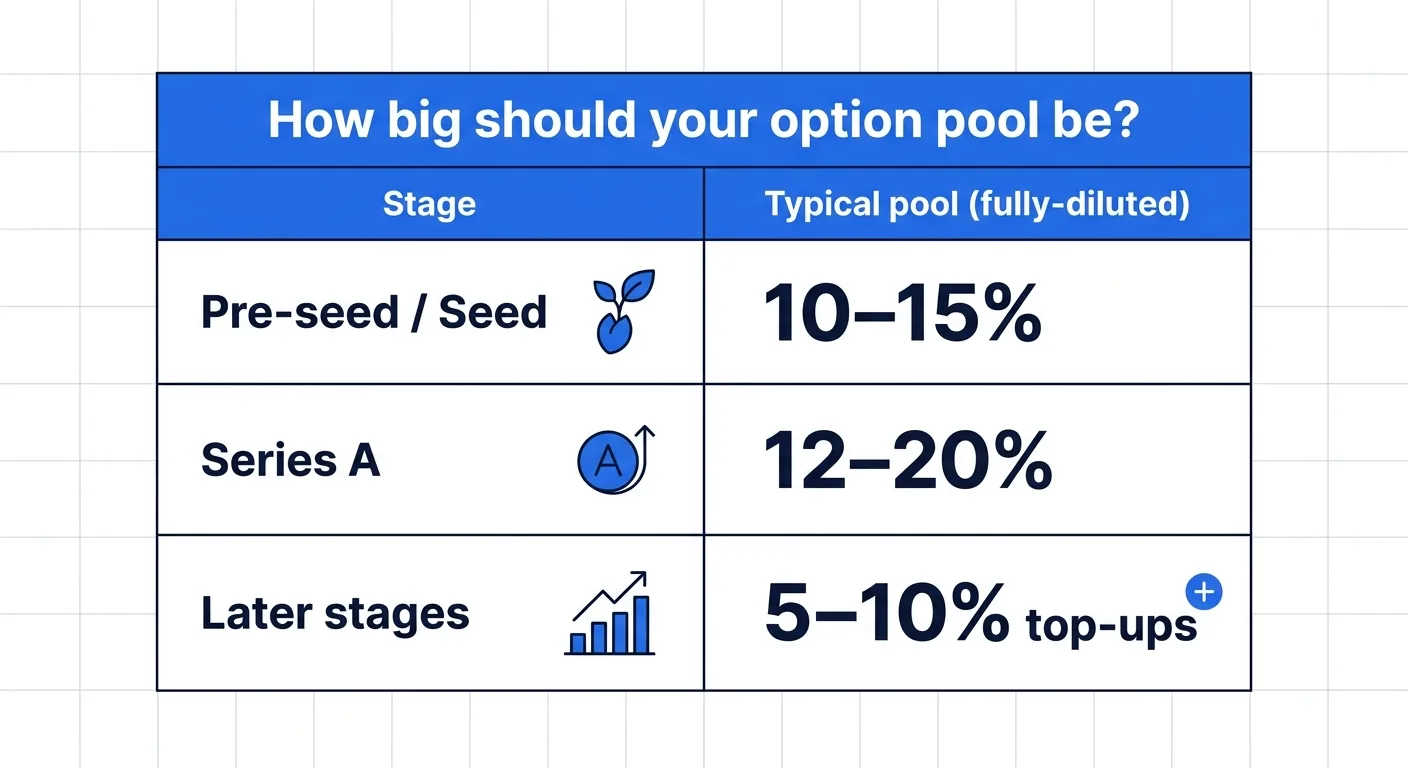
| Stage | Typical option pool (of fully-diluted equity) |
|---|---|
| Pre-seed / Seed | 10% – 15% |
| Series A | 12% – 20% (often "topped up" at the round) |
| Later stages | refreshed as needed, usually 5% – 10% increments |
One detail founders miss: investors usually require the pool to be created or expanded before their investment, which means the dilution comes out of the founders' and existing shareholders' stake, not the new investor's. This is the "option pool shuffle," and it can quietly cost founders several extra percent. Model it on a fully-diluted basis before you agree to round terms.
The Documents You Actually Need
A defensible option program is a small stack of documents, not a single file:
- The Plan document (the ESOP / Equity Incentive Plan): the master rules — who's eligible, total shares reserved, administration, and what happens in an acquisition.
- Board approval / consent: the board must formally adopt the plan and approve each grant, setting the strike price at fair market value.
- The Grant Agreement (Stock Option Agreement): the individual contract for each person — number of options, strike price, vesting schedule, exercise window.
- The Grant Notice / Cap Table entry: recording the grant so your ownership records stay accurate.
The two failure modes are equal and opposite: promising equity casually in an offer email with no paperwork, or drowning early hires in documents they never sign. A clean, consistent template for every grant avoids both.
Mistakes That Cost Startups Equity
Promising equity verbally. "We'll give you 1%" in a Slack message is not a grant. Without a board-approved agreement and a set strike price, you have an expensive misunderstanding waiting to surface during due diligence.
Setting the strike price wrong. The strike price must reflect fair market value at the grant date. Set it too low without a defensible valuation and you create tax problems for employees and the company. Many startups obtain an independent valuation to support it.
Ignoring the cap table. Every promised-but-undocumented grant is an invisible liability. Investors will reconstruct your real ownership during diligence, and surprises there kill momentum. Keep grants and the cap table in sync from grant one.
Forgetting the acquisition scenario. What happens to unvested options if the company is acquired? Acceleration terms (single- or double-trigger) materially change outcomes for your team. Decide and document them up front, not during a deal.
One-off, inconsistent agreements. When every grant is drafted from scratch, terms drift, errors creep in, and cleanup becomes a project. Standardize on one reviewed template.
Putting It Together Without a Six-Figure Legal Bill
You still want a lawyer to adopt the plan itself and to advise on valuation and tax — that part is worth paying for. But the repeatable work around it doesn't need to be slow or expensive. A modern document platform lets you:
- Start each Stock Option Agreement from a consistent, reviewed template instead of a blank page.
- Use AI review to check a draft for missing terms — vesting, exercise window, acceleration — before it goes out.
- Chat with the document to answer an employee's questions in plain language ("What does my one-year cliff mean?").
- Send it for secure e-signature and keep every signed grant in one place, in sync with your records.
That keeps the strategic decisions with your counsel and the repetitive execution fast and consistent.
Frequently Asked Questions
What is the difference between an ESOP and stock options? "ESOP" usually refers to the overall plan that authorizes a company to grant equity; "stock options" are the individual rights granted to employees under that plan. In startup usage the terms are often blended, but the plan is the framework and the options are what people actually receive.
What is a typical vesting schedule for startup stock options? Four years with a one-year cliff is the market standard: nothing vests for the first 12 months, then 25% vests at the one-year mark, with the remainder vesting monthly over the following three years.
How large should a startup's option pool be? Most seed-stage startups reserve 10–15% of fully-diluted equity, often expanding it at Series A. Size it to your actual hiring plan rather than a round number, and model who bears the dilution.
Do stock options cost the employee money? Granting and vesting cost nothing. Exercising — actually buying the shares — requires paying the strike price, and there can be tax consequences depending on jurisdiction and option type. This is why exercise windows and timing matter.
Can I create stock option agreements without a lawyer? Use counsel to adopt the plan and to handle valuation and tax. For the individual grant agreements, a reviewed template plus AI review keeps each one consistent and complete — fast for you, defensible in diligence.
Getting Started
If your equity promises currently live in offer emails and memory, the fix is straightforward: adopt a proper plan, then issue every grant from one consistent, reviewed template — signed, recorded, and in sync with your cap table. The startups that treat equity as a documented system from the first hire are the ones that sail through due diligence instead of scrambling through it.
Issue your next stock option grant from a clean template — not a blank page. Create and e-sign your stock option agreement on AiDocX — free to start.
Ready to automate your documents with AI?
Start free with AiDocX — AI contract drafting, meeting minutes, consultation notes, e-signatures, and more in one platform.
Get Started FreeMore from AiDocX Blog
Buy Sell Agreement Template (2026): Triggers, Valuation and Funding for Co-Owners
A free buy sell agreement template for co-owners, with triggering events, valuation methods, insurance funding and cross-purchase vs. redemption structures.
 James September 26, 2026 12 min
Consignment Agreement Template (2026): Commission, Title, Risk of Loss and Unsold Goods
Free consignment agreement template for makers, artists and boutiques: commission split, title, insurance and how to protect consigned inventory.
James September 26, 2026 9 min
Distribution Agreement Template (2026): Territory, Exclusivity, Minimums and Reseller Terms
Free distribution agreement template (works as a reseller agreement template too): territory, exclusivity, minimums, pricing, IP and termination.
James September 26, 2026 13 min