Independent Contractor Verification Letter: Copy-and-Paste Template
Copy a client-issued contractor verification letter. Confirm service dates and optional payment records without promising future income.
An independent contractor verification letter confirms facts a client can support from its records: who provided services, what the engagement covered, and when it took place. If the requesting organization needs payment information, the letter can also report authorized, verified payments for a defined period.
The useful starting point is the recipient’s request. Ask which facts it needs, who must issue the letter, and whether it has its own form. A client’s letter, a contractor’s self-written statement, and an accountant’s confirmation are different documents; one should not be presented as another.
The template below is for a client confirming a service engagement. It does not guarantee that a lender, landlord, government office, or other recipient will accept it.
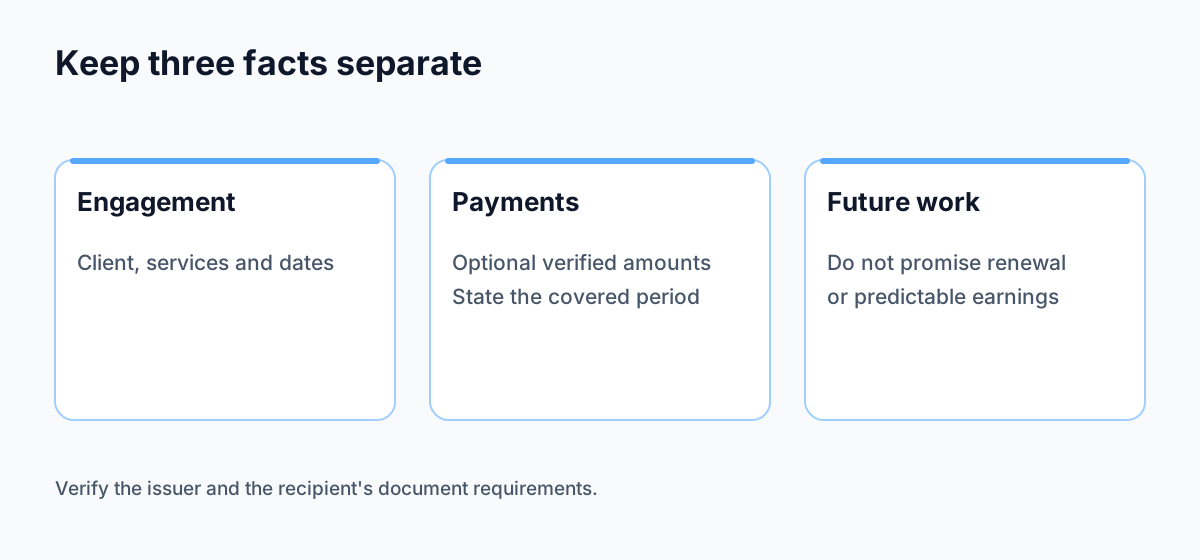
Keep engagement, payments and future work separate
| Information | What the issuer can confirm |
|---|---|
| Engagement | The parties, services and dates shown in the client’s records |
| Payments, if requested and authorized | Amounts actually paid during the stated period, with the currency and basis identified |
| Future work | Only a commitment that actually exists; past invoices do not establish guaranteed future earnings |
The word “contractor” in a letter does not settle worker classification. For U.S. federal tax purposes, the IRS considers the facts of the relationship, including behavioral control, financial control and the type of relationship. Its guidance says no single factor decides the result. IRS guidance on independent contractors and employees
Independent contractor verification letter template
Use the client’s letterhead if available. Replace every bracketed field and remove the optional payment paragraph if it is not requested, authorized or supported by the records.
[CLIENT LEGAL NAME / LETTERHEAD]
[CLIENT BUSINESS ADDRESS]

Date: [DATE]
To: [REQUESTING ORGANIZATION OR RECIPIENT]
Subject: Service-engagement verification for [CONTRACTOR NAME]

At [CONTRACTOR NAME]’s request, we confirm the following information
from our business records.

Client: [CLIENT LEGAL NAME]
Service provider: [CONTRACTOR LEGAL NAME OR BUSINESS NAME]
Agreement or project reference: [REFERENCE AND DATE]
Services provided: [FACTUAL DESCRIPTION]
Engagement period: [START DATE] to [END DATE / ONGOING AS OF DATE]
Status as of [DATE]: [FACTUAL CURRENT STATUS]

[OPTIONAL PAYMENT PARAGRAPH: With the contractor’s authorization,
our records show gross payments of [AMOUNT AND CURRENCY] made to
[CONTRACTOR NAME] between [DATE] and [DATE] for [SERVICES/REFERENCE].
This figure reports payments made during that period.]

This letter confirms only the information stated above. It does not
promise renewal, continued work or a particular level of future income.

For verification, please contact the authorized representative below.

[ISSUER NAME]
[ISSUER TITLE AND AUTHORITY]
[CLIENT BUSINESS EMAIL / PHONE]
[SIGNATURE, IF REQUIRED BY THE RECIPIENT]
Use the organization’s legal name rather than a brand name alone if the recipient needs to match the letter to a contract or payment record. Describe the services plainly: “edited product photographs for the autumn catalog” is more informative than “worked with us.”
An authorized client representative should review the final letter. A contractor can prepare a draft to make the request easier, but should not issue a letter in the client’s name or add the client’s signature without authorization.
Example: reporting past payments accurately
Here is a fictional example for a design engagement:
- The services ran from September 1 to October 31, 2026.
- The client made two payments of USD 2,100, totaling USD 4,200, during that period.
- The project ended on October 31.
- As of the letter date, November 17, no further project had been agreed.
The payment paragraph can report USD 4,200 paid between September 1 and October 31. It should not convert that figure into an annual income estimate or describe the engagement as ongoing.
Keep the basis consistent. Payments received, invoices issued, amounts still owed, and net business income are different figures. If the recipient asks for one measure and the client can confirm only another, clarify the request before issuing the letter.
Email requesting a letter from a client
Subject: Request for service-engagement verification

Hi [NAME],

[RECIPIENT] has asked me to provide confirmation of our engagement.
Could an authorized representative confirm the services and dates
listed in the attached draft?

The recipient requires: [REQUIRED FACTS / ISSUER / FORMAT].
Our project reference is [REFERENCE], covering [DATES].

[If needed: I authorize disclosure of the specified payment figures
to this recipient, subject to your records and company policy.]

Please correct anything that does not match your records and let me
know whether you need additional information.

Thank you,
[NAME]
Attach the recipient’s instructions, not just a blank template. If payment information is needed, identify the period and explain whether the request concerns payments made or another measure. This reduces the chance of a letter that looks complete but answers the wrong question.
Check the letter before it is sent
- Match the parties’ names to the agreement and relevant records.
- State a specific engagement period and an “as of” date for current status.
- Include payment figures only when the scope and authorization are clear.
- Reconcile any reported total to the stated period and currency.
- Confirm that the signer is authorized to speak for the client.
- Use a business contact the recipient can independently verify.
- Remove blank fields, drafting instructions and unsupported predictions.
Keep the issued version with the request, relevant contract and any supporting records. The freelance contract guide covers the agreement that should define the underlying services and payment terms.
Frequently asked questions
Can I write my own contractor verification letter?
You can write a self-statement or prepare a draft for a client. If the recipient requires a client-issued letter, it must be reviewed and issued by an authorized client representative. Label the document according to who is actually making the statement.
Does the letter have to include income?
Only if the recipient requires it and the issuer can disclose and verify the requested information. An engagement-only letter may be appropriate for a different request. Ask for the recipient’s requirements rather than adding financial information by default.
What if I have several clients?
A client can confirm its own engagement and records. Do not ask one client to certify your total income from other clients. Ask the recipient how it wants multiple engagements documented.
Is this an official form or a guarantee of acceptance?
No. It is an editable writing example. The requesting organization may require its own form, supporting records or a different issuer.
Keep the facts with the draft
Organize the recipient’s request, the service agreement and the approved letter together. Use the same project reference across the files so that the issuer can check the draft without reconstructing the engagement from old messages.
Review the freelancer document workflow
Prepared by AiDocX Team with AI assistance; the cited primary guidance was checked on November 17, 2026. The example names, dates and amounts are illustrative. The template is not an official recipient form or a determination of legal or tax status.
Ready to automate your documents with AI?
Start free with AiDocX — AI contract drafting, meeting minutes, consultation notes, e-signatures, and more in one platform.
Get Started FreeMore from AiDocX Blog
Deposit Invoice Template: Show the Upfront Payment and Final Balance
Use a deposit invoice template with a worked 40% example, a final balance invoice, payment receipt wording, and checks that prevent duplicate requests.
 AiDocX Team November 19, 2026 8 min
Project Acceptance Form Template: Client Sign-Off With Open Items
Copy a client project acceptance form, record deliverables and exceptions, and send a sign-off email with a clear review deadline.
AiDocX Team November 19, 2026 8 min
Service Contract Extension Addendum Template: Dates, Fees and Scope
Copy a service contract extension template with a three-month example, fee schedule, approval checklist, and clear treatment of unchanged terms.
AiDocX Team November 19, 2026 8 min