MSA vs SOW: Master Service Agreement vs Statement of Work (2026)
Confused about MSA vs SOW? A plain-English guide to what each document does, what goes in each, how they work together, and why separating them speeds up every deal — with a template workflow for agencies and freelancers.
 Chloe · Content Lead June 28, 2026 9 min read
MSA vs SOW: Master Service Agreement vs Statement of Work
If you sell services — as an agency, a consultancy, a freelancer, or a SaaS vendor with professional services — you'll keep running into two documents: the Master Service Agreement (MSA) and the Statement of Work (SOW). People use the terms loosely, sign the wrong one, or cram everything into a single contract and wonder why every new project needs a fresh legal review. Understanding how MSAs and SOWs divide the work is one of the highest-leverage things a services business can learn.
Here's the difference, and why the split exists.
The Core Idea: Terms Once, Work Many Times
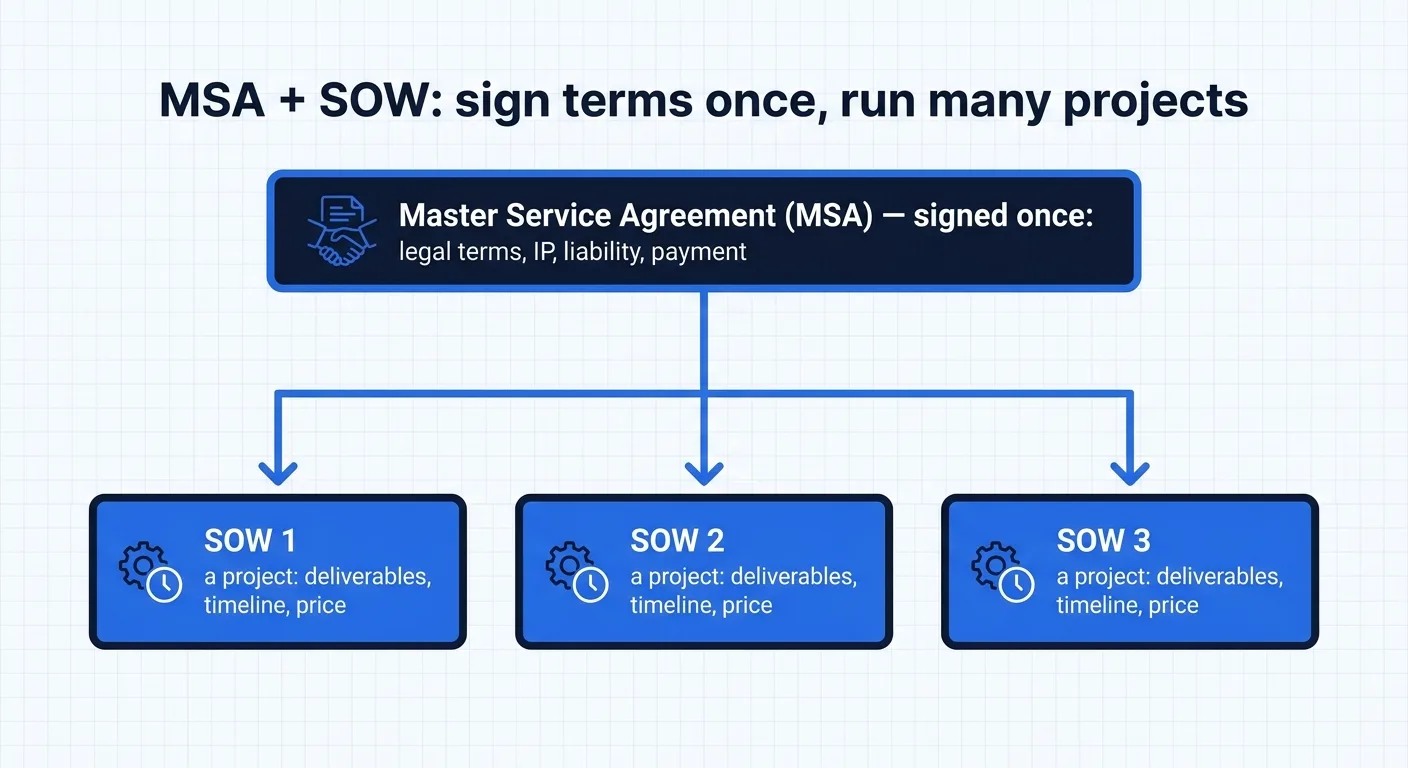
The whole system is built around a simple split:
- The MSA sets the legal terms that govern the entire relationship — signed once.
- Each SOW describes a specific project — the deliverables, timeline, and price — signed every time you start new work.
Think of the MSA as the rulebook for how you and the client will work together, and each SOW as a play you run under those rules. Sign the MSA once; then every new project is just a quick SOW, not a fresh negotiation.
What Goes in the MSA
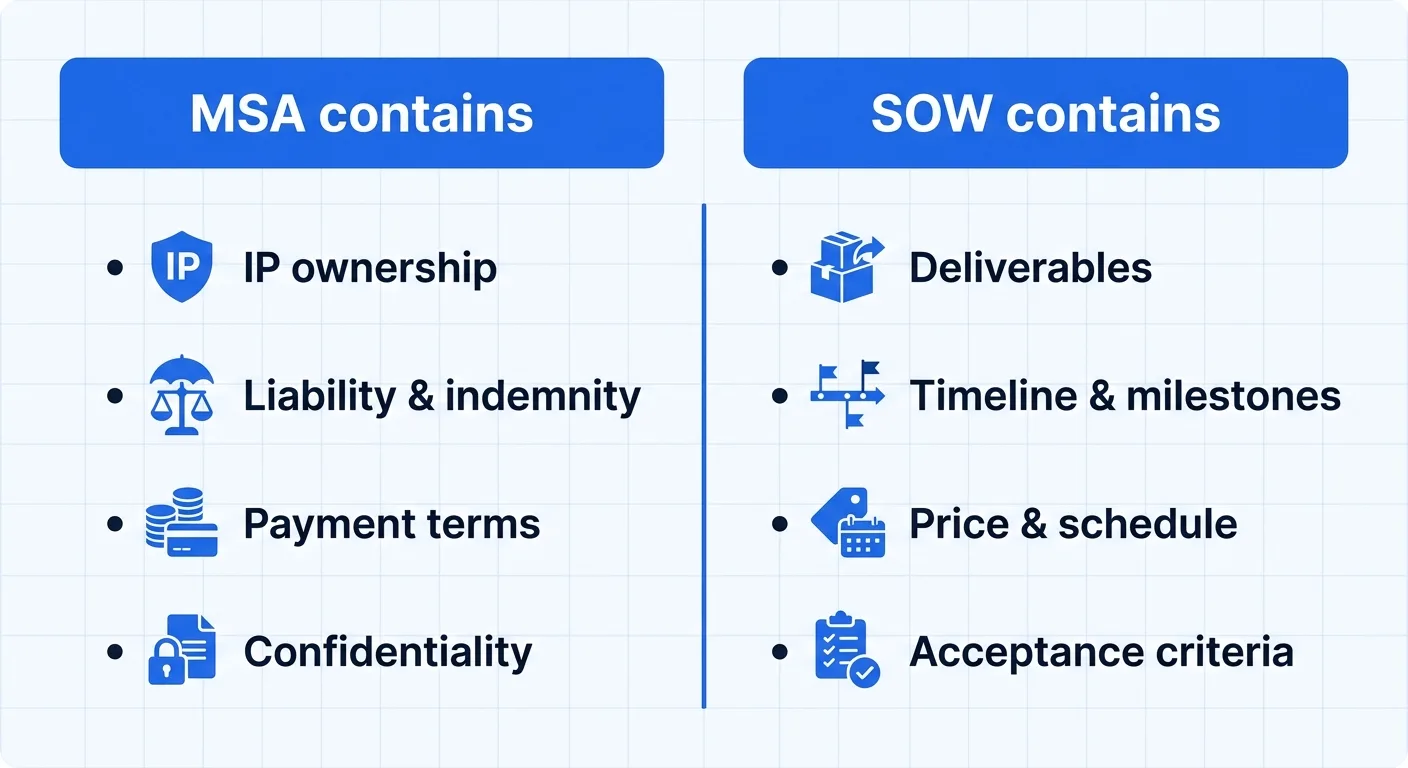
The Master Service Agreement covers the durable legal terms that rarely change from project to project:
- Payment terms — invoicing cadence, due dates, late fees.
- Intellectual property — who owns the work product and when ownership transfers (often on payment).
- Confidentiality — how each side handles the other's sensitive information.
- Liability and indemnification — caps on liability and who covers what if something goes wrong.
- Warranties — what each party promises about its work and authority.
- Term and termination — how the relationship can end, and notice periods.
- Dispute resolution — governing law and how disagreements get settled.
These are the clauses you negotiate carefully once, because they protect you across every project that follows.
What Goes in the SOW
The Statement of Work is the operational document for a single engagement:
- Scope and deliverables — exactly what you're producing.
- Timeline and milestones — dates and phases.
- Pricing and payment schedule — fixed fee, time-and-materials, or milestone-based.
- Acceptance criteria — how the client signs off on the work.
- Assumptions and dependencies — what you're relying on the client to provide.
The SOW is where scope creep is won or lost. A precise SOW — clear deliverables, explicit acceptance criteria, named assumptions — is the difference between a clean project and an argument about what "done" meant.
How They Work Together
| MSA (Master Service Agreement) | SOW (Statement of Work) | |
|---|---|---|
| Covers | Legal terms for the whole relationship | One specific project |
| Signed | Once, at the start | Every new project |
| Contains | IP, liability, payment terms, confidentiality | Deliverables, timeline, price, acceptance |
| Changes | Rarely | Each engagement |
| Purpose | Protect both parties long-term | Define and price the work |
The two reference each other: the SOW says it's governed by the MSA, and the MSA says individual projects will be defined in SOWs. Where they conflict, a well-drafted MSA usually states which controls — commonly the MSA for legal terms and the SOW for project specifics.
Why Separating Them Speeds Up Every Deal
Bundling everything into one contract per project means re-negotiating IP, liability, and payment terms every single time — slow for you, and a fresh legal review for the client. Splitting them means the hard legal conversation happens once, and every subsequent project starts with a lightweight SOW that needs only a quick sign-off. For an agency running many projects with the same client, that difference compounds into weeks of saved time a year.
Common Mistakes
Putting project details in the MSA. Deliverables and deadlines belong in the SOW. Bake them into the MSA and you lose the whole "sign once" advantage.
A vague SOW. "Build a website" invites scope creep. Specify deliverables, acceptance criteria, and what's explicitly out of scope.
No MSA at all. Running every project on a one-off contract works until a dispute exposes the missing liability cap or IP clause. (For the underlying service terms, see our consulting & service agreement guide.)
Mismatched documents. An SOW that contradicts the MSA causes confusion exactly when you need clarity. Keep the reference and precedence language clean.
Frequently Asked Questions
What is the difference between an MSA and an SOW? An MSA (Master Service Agreement) sets the legal terms for the entire client relationship and is signed once. An SOW (Statement of Work) defines a single project's deliverables, timeline, and price and is signed for each new engagement. The SOW operates under the MSA.
Do I need both an MSA and an SOW? For ongoing or repeat work, yes — the MSA handles legal terms once, and each SOW defines a project. For a single small one-off, a combined services agreement can be enough.
Which controls if the MSA and SOW conflict? A well-drafted MSA states the precedence. Commonly the MSA governs legal terms while the SOW governs project-specific details, but it depends on how the documents are written — so make the precedence clause explicit.
Can a freelancer use an MSA and SOW? Absolutely. Freelancers with repeat clients benefit most: sign one MSA per client, then start each project with a quick SOW instead of renegotiating terms every time.
The Bottom Line
The MSA and SOW aren't competing documents — they're a system. Negotiate your legal terms once in an MSA, then launch each project with a focused SOW. It protects you better and makes every new engagement faster to start.
Set up your MSA once and spin up SOWs in minutes: create, AI-review, and e-sign your service documents on AiDocX — free to start.
Ready to automate your documents with AI?
Start free with AiDocX — AI contract drafting, meeting minutes, consultation notes, e-signatures, and more in one platform.
Get Started FreeMore from AiDocX Blog
Buy Sell Agreement Template (2026): Triggers, Valuation and Funding for Co-Owners
A free buy sell agreement template for co-owners, with triggering events, valuation methods, insurance funding and cross-purchase vs. redemption structures.
 James September 26, 2026 12 min
Consignment Agreement Template (2026): Commission, Title, Risk of Loss and Unsold Goods
Free consignment agreement template for makers, artists and boutiques: commission split, title, insurance and how to protect consigned inventory.
James September 26, 2026 9 min
Distribution Agreement Template (2026): Territory, Exclusivity, Minimums and Reseller Terms
Free distribution agreement template (works as a reseller agreement template too): territory, exclusivity, minimums, pricing, IP and termination.
James September 26, 2026 13 min