Shareholders' Agreement Template (2026): Key Clauses Every Startup Needs
A founder's guide to the shareholders' agreement — what it covers, the clauses that prevent co-founder disputes (vesting, tag-along, drag-along, pre-emption), how it differs from the articles, and a free template workflow to draft and e-sign one.
 MinjiLee · Strategic Lead June 28, 2026 11 min read
Shareholders' Agreement Template: Key Clauses Every Startup Needs
Most co-founder disputes don't start as disputes. They start as things nobody wrote down — what happens if a founder quits after eight months, who can block a sale, whether someone can sell their shares to a stranger. By the time those questions become urgent, the relationships are usually already strained, and the absence of an agreement turns a hard conversation into a legal fight.
A shareholders' agreement (SHA) is the document that answers those questions in advance, while everyone is still aligned and optimistic. This guide explains what an SHA covers, the clauses that actually matter, how it differs from your company's constitutional documents, and how to draft and sign one without a five-figure legal bill.
What a Shareholders' Agreement Is — and Isn't
A shareholders' agreement is a private contract among a company's shareholders (and usually the company itself) that governs their relationship: how decisions get made, what shareholders can and can't do with their shares, and what happens when someone joins, leaves, or wants out.
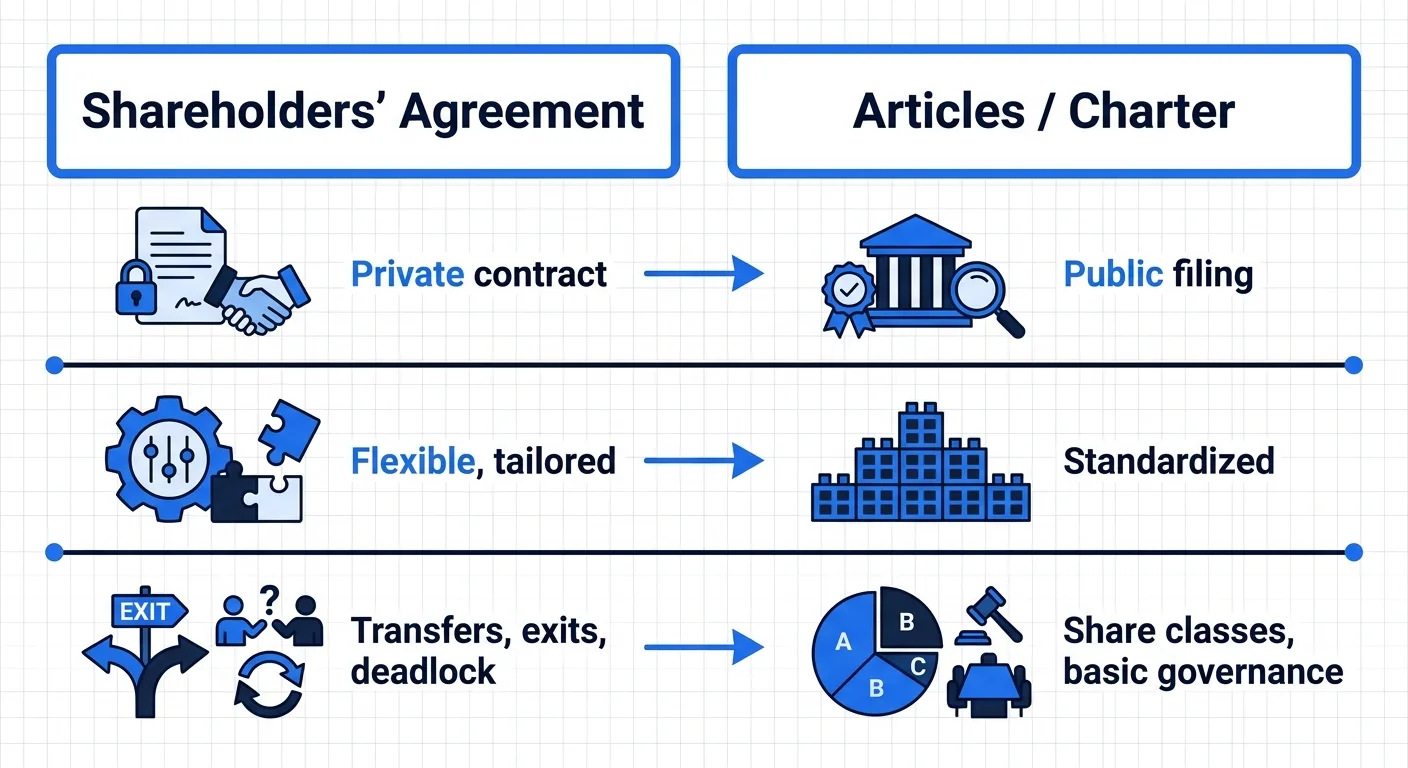
It is not the same as your articles of association / certificate of incorporation (the company's public constitutional document). The distinction matters:
| Shareholders' Agreement | Articles / Charter | |
|---|---|---|
| Nature | Private contract between shareholders | Public constitutional document |
| Visibility | Confidential among the parties | Filed with the company registry |
| Flexibility | Easily tailored to the specific deal | More rigid, standardized |
| Covers | Detailed rights, transfers, exits, deadlocks | Share classes, basic governance |
In practice the two work together: the articles set the legal frame, and the SHA fills in the detailed, often confidential, business arrangements. Where they conflict, well-drafted documents specify which controls.
The Clauses That Actually Matter
An SHA can run to dozens of pages, but a handful of clauses do most of the protective work.
Founder Vesting (Reverse Vesting)
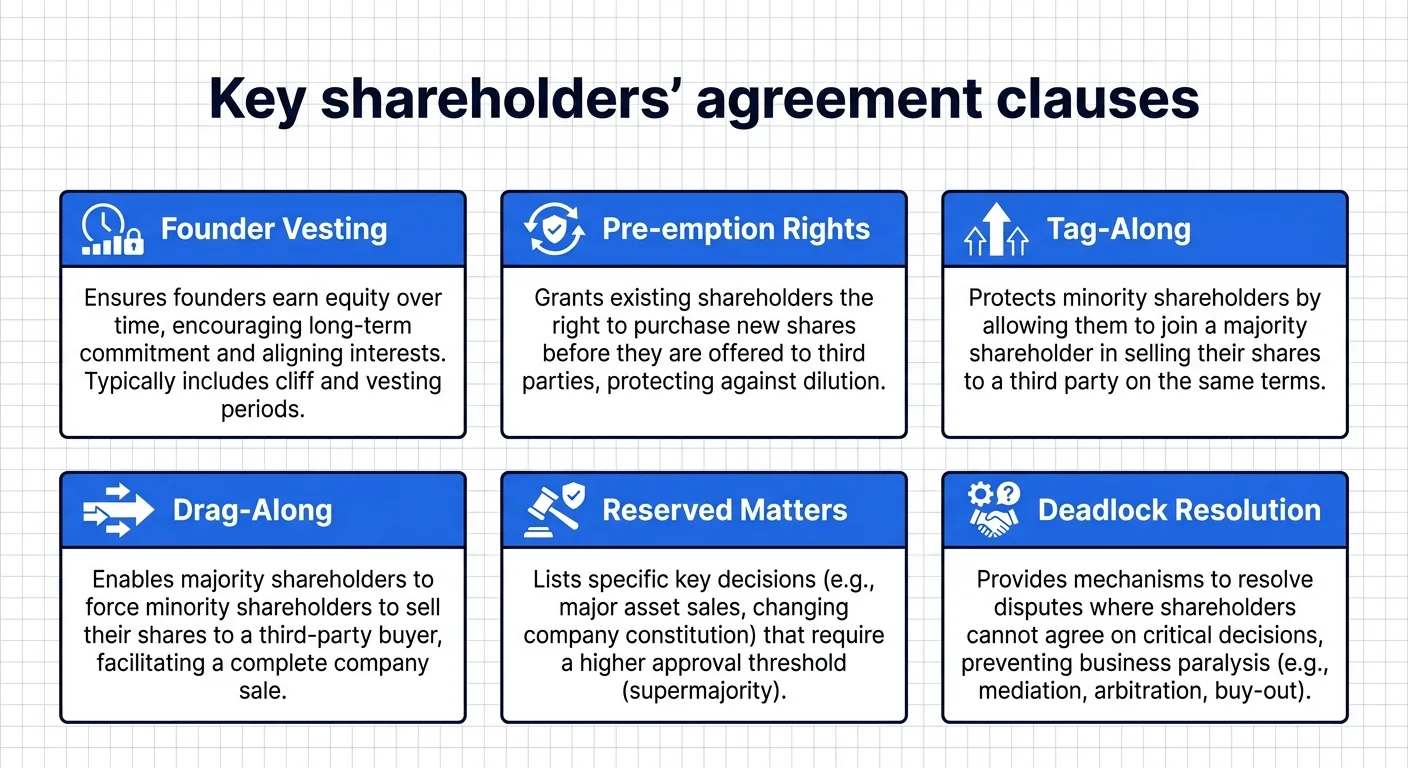
Founders typically agree that their own shares vest over time — commonly four years with a one-year cliff. If a founder leaves early, the company can buy back the unvested portion. Without this, a co-founder can walk away after a few months still owning a huge slice of the company — the single most damaging gap an early SHA can have.
Transfer Restrictions and Pre-emption Rights
These control who can become a shareholder. Pre-emption (right of first refusal) means a shareholder who wants to sell must first offer the shares to existing shareholders, so equity doesn't end up in the hands of an outsider — or a competitor — without the others' consent.
Tag-Along and Drag-Along Rights
Two sides of the same exit coin:
- Tag-along protects minority shareholders: if a majority holder sells to a buyer, the minority can "tag along" and sell on the same terms instead of being left behind with a new controlling owner.
- Drag-along protects a sale: if a defined majority approves a sale of the company, they can "drag" the minority into selling too, so a small holdout can't block a clean exit. Buyers of startups often require this.
Reserved Matters (Protective Provisions)
A list of major decisions that need special approval — issuing new shares, taking on large debt, selling the company, changing the business. This is how investors and minority founders keep a veto over the decisions that affect them most, even without day-to-day control.
Decision-Making and Deadlock
How the board and shareholders vote, and — critically — what happens when a 50/50 split can't agree. Deadlock mechanisms (a casting vote, mediation, or a buy-sell "shotgun" clause) keep a disagreement from freezing the entire company.
Good Leaver / Bad Leaver
Defines what happens to a departing shareholder's equity depending on how they leave. A "good leaver" (e.g. illness) may keep more; a "bad leaver" (e.g. termination for cause) may be required to sell at a lower price. This aligns incentives and discourages bad behavior.
When Should You Sign One?
The honest answer: as early as possible — ideally when co-founders first allocate equity, and certainly before or at your first external investment round. Angel and seed investors will usually expect an SHA (or will bring their own) as a condition of investing.
Signing early is dramatically easier than signing late. When everyone is aligned and the company is worth little, terms like vesting and leaver provisions feel reasonable. After a dispute has started — or after the company is worth real money — every clause becomes a negotiation, and some become impossible.
Common Mistakes
Relying on the articles alone. Standard incorporation documents don't include vesting, tag/drag, or deadlock provisions. Assuming you're covered because you "have a company set up" is a frequent and expensive error.
Skipping founder vesting. Founders often resist vesting their own shares because it feels like distrust. It's the opposite — it's mutual protection that keeps the cap table fair if someone leaves.
Copying a template blindly. An SHA references your share structure, your jurisdiction, and your specific deal. A generic template is a strong starting point, but the numbers, parties, and reserved matters must be tailored — and ideally reviewed — before signing.
Letting it drift out of date. New investors, new share classes, and departed founders all change the picture. An SHA that no longer matches the cap table causes confusion exactly when clarity matters most.
Drafting and Signing One Efficiently
For the bespoke, high-stakes terms — and anything jurisdiction-specific — get a lawyer's eyes on the document. But the surrounding workflow doesn't have to be slow or costly. A modern document platform lets you:
- Start from a structured template with the core clauses already in place, instead of a blank page.
- Run AI review over the draft to flag missing protections — no vesting, no tag-along, no deadlock mechanism — before it circulates.
- Chat with the document to answer a co-founder's question in plain language ("What does drag-along mean for me?").
- Send it for secure e-signature to all shareholders and keep the signed agreement in one place, in sync with your cap table.
That keeps your lawyer focused on judgment calls while the drafting, explaining, and signing stay fast.
Owners who want a plan for death, disability or a co-owner's exit can put it in writing with our buy-sell agreement template.
Frequently Asked Questions
What is the difference between a shareholders' agreement and the articles of association? The articles are the company's public constitutional document filed with the registry; the shareholders' agreement is a private contract among shareholders that adds detailed, often confidential, rules about decisions, share transfers, and exits. They work together.
Do I need a shareholders' agreement if we're just two co-founders? Yes — arguably especially then. The most common early failure is a co-founder leaving with a large stake and no vesting. An SHA with vesting and leaver provisions protects both of you.
What are tag-along and drag-along rights? Tag-along lets minority shareholders join a sale on the same terms as a selling majority. Drag-along lets an approving majority require the minority to sell too, so a small holdout can't block a company sale. Together they make exits cleaner and fairer.
When should a startup sign a shareholders' agreement? As early as possible — when co-founders allocate equity, and at the latest before or during the first funding round. Signing while everyone is aligned is far easier than negotiating after a dispute or a high valuation.
Can I create a shareholders' agreement from a template? A reviewed template is a strong starting point for the core clauses. Tailor the share structure, parties, and reserved matters to your deal and jurisdiction, and have counsel review anything high-stakes before signing.
Getting Started
If your company runs on a handshake among founders, a shareholders' agreement is the single highest-leverage document you can put in place — it turns the questions that destroy startups into clauses you've already answered. Draft it from a solid template, tailor it to your deal, review the high-stakes terms, and get it signed while everyone still agrees.
Put the agreement in place before you need it. Draft and e-sign your shareholders' agreement on AiDocX — start free with a structured template.
Ready to automate your documents with AI?
Start free with AiDocX — AI contract drafting, meeting minutes, consultation notes, e-signatures, and more in one platform.
Get Started FreeMore from AiDocX Blog
Buy Sell Agreement Template (2026): Triggers, Valuation and Funding for Co-Owners
A free buy sell agreement template for co-owners, with triggering events, valuation methods, insurance funding and cross-purchase vs. redemption structures.
 James September 26, 2026 12 min
Consignment Agreement Template (2026): Commission, Title, Risk of Loss and Unsold Goods
Free consignment agreement template for makers, artists and boutiques: commission split, title, insurance and how to protect consigned inventory.
James September 26, 2026 9 min
Distribution Agreement Template (2026): Territory, Exclusivity, Minimums and Reseller Terms
Free distribution agreement template (works as a reseller agreement template too): territory, exclusivity, minimums, pricing, IP and termination.
James September 26, 2026 13 min