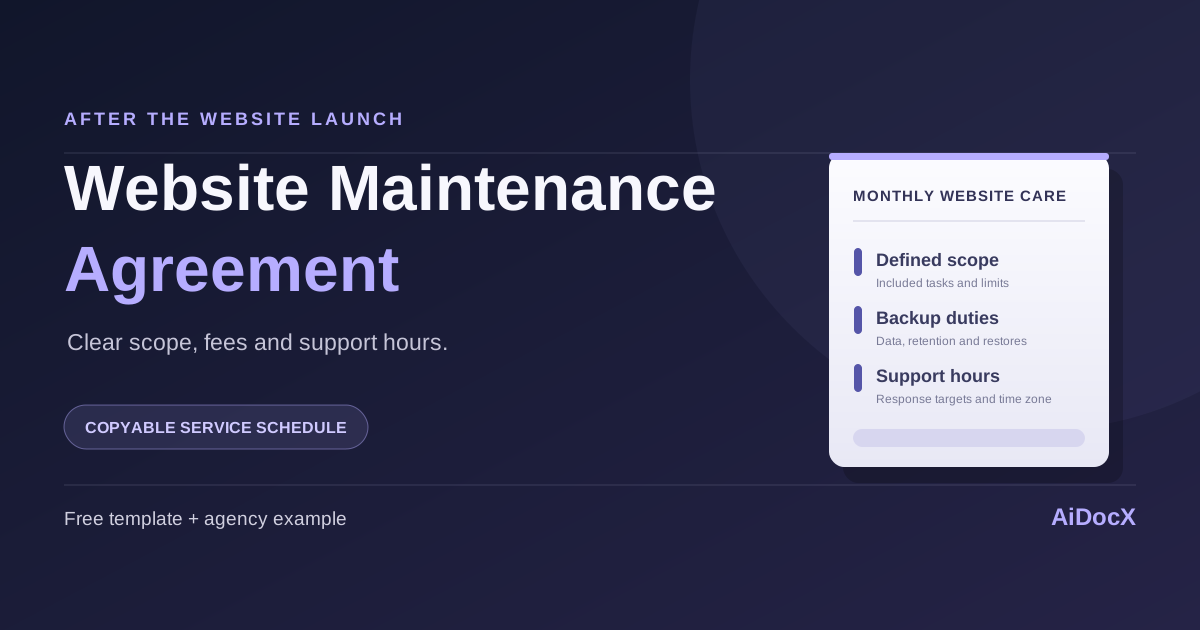
Website Maintenance Agreement Template: Scope, Fees & Support
Copy a website maintenance agreement template with a service scope, support hours, response targets, backup duties, fees and a practical agency example.
A website maintenance agreement defines what happens after a site launches: which website is covered, what the provider will maintain, how support works, what the client pays and how the arrangement ends.
The difficult word is “maintenance.” A client may hear “anything the website needs.” An agency may mean monthly software updates and a small allowance for content changes. A useful agreement turns those assumptions into a service schedule both sides can check.
This guide includes an original, copyable website maintenance contract template and a worked example for a small WordPress site. It focuses on recurring care. The original build belongs in a separate web design project agreement.
Decide what the monthly fee actually covers
List the service and its limit together. “Backups included” is incomplete until you identify the data, frequency, retention and restore responsibilities.
| Service | A concrete description to agree |
|---|---|
| Updates | Covered CMS, themes and plugins; review frequency; testing and rollback process |
| Backups | Files and database; schedule; storage location; retention; restore-test frequency |
| Monitoring | Checks performed, alert destination and when a person reviews alerts |
| Content edits | Monthly allowance, eligible requests and whether unused time carries over |
| Support | Contact channel, staffed hours, time zone and initial response targets |
| Reporting | Tasks completed, exceptions, remaining issues and delivery frequency |
| Hosting and licenses | Who buys, renews and controls each account |
For WordPress, the official backup documentation explains that restoring a typical site requires both its files and database. A copy of uploaded images alone is not a full site backup. The upgrade guidance also recommends backups before updates and checking that they are usable.
Those technical points inform the backup and update fields below. The schedules, prices and support targets remain business choices to negotiate for the actual site.
Website maintenance agreement template
Copy this into your document editor. Replace the bracketed fields, remove options you are not offering and attach an inventory of the covered website and software.
Use this as a service schedule. Connect it to your main services agreement for governing law, liability, confidentiality, dispute handling and any required privacy or data-processing terms. Have those terms reviewed for your jurisdiction and the work involved.
WEBSITE MAINTENANCE AGREEMENT / SERVICE SCHEDULE

Effective date: [DATE]
Provider: [LEGAL NAME AND BUSINESS ADDRESS]
Client: [LEGAL NAME AND BUSINESS ADDRESS]
Covered website(s): [EXACT DOMAIN(S)]
Main services agreement: [REFERENCE AND DATE]
Schedule version: [VERSION]

1. COVERED SYSTEMS AND STARTING CONDITION

Platform / hosting: [CMS, HOST AND PLAN]
Covered components: [THEMES, PLUGINS, INTEGRATIONS AND VERSIONS]
Starting-condition review: [DATE AND REPORT REFERENCE]
Known issues and exclusions: [LIST / NONE]
Work needed before service begins: [TASKS, OWNER AND APPROVED FEE]

2. INCLUDED RECURRING SERVICES

Updates:
[COMPONENTS, REVIEW FREQUENCY AND MAINTENANCE WINDOW]
[TESTING, PRE-UPDATE BACKUP AND ROLLBACK PROCESS]

Backups:
Data covered: [FILES, DATABASE AND ANY EXCLUDED SYSTEMS]
Schedule: [FREQUENCY]
Storage: [LOCATION AND ACCESS OWNER]
Retention: [PERIOD / NUMBER OF COPIES]
Restore testing: [FREQUENCY AND TEST SCOPE]
Restore work included: [LIMIT / SEPARATE APPROVAL PROCESS]

Monitoring:
Checks and frequency: [CHECKS]
Alert destination: [CHANNEL]
Staffed review hours: [HOURS AND TIME ZONE]

Content edits:
Eligible work: [SMALL TEXT / IMAGE CHANGES, ETC.]
Allowance: [HOURS OR REQUESTS PER BILLING PERIOD]
Minimum time increment: [INCREMENT]
Unused allowance: [EXPIRES / CARRIES OVER ON THESE TERMS]

Service report:
[CONTENTS AND DELIVERY FREQUENCY]

3. EXCLUDED WORK AND EXTRA REQUESTS

Excluded unless separately agreed:
[REDESIGNS, NEW FEATURES, NEW INTEGRATIONS, MAJOR MIGRATIONS,
SEO CAMPAIGNS, MALWARE CLEANUP OR OTHER SPECIFIC EXCLUSIONS]

Provider will state the scope, fee and schedule for extra work.
Extra charges require approval from [AUTHORIZED CLIENT CONTACT]
before the extra work begins.
Pre-authorized emergency work, if any: [CAP AND CONDITIONS / NONE]

4. SUPPORT HOURS AND INITIAL RESPONSE TARGETS

Support channel: [EMAIL / TICKET PORTAL]
Support hours: [DAYS, HOURS, TIME ZONE AND HOLIDAY CALENDAR]

P1 — [DEFINED CRITICAL INCIDENT]:
Initial response within [NUMBER] staffed support hours.

P2 — [DEFINED MAJOR FUNCTION ISSUE]:
Initial response within [NUMBER] staffed support hours.

P3 — [DEFINED ROUTINE REQUEST]:
Initial response within [NUMBER] staffed support hours.

A response means a person acknowledges the request and provides
the next step. An automated receipt is not the initial response.
These are response targets, not guaranteed resolution times.
The response clock runs only during the support hours above.
Provider will give a next-update time during investigation.

After-hours coverage: [SEPARATELY AGREED TERMS / NOT INCLUDED]
Escalation contact: [ROLE AND CHANNEL]
Any service credits or remedies: [MAIN AGREEMENT REFERENCE / NONE AGREED]

5. FEES, INVOICES AND RENEWALS

Recurring fee: [AMOUNT AND CURRENCY] per [PERIOD]
Tax treatment: [INCLUDED / ADDITIONAL / AS APPLICABLE]
Billing date and payment due date: [TERMS]
Approved extra work: [RATE / FIXED-QUOTE PROCESS]
Third-party costs and renewal owner: [LIST]
Fee changes: [NOTICE AND AGREEMENT PROCESS]

6. CLIENT RESPONSIBILITIES AND ACCESS

Client will provide necessary access through a secure channel,
identify an authorized approver, maintain the listed accounts
and licenses, and advise Provider of planned third-party changes.

Provider will use named accounts and access appropriate to the work.
Passwords, recovery codes and API secrets are not part of this schedule.
Access to personal data, subcontractors and incident notifications
will follow [MAIN AGREEMENT / DATA-PROCESSING TERMS REFERENCE].

7. INCIDENTS AND THIRD-PARTY DEPENDENCIES

On a reported or detected issue, Provider will assess scope,
record findings and notify [CLIENT CONTACT] through [CHANNEL].
Emergency actions and spending authority: [AGREED LIMITS]
Host, registrar and external-vendor escalation: [RESPONSIBLE PARTY]

No uninterrupted availability, absence of security incidents,
or recovery without data loss is promised by this schedule.
Any specific uptime or recovery commitment must be separately
defined with its measurement, dependencies and remedy.

8. TERM, NOTICE AND SERVICE PAUSES

Service starts: [DATE]
Initial term and renewal method: [TERMS]
Notice to end or not renew: [PERIOD, RECIPIENT AND METHOD]
Unpaid invoices, disputed charges and any service pause:
[MAIN AGREEMENT REFERENCE / AGREED NOTICE AND REMEDY PROCESS]
Treatment of unused prepaid fees: [AGREED TERMS]

9. EXIT AND HANDOVER

At the end, the parties will agree the handover date and recipient.
Handover items: [LATEST AVAILABLE BACKUP, SERVICE HISTORY,
OPEN ISSUES, LICENSE INVENTORY AND ACCESS LIST]
Handover fee, if any: [AMOUNT / INCLUDED]
Backup retention or deletion after exit: [PERIOD AND INSTRUCTIONS]
Provider access removal: [OWNER AND DATE]

10. AGREEMENT AND CHANGES

Changes to scope, fees or commitments require written agreement
by the authorized contacts.
Order of precedence with the main agreement: [AGREED RULE]

Provider name / role: [NAME / ROLE]
Signature: [SIGNATURE]     Date: [DATE]

Client name / role: [NAME / ROLE]
Signature: [SIGNATURE]     Date: [DATE]
The Australian government's contract preparation checklist covers defined work, payment, variations, incomplete work and early termination. It is a useful completeness check; its jurisdiction-specific legal explanations should not be transplanted into another country's contract.
Response time is different from resolution time
A four-hour response target promises a human acknowledgment and next step within the defined clock. It does not mean every outage can be repaired in four hours.
Suppose your support hours are Monday to Friday, 9 a.m. to 5 p.m., Europe/London, excluding the holidays listed in the agreement. A request arriving at 4 p.m. on Thursday uses one support hour that day. A four-support-hour response target expires at noon on Friday, assuming neither day is an excluded holiday.
If you intend to promise a calendar-hour target, including nights and weekends, write that explicitly and arrange the staffing to provide it.
| Incident class | Example definition | Illustrative response target |
|---|---|---|
| P1 | Public site unavailable, or suspected compromise | 4 staffed support hours |
| P2 | Important form or site function not working, with a workaround available | 8 staffed support hours |
| P3 | Content edit or minor visual issue | 16 staffed support hours |
These are examples, not industry benchmarks. Decide how requests are classified, how the client can escalate and what the provider sends while investigating.
Monitoring also needs its own definition. An automated alert at 2 a.m. does not create staffed overnight coverage unless that coverage is part of the service.
For measurable availability promises and remedies, use a separate service level agreement.
Worked example: a small agency's WordPress care plan
The following fictional example shows how to make a plan specific. The price is illustrative, not a market-rate recommendation.
A studio offers care for one brochure website at 300 USD per month. Its schedule includes:
- Monthly review and installation of covered updates, with a pre-update backup and checks of the home page and inquiry form.
- Daily file-and-database backups stored away from the live hosting account, retained for 30 days, with a quarterly restore test.
- Up to two hours of small text and image edits per month; unused time expires.
- Support Monday to Friday, 9 a.m. to 5 p.m., Europe/London, using the response targets above.
- A monthly report listing completed work, unsuccessful tasks and open issues.
Hosting, the domain and paid plugin renewals are paid by the client. New features, malware remediation and major version migrations require an approved quote.
The client requests three changes in December:
| Request | Treatment in this example |
|---|---|
| Replace two team biographies | Uses the monthly content-edit allowance |
| Build a new customer portal | Separate scope and quote before work begins |
| Investigate a form error after a third-party change | Assess and explain the cause; agree the fee for any excluded repair |
If approved extra work takes three hours at the agreed 95 USD per hour, that adds 285 USD. The month totals 585 USD before applicable taxes: 300 + (3 × 95). The agency should record the approval rather than surprise the client with the extra charge.
The example does not promise that a backup can recover every external system. Payment gateways, third-party booking tools and email accounts need their own coverage decisions.
Set a clean boundary between launch and ongoing support
Before recurring maintenance starts, record the state of the site. Otherwise, an agency may inherit old faults without either party realizing it.
Use a project sign-off and acceptance record to identify the delivered version, known issues and outstanding project work. Then state when the maintenance period begins.
Keep these categories separate:
| Category | Where it belongs |
|---|---|
| Fixing a defect in the original build | The build agreement's defect or warranty terms |
| Routine updates and agreed small edits | The maintenance schedule |
| Adding functionality or redesigning a section | A new scope or approved variation |
| Responding to a security incident | The agreed incident scope and any separate obligations |
A support plan should not silently cancel an existing warranty. Equally, the original build fee should not become an undefined promise to maintain the site forever.
Review the schedule, then collect signatures
Resolve the scope, price, response clock and exit terms before sending the final PDF. In AiDocX, you can upload the reviewed document, place fields for the client and provider, and send it for electronic signature.
Send your website maintenance agreement for signature.
Keep the signed schedule with its main agreement and component inventory. Website monitoring, backups, ticketing and maintenance work still need to be delivered through the systems and people named in the schedule.
Frequently asked questions
Is a website maintenance agreement the same as a web design contract?
They cover different stages. A design contract defines the build and delivery. A maintenance agreement defines the recurring service after the agreed start date. You can connect them by reference while keeping their fees and scope clear.
Can I use this as a WordPress maintenance contract template?
Yes, as a starting service schedule. Identify the specific WordPress site, hosting, themes, plugins, backup coverage and test process. A generic promise to “update WordPress” leaves too much unspecified.
Should a maintenance plan include unlimited edits?
Only if you can define and deliver that promise. A stated time allowance or request limit is easier for both parties to track. Explain whether the allowance includes maintenance tasks, content work or both.
Does “daily backup” mean there can be no data loss?
No. Say what is captured, when the last successful copy was made, what retention is available and what a restore covers. If you need a recovery-time or data-loss target, agree it explicitly.
Who should own the domain and plugin accounts?
Decide this in the schedule and make sure the client can receive the necessary access at exit. Record ownership, billing and license-transfer limits separately; never paste passwords into the contract.
Is a 24/7 monitoring tool the same as 24/7 support?
No. A tool may check the site continuously while people respond only during staffed hours. Define both promises separately, including escalation outside those hours.
Prepared with AI assistance using the linked primary references. The template and fictional example were created for this guide; no human legal review is claimed.
Ready to automate your documents with AI?
Start free with AiDocX — AI contract drafting, meeting minutes, consultation notes, e-signatures, and more in one platform.
Get Started FreeMore from AiDocX Blog
Project Sign-Off Template: Client Acceptance Form + Email
Copy a project sign-off template with deliverable checks, open-item tracking, a filled example and a client approval email for agency and freelance projects.
Deposit Invoice Template: Show the Upfront Payment and Final Balance
Use a deposit invoice template with a worked 40% example, a final balance invoice, payment receipt wording, and checks that prevent duplicate requests.
 AiDocX Team November 19, 2026 8 min
Project Acceptance Form Template: Client Sign-Off With Open Items
Copy a client project acceptance form, record deliverables and exceptions, and send a sign-off email with a clear review deadline.
AiDocX Team November 19, 2026 8 min